Photo: akatov.pravorg.ru
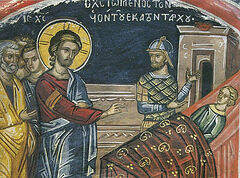
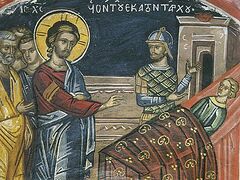
Matthew 8:5–13
The great and unapproachable God came down to earth in Christ Jesus and became near and accessible to us. He entered people’s homes, ate with them, touched them, and they touched Him—even the hem of His garment. Through this communion with the visible Man, they received gracious help from the invisible God.
And when the Lord ascended into heaven, He did not take away the possibility of this simple communion with Him. He promised that He would always be present wherever two or three are gathered in His Name. Thus, we can write the names of our loved ones, living or departed, to be commemorated before the Holy Altar. We partake of the prosphora, holy oil, and holy water, which the Lord has sanctified and endowed with His grace. We serve molebens before His holy icon and receive the blessing of the priest. Yet we must always remember that God Himself is here, close beside us, extending His invisible hand to help us. Although He has established the entire gracious order of the Church for our benefit, He Himself has no need of visible means in order to come to our aid. He does not even require a single spoken word—our very desire is enough. We must never forget this, especially since Christianity has flourished in our land for more than a thousand years.
In today’s Gospel, however, we are given the example of a man who was raised in a country where paganism had flourished for more than a thousand years. This was the Roman centurion. He came to Jesus and, without even making a request, simply said: Lord, my servant lieth at home sick of the palsy, grievously tormented.
The Lord immediately expressed His willingness to come, but the centurion replied: Lord, I am not worthy that Thou shouldest come under my roof: but speak the word only, and my servant shall be healed. For I am a man under authority, having soldiers under me: and I say to this man, ‘Go,’ and he goeth; and to another, ‘Come,’ and he cometh; and to my servant, ‘Do this,’ and he doeth it.
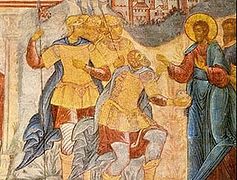
The Lord marveled to find such faith in a man who had never been taught the true worship of God, and He said to those around Him: Verily I say unto you, I have not found so great faith, no, not in Israel. And I say unto you, That many shall come from the east and west, and shall sit down... in the Kingdom of Heaven; but the children of the kingdom shall be cast out into outer darkness: there shall be weeping and gnashing of teeth.
These words were spoken about the Pharisees, who had become so absorbed in their countless legal prescriptions that they had forgotten the living God Himself.
Yet these same words of the Lord could also be addressed to us if we lose sight of the living God amid the splendor of our churches, the beauty of the divine services, and the abundance of holy things.
I recall one parish feast day. After the early Divine Liturgy, the rite of the Blessing of the Waters was served. There was pushing and shouting; tables were overturned and broken in the crowd. At last the holy water had all been taken, and everything quieted down. Then an elderly woman arrived. She walked over to a radiator, opened the valve, filled her little can with water, and said, “Well, I could barely make it. I missed the blessing of the waters, but at least I’ll take some water from here—after all, it’s from God’s house.”
And who could doubt that the Lord rewarded her according to her faith? He surely granted her far more than He did those who, amid disorder and quarrelling, managed to carry away water that had been blessed according to the full rite.
Of course, this does not mean that it is enough for salvation simply to pray at home and draw water from the tap. To despise holy things or the God-established priesthood would be no different from despising the humanity of Jesus Christ Himself. Both the centurion and the elderly woman did everything they could to find Jesus Christ and draw near to Him. But both also remembered that they had come to the One Who is greater than the Temple, greater than every rite, greater than everything visible and invisible.
His word can penetrate every distance and every wall. It can instantly heal every sickness and deliver us from every affliction. It can sanctify all the waters of the earth—or turn them into blood. In a single moment it can destroy the earth and create it anew.
Such is our God. Let us therefore render unto Him the glory, honor, and worship that are His due.