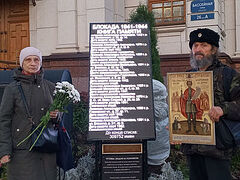
Viktor Grigoryevich Bichikov, a prisoner of the Nazi concentration camps We have a tradition at our parish: for almost 20 years, on May 9, we go to congratulate the veterans. We bring our children, whole families, large groups, flags, flowers, gifts, and guitars. We thank them for their heroic deeds, sing war songs together, listen to their stories, and take photos for our children. When the children grow up, those veterans will no longer be with us. There are very few of them left now—there is only one person in our city—but we congratulate both the veterans of labor and those who were young prisoners of concentration camps, as well as those who survived the Siege of Leningrad.
Last year, we were fortunate to visit Viktor Grigorievich Bichikov, who was a young prisoner of the Nazi concentration camps during the war. He showed us his diary, which detailed his childhood and youth. I asked him to let me take photos of it, and they remained in my laptop for a long time as my son was learning to walk and my daughter was starting first grade. It wasn’t until December that I finally had the time to start deciphering the text, and I was amazed. Viktor Grigorievich’s diary turned out to be a treasure trove. The beautiful, even handwriting, the literary language, and the unbiased presentation of facts made it a great document of its time. Unfortunately, some of the photographs were unclear, and it wasn’t until the following May 9 that I was able to ask for Viktor Grigorievich’s address to re-take the photographs. However, he had already passed away. It was a shame, as he had lived in the building next door. I thought to myself, “You put off something important until later, but that later may never come.”
By God’s Providence, my request was passed on to the late author’s daughter, who graciously allowed me to take the diary home for work. This blue notebook, titled “Germany,” encompasses both the historical events of the twentieth century and a brief dictionary of German words, as well as the pain of Russia’s current state. However, it lacks any bitterness or envy towards former enemies. The story of Viktor Grigorievich’s family is representative of thousands of families who have experienced similar challenges. Unfortunately, not everyone was able to leave behind these harrowing memories. But even this brief diary shows that today, as it was a hundred years ago, Russia is miraculously alive, thanks to God’s help and the amazing Russian soul...
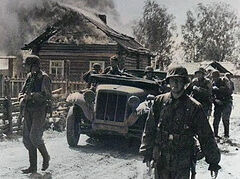
 Cover of V.G. Bichikov’s Diary I was born on April 14, 1938, 3 years before the start of the Great Patriotic War. I do not remember those 3 years, but I remember my life perfectly from October 3, 1941, when the Germans entered our village of Mileevo in the Khvastovinsky District of the Kaluga Region. They came to our house. I was three years and six months old, but I remember very well how they kicked us out of the house and chased the chickens (although some Germans criticized those who tore off the chickens’ heads).
I remember running under the bank of our little river (which flows into the Resseta, which flows into the Zhizdra, which flows into the Oka), and then running into the forest. This was around July 1943.
When I grew up, I found out that Kaluga was liberated on December 31, 1941, and the front line was stopped just forty kilometers from our village until July 1943. It wasn’t until the battles near Orel and Kursk that our village was forced to move westward.
 A page from the diary I remember how in the summer of 1942, my mother, my brother Sergei (he was a disabled child) and I myself were taken to be shot. Our neighbor (he was named Zolotoy) was a politsai,1 and he told the Germans that my brother was hiding weapons. When the Germans started searching, they found a bayonet or a rifle that the neighbor had buried. When we were being shot, I didn’t understand anything yet, so I wasn’t afraid. But apparently, God saved us (the author has highlighted the capital letter in the word “God”—K.G.).
Then I remember July 1943, when the Germans were retreating and took some of our villagers with them as prisoners. Maybe some of them managed to escape along the way, because there were constant air raids by our planes, and everyone was running away, both the Germans and our own people. But my mother, my brother, three or four other families from our village and I ended up behind barbed wire in Lithuania, and then we were taken to Germany, on the other side of the Elbe, to Trebnitz, in the state of Halle, in the city of Könnern. The Zalle River flowed nearby.
My mother, Praskovya Ivanovna, and my brother worked from dawn to dusk, but I was only five years old and wasn’t allowed to work. However, when it was necessary to hunt hares for the Germans, all the children were forced to participate. We were fed, if it can be called food, like pigs: with potato peels, thin soup, and a slice of bread so thin that I later wondered how it was possible to slice it so thinly. Although I was small, I was always hungry.
 Victor Bichikov One day, I stole a piece of bread, leaving an adult without any. That was the only time I did that.
On Sundays and when the Germans had big holidays, we were given soup with dried potatoes. On holidays, a German girl about my age would come running to the barracks. She seemed so beautiful and elegant to me. She would call out to me, “Armer Wicht,”2 and give me something sweet, like a pastry. Now, after all these years, I would like to see her; she would be gray-haired but still kind.
I remember our liberation. There must have been a thousand people, including us children, (I was the youngest and smallest, and the others were around 9 or 13), rushed to meet the liberators. They were Americans on what I thought were huge tanks. They were laughing and throwing chocolate at the crowd. However, I didn’t get any. Before that, there had been a heavy artillery barrage, and the mayor of Trebnitz had been killed on the bridge over the River Zalle when a train carrying shells exploded. I remember his funeral.
I can still see, in my mind’s eye, the planes flying over the bridge and the train.
I can still see, in my mind’s eye, the planes flying over the bridge and the train. Although we were on the other side of the Elbe, according to the agreement with the Americans, this part of the territory belonged to us, so we were returned to the Soviet side. We began our two-month journey back home to the Kaluga region. There were inspections along the way, and I began to study and make drawings in the transit camps. There were many deaths along the way, as people were not only inside the train cars but also hanging on the sides. Fate protected me; one day, on our way home, about ten boys found an object and started to dismantle it. I walked away, and suddenly there was an explosion. I saw two or three boys running away, covered in blood, and the others were probably dead.
In the same way, young fellows were already dying in my village, from dismantling or burning shells in bonfires. And there were a lot of shells in the field.
 10th grade student at Khvastovichi School. June 24, 1954.
We returned (me, my mother, Sergei, and three others) to the village of Mileyevo at the end of July 1945. Our house was intact, and in August I was enrolled in the first grade. I was seven years old. I enjoyed studying. I was the first to learn to read, and since there were few textbooks, my teacher would place me in the middle of two classes, and I would read to them. We also had limited access to notebooks, so we used anything we could find to write on, such as newspapers and other pieces of paper. In the class of my year, there were few who were my age, the rest were three to five years older than me due to the war. When we finished seven classes, and we had to go further, to grades eight to ten (the school was located in the district center of the village of Khvastovichi), they told me: “Go, Vitya, study on, but it’s time for us to get married and twist cows’ tails (i.e. work).” I, another boy, Ilya, and two girls, Frosya and Maria, went on to study in the eighth grade. This was in 1952. Before then, studying in grades eight to ten cost money, but by that year you no longer had to pay for it.
Life was very difficult after the war, especially from 1946 to 1949. After the war, we had some children’s clothes left over from Germany, and my mother went to Ukraine in the summer of 1946 to exchange them for bread. We had a cow named Zorka, which helped us survive. We used clover for food (it made good flatbread), and we dug up potatoes that were rotten after the winter; but we were forbidden to dig them. Each family had to provide a certain amount of milk, eggs, potatoes, meat, and fruits to the government. No one cared whether you had it or not. These were harsh measures, but they were necessary to ensure the survival of the city, while the villagers would survive on their own. In 1948, food rationing was abolished, three years after the end of the war. Our collective farm, Zavety Ilyicha, was impoverished. We received 100 grams of grain per workday, which meant that we received thirty kilograms of grain for 300 workdays. This was how we lived.
Someone, I don’t remember who, supposedly accidentally chopped off his finger while chopping wood (to avoid being drafted into the army). He was taken to trial.
My mother, who was on her deathbed, was lifted from the wood stove by the chairman and sent to work.
A meeting of collective farmers was held in 1948 for the unfulfilled norm on workdays. They voted for eviction to labor camps on Sakhalin. They voted with their heads down, because they were ashamed to look into the eyes of their neighbors. Among those convicted was a woman who had returned with us from Germany. She was ill and couldn’t work out the required number of workdays. Several collective farmers were evicted (more precisely, imprisoned).
Everyone voted in favor, you couldn’t vote against. When the woman’s husband returned to the village after earning money (men would go to other areas for a week or a month to earn extra money by sawing logs into planks), he went to the chairman and asked where his wife was. The chairman was frightened and almost lost his mind. The husband was tried, and he disappeared.
 A page from the diary My mother, who was on her deathbed, was lifted from the pechka by the chairman and sent to work.
We planted our own garden; we tied ropes to the plow, and mostly women pulled it instead of horses, while we children planted the potatoes.
My mother died on January 6, 1953, when she was 59 years old.
The day before, my mother asked me (she was no longer able to get up, she was lying on the stove) to call the psalmist (this was the closest thing to a priest in the village). (Apparently, this was a religious woman who, in godless times, could read the Psalms or the Canon for the Departure of the Soul in as a layperson. V.G.’s daughter confirmed that his mother was a very believing person, and she may have sensed her impending death on Christmas Eve - K.G.) I invited her over, but I asked a friend to let me stay with him overnight, because we were going to go to the forest to get firewood in the morning (I had been going to the forest to get firewood since I was ten years old). When I came home in the morning to get the sled, my mother’s body was already washed, and there was no coffin yet. I went to the window, still not understanding or believing what had happened. Then I was sent to the store to buy bread, and I was standing in line, a little boy among the adults, when someone said that Praskovya Ivanovna had died, and I started crying. But I didn’t get any bread, not even half a loaf. Everyone was hungry.
On January 7, my brother arrived from Bryansk, and on January 8, my mother was buried. My brother left, and I (the holidays were over) went to the eighth grade. Our homeroom teacher was Remedios Alfredovna, a Spanish woman. There were five or six of them in the school. They were taken out of Spain as children in 1936. They received an education, graduated from Leningrad University and were sent to us for three years.
When she found out that I was alone, she managed to get 150 rubles from the district welfare office to buy me a suit. I wore it in eighth, ninth, and tenth grades, but it eventually completely wore out.
At the end of the ninth grade, Remedios Alfredovna left for Kaluga because of her illness (she was very thin and had very black hair). At least you could buy white bread there. I haven’t seen her since then. I only heard that after Franco’s death, when things became peaceful in Spain, she returned to her homeland.
 Viktor Bichikov (second from left)
All the children who studied at the secondary school in Khvastovichi lived in flats (I mean, not the local ones, but from other villages). There were two other guys with me, but they had parents. One day, in the tenth grade, me and these guys decided to earn some money, so we went to the logging company. It was January 1955. They gave us saws and took us far away in a car, telling us to cut down trees. There was snow up to our waists. They left us there. We cut down five trees, but we didn’t have any energy left. We only had a little bread and a can of beans for food. We didn’t earn anything. Even though we were missing for two days, no one at school even noticed.
 Viktor Bichikov (right) on Red Square in Moscow during his studies at the Saratov Tank School In tenth grade, I liked a girl named Raya. She was two years older than me. I helped her with math, and she sometimes treated me to food. She was my first crush.
After graduating from tenth grade, I entered the Technical School in Kaluga, where orphaned children received a small amount of money (a scholarship) and uniforms. In 1956, I graduated with a fifth-grade turner’s certificate, as I had consistently excelled in my studies.
I worked as a turner at the Foundry and Mechanical Plant for a year. Vasya and Vyacheslav lived with me in the dormitory. We didn’t earn much because we were single, but married people were given good jobs at the plant, which paid well. They earned up to 1,000 rubles, while we earned 390 rubles apiece.
In 1957, I turned 19 years old, and I had to join the army (at that time, you had to be drafted at the age of 19). Despite the fact that the military commissar told me to go to the Higher Naval School, I decided to go to the Secondary Military School (Tank School) in Saratov.
 Viktor Bichikov (left) In 1957, I entered the Saratov Tank and Technical School. I failed the Russian language dictation, but since I had work experience and a very good high school diploma, I was allowed to continue taking the exams. I always got at least a B in my essays, but I didn’t do well with the dictation. However, I received three A’s: one in mathematics, one in written and oral exams, and one in physics. I retook the dictation and received a B. The head of the school, General Yefremov, said: “Comrade Bichikov, you’ll have to leave.” “Why?” “Well, you have a failing grade in Russian. Although you got a B, it’s still a failing grade.” He then asked the supervisor, “How is his physical education?”
I was thin, weighing fifty-four kilos, but I was strong. The curator replied, “He’s the best at physical education, with his pull-ups, parallel bars, and running. In addition, when he worked at a factory in Kaluga, he spent a year learning how to drive a T-34 tank at DOSAAF,” and the regional military enlistment office recommended me for admission to the school. I already knew that I would be accepted, but General Yefremov wanted to ensure my commitment to service.”
 Children of parishioners of the Archangel Michael Church in Krasnoznamensk, Moscow Region, congratulate Viktor Grigorievich Bichikov on Victory Day (the last Victory Day in his earthly life) In March 1958, since our school was in charge of school No. 39 in Saratov, we cadets came to their school. I was the squad leader, a junior sergeant. When we first arrived, I immediately noticed a pretty schoolgirl with a large white bow on her head. Then the dancing began, and we were young: the girls were sixteen to seventeen years old, and we were seventeen to twenty. Everyone was dancing, and I was standing off to the side, when suddenly they announced a “white dance,”3 and she asked me to dance. We started talking; she had ordinary working-class parents, and her father worked as a mechanic at the institute—a wonderful man.
I often (once a week) went AWOL to Galya, but we didn’t do anything but kiss until we got married, two years later. That’s how pure our relationship was.
In 1960, I graduated with honors and chose the Kiev Military District. On July 28, I graduated and got married to Galya at the registry office. So we went to serve together.
In 1963, I entered the Leningrad Military Engineering Academy. Mozhaiskiy district. I graduated in 1968 at what was then the Baikonur-Omsk-Golitsyno (now Krasnoznamensk) Moscow region. I reached the All-Russian Central Control Center. From 1982 to 2012—thirty years in the First Test Center, in June I celebrated the anniversary of the unit. I had fifty-five years of work experience .
Everyone was dancing, and I was standing off to the side, when suddenly they announced a “white dance”, and she asked me to dance.
Sixty-seven years after the end of the war, my granddaughter Olya and I visited Germany and the places where I was in 1943–1945 from April 12 to 26. These places include Könnern and Trebnitz, which has become a suburb of Könnern. It was a long-awaited dream come true. We stayed in a hotel in Berlin. It was a completely different world, with different people. I was offended for our people.
Even after the war, there were still four collective farms in the village of Mileyevo, because the village was large; before the war, there had been 700 houses, and after the war, only half of them remained. There were herds of horses, and there were many cows. Every family had a cow, not counting the ones that belonged to the collective farms. There were many children. Although we had only a seven-year school, even after the war there were four first-grade classes, because the village was still alive. The village was divided into four parts, with a church that had been destroyed during the war. It was there that I saw my first movie, and I remember the film, “The Tale of the Land of Siberia,” for the rest of my life. I was ten years old then. Four groups of children used to fight for control of the church. It was like a city, with one street fighting against another—one part of the village fought against another. It was wonderful and friendly, although there were bricks involved.4
 Viktor Grigorievich Bichikov and his wife Galina How many stupid things our country’s leaders did with religion! People believe, and let them believe, they went to battle with faith in God and won. Who needs churches destroyed?
I’ve been watching the movie “Life and Fate,” and something in it resonates with me. Although I was a young child at the time, and I’m now quite old at seventy-four, I experienced the beginning of the war, two years of occupation, two years as a prisoner in Germany, as a young witness. The aftermath of the war was the hardest time.
I served in the Soviet Army for many years, where service was above all else; if you went there according to your calling, to your desire to serve your country, then you must live up to that. There are officers who were assigned to a certain city (unit) and serve there until retirement, just like in civilian life. That’s not how it should be. An officer must serve, otherwise he becomes a petty tyrant. I had six different places of service at different times, endured all the relocations, but it was proper service…
The transition from one age to another, the transition from one way of life to another, a higher way of life, is always accompanied by pain and struggle.
Sometimes I remember Nikolai Ostrovsky’s wonderful words: “One should live in such a way that one doesn’t become tortured with regret for wasting the years aimlessly.”
***
I have nothing to add to Viktor Grigorievich’s diary, and I can only silently bow my head in reverence for the bravery of our ancestors who endured such things. Lord, preserve our homeland with their holy prayers! And grant them the Kingdom of Heaven…