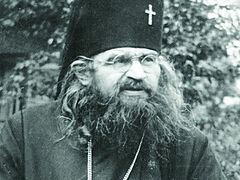
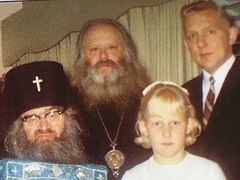
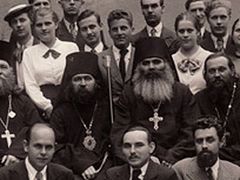
St. John was completely devoted to the care and upbringing of children, and did everything he could to save them both physically and spiritually. When he was sent to Shanghai, he soon opened an orphanage—at first there were only eight children, but the number grew to over 1500. He saved the many Russian orphans who found themselves in China, and Chinese children as well. He was also very concerned with the Russian Orthodox families in Shanghai. Here are the recollections of one of his orphans, Tatiana Kennedy (Urusova), who moved with other orphans from Shanghai to San Francisco.

1938–1948. Shanghai
Vladyka John tirelessly showed care, concern and guided us children spiritually in Shanghai. Every year he conducted exams on the Law of God in person in all the Russian schools and orphanages in the city. All the children had to know the names of their patron-saints, their Lives, and receive Communion on their name days.
On the annual traditional school children’s festival of Sts. Cyril and Methodius, the enlighteners of the Slavs, children of all schools had to attend the Divine Liturgy at the cathedral. The choir consisted of singers from different schools. The Liturgy would be followed by refreshments at the cathedral grounds. Vladyka was always present among hundreds of children.
I was raised and lived at St. Olga’s Orphanage at the Convent under Abbess Ariadna and studied at the S. E. Dieterichs Girls’ High School. Vladyka believed that schoolgirls should help and vest him during the services. I was honored to be Vladyka’s assistant from the age of ten to sixteen.
For some years, I also went to St. Sophia’s Roman Catholic School, where the teachers were missionary nuns who tried to convert their pupils to Catholicism. Vladyka fought against us studying at that school. He would come to the school gate at the end of classes, greeting and blessing us. And he would say strictly that we should not wear that uniform and go to that school, because we had our own Russian schools.
The Nativity of Christ was celebrated according to the old Russian traditions. After the solemn Vigil at the convent, we, a group of girls led by a nun, would walk through the sleeping city to the cathedral with a burning Christmas star to glorify Christ and greet Vladyka on the feast. Always shining with joy, Vladyka would receive us in his room. Having glorified Christ, we would take turns approaching him for a blessing and each of us would receive a bag of sweets that large baskets standing in his cell were filled with. We would give him woolen socks that we would knit ourselves for the feasts. But to our perplexity, we later saw those socks on beggars.

From the windows of the third story of the convent’s mansion, where our orphanage was located, we could see Vladyka walking down the street in torrential rain and foul weather, in winter and summer, towards the Orphanage of St. Tikhon of Zadonsk that he had himself set up. On his way there were a “House of Mercy” for men and an home with a church for elderly women, and then there was a prison. We knew that Vladyka was going to visit all those institutions. Sometimes, on his way back, he would drop in on us. The convent was notified of Vladyka’s arrival by a peal of bells. In bad weather, soaked all through, in sandals on bare feet, he would go into the church and venerate the altar table with wonderworking icons, and then would go up the back stairs to us children in the orphanage. After singing to Vladyka, “Eis polla eti, Despota”,1 we would come up for his blessing. He asked us the names of our patron-saints and sometimes their Lives, and which Gospel was read for that day. He wondered if we had enough food. During the Second World War, when food was very scarce, our orphanage received soup from a public canteen. Then Vladyka would taste food himself, scooping it with a spoon right from the pot.
Although he could be strict with us, we were drawn to Vladyka, and whenever we saw him walking through the city, we ran to him to receive his blessing. We children felt light and joyful with Vladyka.
1962–1966. America.
In 1962, we were happy to welcome Vladyka John in San Francisco. I was then married and had three children.
Vladyka’s concern for his flock did not cease. He fought against mixed marriages, the change of Russian surnames to foreign ones, and participation in the heterodox celebration of the Nativity of Christ. Vladyka’s authority and personal concern for the upbringing of children in America convinced us parents that he would guide and correct us. His instructions were as follows: “Living in a free country, you should especially enjoy freedom of religion, without giving up or changing your own customs.” His influence was expressed, for example, in the fact that children asked Santa Claus to bring them a Christmas tree on January 7, not on December 25 (according to the civil calendar).

Our work with Vladyka during the hard times in San Francisco brought our family especially closer to him.
Despite all the trials for Vladyka, he continued, as in Shanghai, to visit the sick and infirm Russian people and give the Holy Body and Blood of Christ to them. I often drove Vladyka in my car. He continued to devote a lot of time to children, including our children. He taught our eight-year-old son to read from the Book of Hours, lingering with him after the Liturgy. He would talk to our three-year–old Musenka and give her his pectoral cross to kiss and prosphora to eat. Shining all over, he would listen to her babble at a time when the churchwarden, lawyers and other public figures were waiting for him on urgent affairs.
One day Musenka was admitted to hospital for a gland operation. In an unfamiliar environment, she couldn’t sleep and cried all the time. The nurses were afraid to enter the children’s ward because she started crying even more. In the morning, a nurse from the hospital called me and wondered who it was all in black and with a black beard who came to Musenka at eleven in the evening. She said they were scared when he headed for her ward, fearing that she would burst into tears and wake up the other children. To their amazement, when Musenka saw him, she stopped crying, smiled at him, and talked to him; and after he had left, she fell sound asleep.
1964–1966. Oregon.
We were worried about my husband’s transfer to Oregon, because we had to be separated from Vladyka. With regret, he blessed us before our departure with small icons of Sts. Nicholas the Wonderworker and Seraphim of Sarov, taken from the walls of his cell.
And even in Oregon, Vladyka did not cut off contact from us. He wrote letters to us, sent postcards to our children for their name days, thanked them for remembering him when he received modest parcels from them, and always signed: “Loving you, Archbishop John.”
Sometimes Vladyka honored our family with a visit on his way from Seattle to San Francisco. He also visited us in Oregon with the wonderworking “Kursk-Root” Icon. The last time Vladyka, accompanied by a priest and an acolyte, was with us on his way from Seattle late in the evening. All of them were tired on their journey, and my husband tried to persuade Vladyka to stay with us for the night, but he never missed the Divine Liturgy and Holy Communion, so he wanted to go to San Francisco at night. Finally, he surrendered and agreed to stay, but on condition that he would serve at our home in the morning. Our whole family had to receive Communion, and Vladyka himself confessed each of us. He told me to read the Holy Gospel for ten minutes every day. To prepare for this great sacrament that evening, he instructed us spiritually and ordered us to read the Akathist to the Queen of Heaven and all the prayers before Communion.
It was November 12, 1965—the last time we saw Vladyka alive.
We, his spiritual children, feel that Vladyka was and is still with us.