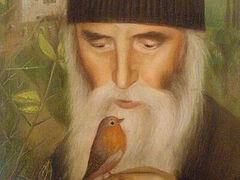
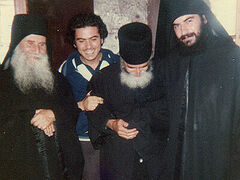
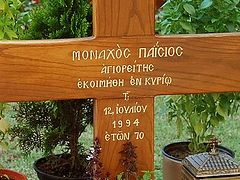
Archpriest Sergei Tishkun, rector of the Church of the Nativity of the Most Holy Theotokos in Krylatskoye in Moscow, talks about St. Paisios the Hagiorite, whose feast the Russian Orthodox Church celebrates on June 29/July 12.
 Archpriest Sergei Tishkun St. Paisios is especially dear to me, because during my studies in Greece I had the opportunity to experience the Greek tradition, to come into contact with some fathers and ascetics of piety, and to visit Mt. Athos many times. Unfortunately, I did not see St. Paisios, because I am quite young, but I met the fathers who had known St. Paisios personally; for example, Metropolitan Hierotheos of Nafpaktos. We will talk about the life path of St. Paisios.
St. Paisios the Hagiorite was canonized by the Patriarchate of Constantinople on January 13, 2015. Hieromonk Isaac, one of his spiritual children, compiled the elder’s Life, revealing details of the saint’s birth and development of personality in his pious and courageous family during the tough years of hardship and war.
Arsenios Eznepidis was born on July 25, 1924 in the village of Pharasa, about 125 miles south of Caesarea (now Kayseri)—the main city of Cappadocia. There were fifty churches and many holy springs in Pharasa. On fasting days throughout the year, most of the villagers ate and drank water once a day, so they actually lived according to the monastic rule. The future saint’s father, Prodromos, was a religious man and came from a noble lineage that had historically governed Pharasa from generation to generation. The grandfather and great-grandfather of St. Paisios were its mayors. Due to the persecution by the Turks, he had to change his surname and began calling himself Eznepidis, which means a “foreigner”. His great-grandfather bore the surname Digenis, which is the name of a legendary Greek hero and warrior. His father was engaged in farming and iron smelting.
 Arsenios Eznepidis (the future Elder Paisios)
Prodomos was distinguished by his courage, patriotism, and sense of justice, but, as St. Paisios recalled, he was very stern with his children. The saint later related that he was only three years old when a neighbor took him to pick some figs. He thanked the child by giving him two figs, which the boy ate. When his father learned about this, he started beating his son. His mother defended Arsenios. By the way, she came from an impoverished aristocratic family and was related to St. Arsenios the Cappadocian—a perfect and blameless monk, as the youth Arsenios called him. That’s the kind of monk Elder Paisios strove to become all his life.
St. Arsenios the Cappadocian served as a priest in the village of Pharasa, where St. Paisios was born, and was a prominent bearer of the Cappadocian tradition. In 1986, the Orthodox Church canonized him, and St. Paisios probably played a crucial role in this. At Arsenios’s Baptism— the future Paisios—they wanted to name him Christos after his grandfather. But St. Arsenios, who baptized the infant, wanted him to be named Arsenios, so that the monk, as he said, could have a spiritual lineage. So St. Paisios became a successor in the spiritual lineage of St. Arsenios.
In the same year of 1924, when Arsenios was born, the Greeks of Asia Minor were uprooted from their ancestral land—the history of Greeks living in Asia Minor that had spanned 3,000 years ended, and there was the “resettlement”, or rather, expulsion of the native Orthodox Greek population from their ancient homes. Approximately one and a half million Greeks were expelled; according to official figures, over 350,000 died at that time—it really was a great tragedy. On the way by ship from Asia Minor—from Pharasa to the port of Piraeus in what is now Greece—his mother laid her baby Arsenios on the deck and covered him with blankets. A sailor stepped onto the baby without noticing it, and little Arsenios’ body turned into one continuous bruise. Afterwards, St. Paisios said: “Oh, if I had died then, with the grace of Baptism I had just received, my body would have been thrown into the sea, fish would have reveled in their dinner, and I would have gone to Heaven and become a little angel.” He so yearned for God and aspired to Him all his life.
Little Arsenios learned from his parents reverence for God and sacrificial service to people. Instead of fairy tales and children’s stories, his parents told him about the life and miracles of St. Arsenios.
The second person after St. Arsenios who had the most salutary influence on little Arsenios was his mother. He felt a special love for her and helped her as much as he could. He learned the humbleness of mind from her. His mother advised him not to try to beat his peers in any games. Other boys called him a “refugee”; he was offended, but his mother would tell him, “This teaches you not to be proud.” She taught him not to even strive to be the first. The mother instilled abstinence in her children, not allowing them to eat anything until the whole family gathered at the table. From childhood, St. Paisios preferred tasteless food and washed his own clothes.
His mother told him never to pronounce the name of the tempter, the devil. Twice a day, the whole family prayed in front of their home iconostasis. Their father instructed the children that each of them should stand before God every evening, like a soldier, and give an account of the day lived. Arsenios’ mother constantly repeated the Jesus Prayer.
The elder later recalled: “My mother’s look and words helped me more than my father, who was liberal with his slaps and cuffs. Of course, they both loved me, but my mother’s noble, generous behavior corrected me more than my father’s harshness and punishments.”
St. Paisios’ grandmother, whose name was Hadji-Christina,1 also played a great role in his life. Instead of telling him fairy tales, as did his mother, she related to her grandson something from the Gospel or the Lives of saints, showing him icons. She gave him an icon that she had brought from the holy sites, which depicted Christ as a Child helping Righteous Joseph in a carpentry workshop. It was this icon that prompted Arsenios to choose carpentry in order to be like Christ.
From childhood, Arsenios dreamed of being a monk. He practiced prayer, learned the lowliness of mind and abstinence. Having learned to read and write, Arsenios often read the Holy Scriptures and the Lives of saints. Seeing Arsenios’ “excessive zeal”, his older brother would hide books, but the saint showed amazing persistence. It got to the point that he very often ran away to read in the woods and live like hermits, retreating into dilapidated houses or St. Barbara’s Church; he was already trying to use the experience of saints in practice.
 St. Arsenios the Cappadocian
He later said that if we read the Lives of saints and other spiritual literature, but do not use what we read in our lives and do not try to put it into practice, then our reading is meaningless. We will be like people who watch gladiator fights, while sitting and not trying to stand up from their seats to do something.
He finished elementary school with good grades, but did not continue his studies. Arsenios began to master carpentry. In addition to household items, he made church items and coffins. The first things he made were a cross and an iconostasis for the house. He did not charge for the coffins, thus expressing his compassion for those who were bereaved.
At the age of fifteen, Arsenios was vouchsafed a miraculous appearance of the Savior. It happened as follows. Once, one of Arsenios’ older brother’s friends, Kostas, told him about Darwin’s theory in order to tempt him. Very confused, Arsenios said: “I will go and pray. And if Christ is God, He will appear to me so that I will stop wavering in faith—He will give me a sign through a shadow, a voice, or something like this.”
Arsenios ran away to his beloved Church of Greatmartyr Barbara, praying long and hard, and waiting for a sign, but did not receive it. Then he thought: “Since Christ was so outstanding, righteous, and virtuous, and His fellow countrymen envied His virtue and condemned Him to death, and even if He was just a kind Man, then I nevertheless must love Him, obey Him, and sacrifice myself for His sake.” And he saw the light, and as he later related, Christ Himself. “I saw Him from the waist up,” recalled Elder Paisios, “He looked at me with great love and said: I am the resurrection, and the life: he that believeth in Me, though he were dead, yet shall he live (Jn. 11:25).”
After that event, Arsenios began to struggle even more zealously. Whenever someone wanted to marry him off to some lady, he strongly objected: “No, I will be a monk! I am not for this world.”
Soon he went to the local diocesan administration and wondered if he could become a monk. But they told him that he should first grow up and serve in the army. His brothers were fighting and Greece was then occupied by German troops: Arsenios had to take on the entire burden of farming, and was his mother’s helper and support. Arsenios often saw his mother weeping and worrying about his brothers who were fighting in the war, so he put off his idea of becoming a monk. Later he would say, “Wandering doesn’t mean making yourself comfortable without caring about your family’s fate; wandering means sacrifice.”
In April 1948, Arsenios was drafted into the army and received a military specialty as a radio operator. Before the army, he had earnestly begged Greatmartyr Barbara that he would not shed blood in the war, regardless of how dangerous it was; and the unit were the future saint served participated in fighting. Arsenios very often experienced mortal danger and difficulties, but he did not lose heart, and God did not forsake him—he never shed blood.
The future saint spent his whole life striving for solitude, and this is one of the reasons why he did not become a priest—because he would have to be available to his parishioners twenty-four hours a day. Arsenios was afraid that if he took on the priestly ministry, he would have absolutely no time for repentance, tears, or prayer. There was a second reason though. When he served as a radio operator and his company was surrounded, Arsenios contacted the air force, planes arrived, and they bombed the enemies. Although he himself did not use weapons in that situation, he believed that his call for air support caused people’s deaths, which meant that he couldn’t be a priest.
In 1950, when the future saint was still serving in the army, he fulfilled his cherished wish and for the first time visited Holy Mount Athos, namely the Philotheou Monastery where his relative Hieromonk Simeon struggled. Interestingly, he was troubled during that stay. Arsenios saw Fr. Simeon cooking delicious dishes in his cell and even breaking his fast sometimes. But as it turned out, he suffered from tuberculosis and was prescribed high-calorie food in order to be cured. Meanwhile, Arsenios went to Mt. Athos with a special knife so that it would be convenient to cut herbs, because he believed that Athonite monks ate only herbs and nothing else.
Providentially, Arsenios met a virtuous elder from the Koutloumousiou Skete, Hieromonk Cyril, who later became his father-confessor. He wanted to find an elder who would take him as a novice, but on that first visit he did not find one. In addition, Arsenios received news from his father about difficulties in their family, and he decided to return to his parents after the army.
 The future St. Paisios in the army After returning from Mt. Athos, Arsenios took up carpentry. He gave the money he earned to his relatives and donated it to the poor, while he made windows and doors for free. Although his job required physical effort, Arsenios fasted, prayed and made bows at night, and slept on the floor. He recommended many pilgrims to pray at night. Because just as the rain that falls at night is very useful to plants and all living things, and all nature comes alive in the rain, so prayer, which is performed at night, quickens the soul.
And in March 1953, following his calling, he made the final decision to devote his whole life to monastic labors. Having distributed his savings and provided for his widowed sister, he left for Mount. Athos. At first, he chose the Konstamonitou Monastery, but a storm broke out, and he found himself at the Kalyvia of the Meeting of the Lord of Kafsokalyvia—this is the very southern edge of the Athos peninsula. He ended up in a kaliva where two Zealots somehow got along. After living with those elders for a month (of course, life was very austere and strict there), Arsenios left them. On his way, he met Bishop Hierotheos who advised him to join the cenobitic brotherhood of the Esphigmenou Monastery.
In those days, that monastery was notable for its very strict rules; there was someone to learn from there. As Arsenios used to say, the brethren of this monastery were a living patericon. The fathers labored in silence—there were sixty of them at the monastery, but none of them even asked where Arsenios came from. The only Book that was always in the cell was the Holy Scriptures. The Esphigmenou brethren followed the ancient rule and fasted for three days, eating food without oil before Communion.
On the eve of Communion, most of the fathers of Esphigmenou held a vigil from evening to morning. Lent in Esphigmenou was a real ascent to Golgotha. On the days when the church regulations did not allow work, the brethren were uncompromising. They would have rather watched a storm sweep grapes or barrels of oil into the sea than violate God’s commandment and tempt laypeople by working on a Sunday or a great feast.
Most of all, Arsenios was moved by the brotherly love that the monastery fathers had for each other; they had remarkable spiritual courage and always aspired to self-sacrifice. This spirit—to do something to make things easier for their brothers—reigned in obediences, at the meal, and everywhere. The fathers constantly tried not to grieve Christ in any way, so they continuously lived in a state of spiritual triumph—they lived in Paradise.
Initially, Arsenios performed obediences at the refectory, at the bakery, and then at the carpentry shop. Another area of his responsibility was two churches located outside the monastery; he kept them clean and lit icon lamps in them. Regardless of what obedience Arsenios was assigned, he labored with all his might and worked his heart out. He became, as he later said, “a pair of rubber boots on duty” for the love of Christ. No matter how hard his obedience might be, after the end of the working day, Arsenios prayed and praised the Creator at night.
His Life says that Arsenios stood through the entire service and did not leave church until he had read all the thanksgiving prayers after Communion. In winter, he managed without a stove in his cell and without warm clothes outside, sleeping on bricks and stone slabs. Of course, such an austere life affected his health—the saint was ill all his life.