Esphigmenou Monastery
Like many celebrated ascetics, Arsenios did not avoid the devil’s wiles. At one time, the evil one confused him by stirring up his memories and worries for his family, appearing to him in a dream as a sick or reposed relative. Then he appeared to Arsenios in a sensual form, aiming to intimidate him, and spoke to him. With God’s help, Arsenios overcame his cunning, avoiding satanic snares and tricks. The saint used to say that there is no man who is not tempted by the devil. If you live in the world, he gives you temptations from the outside. But if you live in the desert, then the devil tempts you in a worse, more severe and more terrible way, because then he himself comes to an ascetic.
At the age of thirty, he received his first tonsure—as a riassaphore monk—with the name Averkios. The young riassaphore monk undertook backbreaking labors—taking on the ascetic labors and rules of a schemamonk. And great temptations began. The following thought started tormenting him: “It would have been better if I had broken my leg so as not to make these bows.” He got to the point when the very sight of a prayer rope made him shiver. The saint shared it with this abbot, who told him how many prayers and bows he should perform; this is why a young monk must have a father-confessor. And not just every monk—St. Paisios himself later adjured that every Christian, if he wants to reach the quiet haven of the Kingdom of God, cannot do without a father-confessor.
After that, whenever he was worried about the rule he was observing, St. Paisios would say to himself: “If you can’t make 300 bows, then make 200. If you can’t make 200, then make 100. If you can’t make 100, then make fifty. Even if you have no strength to perform that, then never mind. Make three prostrations for Christ and one for the Mother of God. Four prostrations are so little that even the dead can perform them. The most important thing that a person needs, including a Christian and a monk, is to stand and pray before God.” And he always said that prayer is not measured by quantity, but by quality.
Over time, R-Monk Averkios’ desire for a quiet, secluded life matured more and more. And one day he asked for a blessing to leave the monastery.
Arriving in the Iveron Monastery, he venerated the Iveron Icon of the Mother of God and felt a special, tender feeling. R-Monk Averkios concluded that God was blessing him to leave Esphigmenou. Knowing about the virtues of Elder Cyril, who struggled at the Koutloumousiou Monastery’s Skete, he became his novice. But he only lived with him for a month, because the Esphigmenou Monastery didn’t give him permission to remain there. Brother Averkios was a very good carpenter, and the monastery certainly needed him. But he nevertheless left Esphigmenou and ended up at the Philotheou Monastery. He was thirty-two years old at the time. As we have already mentioned, Brother Averkios’ distant relative, Hieromonk Simeon, struggled at Philotheou.
According to archival evidence, Brother Averkios entered the Philotheou Monastery in 1956. There he had the opportunity to visit his father-confessor, Elder Cyril, because this monastery was idiorrhythmic, and very different from a cenobitic one. In an idiorrhythmic monastery, the brethren do not choose an abbot. They can have property, gather for a common meal only on the feasts, and receive money from the monastery for their obediences.
At Philotheou Monastery, Brother Averkios’s obedience was in the refectory, and then he was appointed head of the carpentry workshop. At the age of thirty-two his health deteriorated, and the monastery elders sent him to Konitsa in his homeland to take a cure.
When the thirty-three-year-old Brother Averkios returned to Mt. Athos after his illness, he was tonsured into the mantia with the name Paisios after St. Paisios II, Metropolitan of Caesarea.
While staying at Philotheou, St. Paisios thought a lot about stillness, but his attempts to retreat to the desert were not blessed. One day, he asked a boatman to take him to a deserted island, but the boatman did not arrivedat the appointed time. On another occasion, St. Paisios intended to become a novice of an Athonite elder, Peter, but soon the elder died, and again he remained at the monastery. Another time, he agreed with a monk of Philotheou to go to Katounakia for the sake of stillness, but in a dream he heard the voice of the Most Holy Theotokos Who forbade him to go to Katounakia and ordered him to go to Stomio—a monastery in Greece near where his parents lived. And Elder Paisios certainly couldn’t have expected that he would have to leave Mount Athos, where he sought silence, and go to Stomio monastery—in essence, back to the world. But he had to fulfill his vow: When he was in the army and escaped from enemies under incredible circumstances, he promised that when the war was over, he would rebuild the monastery. And now the time had come.
In 1958, at the age of thirty-four, Monk Paisios left the monastery and traveled to Stomio, only to find himself in a burned down monastery. There he had many problems with people who did not understand him, because they were used to a free life, whereas the elder set about introducing Athonite traditions at Stomio.
In 1962, at the age of thirty-eight, he notified the ruling hierarch of his departure, handed over to him the monastery treasury and keys, and left for the Holy Mount Sinai. There he reestablished monastic life as it were, because—just imagine—the monks at Mt. Sinai were recieving Communion only four times a year before his arrival. But through Elder Paisios’ efforts, the monks gradually began to take Communion more often. At Mt. Sinai, the monks had not had a common meal—everyone would eat in his cell. Elder Paisios considered this wrong, and with his arrival, the common meal was introduced there.
Tourists would come to the monastery half-naked, which inevitably troubled the monks—and this issue was resolved. St. Paisios used almost all the money he earned from the sale of handiwork (he lived in a separate cell as a hermit, carved icons and sold them) to feed Bedouins, buying food and clothes for them. The saint gave special care to a Bedouin boy named Suleiman. His father was dead, and the child suffered from tuberculosis. The saint would often come to Bedouins’ homes at night, quietly leaving provisions and clothes at their doors. He was a St. Nicholas not only for Bedouins, but also for those living close to him.

In 1964, when the elder was forty, his health deteriorated greatly. Although he did not want to leave his desert, he had to return to Mt. Athos. Afterwards, two months before his repose, the elder said: “Ah, if I had the strength, I would abandon everything and go to St. Episteme’s Cell on Mt. Sinai for a year. I would live there as a monk, sing like an angel, and die like a soldier on the front line.”
St. Paisios returned to the skete at the age of forty and began to live at the Kaliva of the Holy Archangels. He eagerly helped the brethren, indulged in silent seclusion whenever possible, and practiced prayer and Divine contemplation. Once a week, he went for confession to his father-confessor, St. Tikhon (Golenkov) at Kapsala. During those meetings, St. Tikhon constantly asked him: “When are you going to take the schema?”
Thus, in 1966, at the age of forty-two, St. Paisios was tonsured into the great schema. In Russia we have an idea that it is done in old age or just before death. But that is not the case in Greece; there, a monk can be tonsured immediately into the great schema at a fairly young age. Four months later, also for obedience, the saint became the head of the Iveron Skete.
Meanwhile, the saint’s condition worsened; he started having prolonged bouts of severe dry coughing—first spitting blood, then blood came up his throat, and his temperature spiked. He had to leave Mt. Athos and go to the hospital in Thessaloniki. The X-ray showed that the saint had bronchiectasis. They quickly began to prepare him for surgery, because the doctor said that there was not a day to lose.
After the hospital, St. Paisios lived for some time in a sisterhood in the village of Souroti not far from Thessaloniki. That sisterhood had helped him during his illness and surgery in Thessaloniki, and then it grew into the Convent of St. John the Theologian. There he could not avoid temptations either; the elder asked the Metropolitan of Thessaloniki to bless him to found the convent, but the metropolitan did not bless him. Then, via his friend, Fr. Agathangelos, he conveyed the request to another hierarch, whose diocese bordered that of Thessaloniki: Metropolitan Synesius of Kassandreia, who blessed the establishment of the convent. After that, St. Paisios returned to Mt. Athos. He needed a change of climate after the operation, and so he retired to Katounakia.
In addition to his ascetic labors, he did wood carving, sold some of his products, and provided himself with a modest livelihood, distributing most of it, as before. When the Holy Kinot of the Holy Mountain commissioned Hieromonks Vasileios and Gregorios to revive monastic life at the Stavronikita Monastery, St. Paisios helped revive it.
In 1968, Elder Tikhon (Golenkov) reposed in the Lord. Before his death he expressed a desire for St. Paisios to succeed him in the cell.
In 1971, at the age of forty-seven, St. Paisios was vouchsafed an apparition of St. Arsenios the Cappadocian. He composed the Life of this saint—a “perfect and blameless monk”—whom he loved very much and whom he sought to emulate, as was stated in the first part of this article.
The following year, St. Paisios managed to visit his birthplace—Pharasa. And in 1977, at the invitation of the Orthodox church in Australia, he visited this country. His Life says that when the saint was flying in an airplane over Syria, he confessed that he felt a special grace, because many saints shone forth in this land; but when he was flying over Tibet, he felt incredibly cold.
After struggling in the kaliva of the Holy Cross for about eleven years, at the age of fifty-five Elder Paisios moved to his final home, the Panagouda Cell, which means “little Panagia”—that is, the Mother of God. The cell was absolutely unsuitable for anyone seeking a secluded life, but he was filled with compassion for pilgrims who now began to come to him in great numbers for counsel and with prayer requests. The elder installed a box at the entrance to the kaliva area and wrote: “Write down what you need, drop your note into the box, and I will help you by prayer more than by words. Thus I will have more time to help the suffering.” He did not understand those who said that monks should help the world and enlighten people. He believed that monks are the “radio operators” of the Church; in the desert they live with Christ, there is no “interference” there and they have the best “connection” with God; and with their prayers they warm up the whole world.
Interestingly, the elder was very upset whenever people asked him to perform a miracle, because he said that they were showing their weak faith or even lack thereof. “An impious faith seeks miracles, but we must believe in God with pious faith, without seeking miracles to keep our faith alive. When I see adults asking me to perform a miracle in order for them to believe, do you know how much it upsets me?” Like other fathers and our Lord Jesus Christ, he repeated that even if such people saw a miracle, they would not believe.
In 1988, at the age of sixty-nine,1 having barely recovered from a hernia operation, Elder Paisios decided to go to Mt. Sinai. He wanted to stay there as long as possible, but he was very weak and could hardly walk, so he could no longer climb cliffs and other hard-to-reach places and so lived at the monastery. That visit did not last more than a month, and the elder returned to Mt. Athos again.
At the age of sixty-nine, the elder left the Holy Mountain and came to the Souroti Convent for the feast of St. Arsenios, but he did not return to Mt. Athos, although he had the opportunity. At Souroti, he suddenly felt so bad that he was rushed to the hospital. It emerged that he had cancer that had metastasized to his lungs and liver. When the abbess told the elder about his diagnosis, he put her hand into his and exclaimed with extraordinary joy, “Let’s dance together, mother!”—although he had never danced in his life. The elder was overwhelmed with joy and literally shone with happiness. The abbess burst into tears, but the saint tried to console her, “Why are you crying, silly? I have been living for seventy years—do you think it is not enough?”
The elder underwent surgery, then another, and chemotherapy began. The doctors realized that he would not survive a second course of chemotherapy, and it was stopped. The ascetic did not want to be treated, but he obeyed the doctors and heeded their recommendations until his final days. It was only when he felt his death approaching that he stopped taking even painkillers. St. Paisios decided to return to the Holy Mountain after the operation and told the doctors about it. But when the doctors said that he could only be taken in a special car for transporting seriously ill people, because the journey was very long (seven hours) and he would not hold out without an oxygen mask, Elder Paisios refused to return to Mt. Athos, resigning himself and staying at the Souroti Convent. He discussed with the abbess all the details of his funeral.
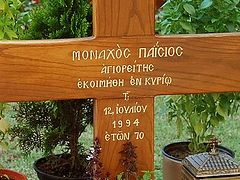
 The grave of St. Paisios the Hagiorite
He received Communion for the last time on July 11, and on July 12, 1994, he fell asleep in the Lord. And on January 13, 2015—twenty and a half years later (it is very rare for saints to be canonized so quickly)—St. Paisios was canonized by the Holy Synod of the Patriarchate of Constantinople.