The history of the Baptism of Russia (Rus’) raises many questions among researchers. Broadly speaking, scholars of the Christianization of Russia can be divided into several camps. Some will be critical of the process of spreading the Christian faith among the Slavic tribes, pointing out the “violence” and “cruelty” of the baptizers. Others will talk about Prince Vladimir’s holiness and try to prove that his methods were humane, and his actions were dictated by Christian love. Can there be such a contradiction? Can politics ever truly be Christian? Can a Christian remain himself, having great power over the destinies of other people?
The history of the Christianization of Russia, as we are used to hearing it, appears before us in a rather polished form: Having received Holy Baptism, the holy Prince Vladimir Equal-to-the-Apostles gathers people on the Dnieper River and baptizes everyone who comes, saying that whoever does not come to be baptized is no friend of his. It is quite dangerous in any era not to be a friend to those in power, so perhaps we should not view Prince Vladimir’s call as absolutely inoffensive. The Prince made it clear that the further development of his domestic policy would be in line with Christian concepts. Russia was entering the orbit in which its Christian neighbors moved and whose center was Constantinople. Such was the will of the ruler who at that moment found himself at the helm of the state ship. The will of his people was either to obey him or to reject him.
The key question in this episode is the question of will. Every event in human history is the result of the interaction between the will of God, the will of man and the will of satan. It is hard for us to determine on a national scale what is the will of God and what is the outcome of the victory of dark forces, which is why on such a scale it is more convenient to speak of political advantage. But there is a measure that concerns human will, and at this level we can draw certain conclusions.
Prince Vladimir lived a very eventful life. His will to power led him to rule Kiev as a result of fratricide. During that same internecine strife his younger brother Oleg was killed, but St. Vladimir achieved his goal and began to reign in Kiev. It is hard to say what feelings the prince had when thinking about his brothers’ deaths. We can only say that the path to power is paved with such “stones”: the bloody sacrifices of those who hinder an ascent to power. No one is able to resist the human will—even God humbly steps back and waits for a person to want to find Him on his own and learn what He wants. We see that people are unstoppable when they are passionate about achieving something—it is precisely this capability that popular psychological advice refers to when it says: “The main thing is to want it, and then you will succeed.” This is absolutely true, and it happens that God finally grants what a person lusts for; but once he gets what he wanted, he throws it away because it becomes repulsive to him.
Similarly, power bought at the price of one’s brothers’ lives should torment the human heart. Regardless of whether Prince Vladimir intended to kill his brothers or they became merely the “branches” snapped along the prince’s path, what matters is that when people choose a certain path, sooner or later they realize the price they will have to pay for taking it.
St. Vladimir’s path did not end with securing the Kievan throne—every ruler strives to strengthen his power and expand his spheres of influence, which is why the prince raised the question of Russia’s religious identity. At that time, various Slavic pagan cults enjoyed the greatest popularity in the principality. As expected, different tribes had their own pagan patrons. In such a situation it was quite difficult to consolidate the people and bring them together as one. Besides, the most prominent examples of religious triumph were by no means pagan states.
What should a strong young man do when he needs to strengthen his home? He will look at those who do it best. On the scale of princely power, the “home” was the whole of Russia, the entire nation. How will a father lead his family? Only by knowing where he is going, Who is waiting for him ahead, and Who is his support and Teacher. Prince Vladimir had to choose the path that his family and all the people who believed him would take, and there were several examples before his eyes. Among them were European cities and states, the most populated of which had about 100,000 residents; pagan tribes, scattered and wild; and Muslims, alien and distant. But of course, the brightest example was Constantinople, which at that time was called simply the City (“Polis”). All roads led there, and about a million people passed through it. It was the center of the whole world, the center of the Roman Empire at that time.
The choice was obvious—the people who ruled that City had no problems with their political goal-setting; but what was their ideology? At that time the ideology was the [Christian] faith. Faith was on the warriors’ shields and on the banners of military units. Those who battled with this city could see the state’s program, which was written in the form of “Chi-Rhos” on Byzantine shields.
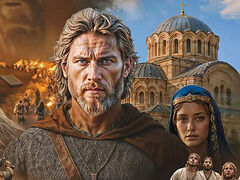
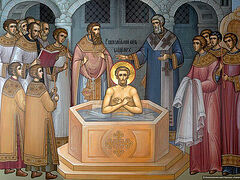
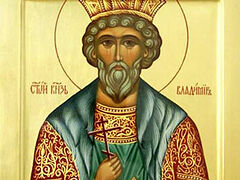
Thus, the symbol of the world’s most powerful state was the Orthodox faith, and this symbol attracted the young prince with its might. His task was to adopt this symbolism and assimilate it for his people so that they could become just as invincible in their lives and territories. The will to power led St. Vladimir to the princely throne, but only the Lord and the prince himself know what brought him to Christ. There is a tradition that the prince went blind before his Baptism—an event that turned his life upside down. Deprived of his eyesight, Prince Vladimir lost all his strength, the support of his warriors and, in fact, his principality. What can a blind ruler offer to his people? He can only live out his days. Undoubtedly, this event, if it did happen, must have raised serious questions in Prince Vladimir’s soul. Our sufferings are meant to raise the degree of our life aspirations. In any case, the prince was baptized, received the new name Vasily (Basil), and became a new man.
 Monument to Prince Vladimir in Moscow. A figure fragment, 2016
His next step was to lead his people along the same path that he himself had walked. We do not know the spiritual foundations of the prince’s decision—his life in God is known only to himself and God—but we can see the fruits of his decisions. We see that after embracing Orthodoxy the prince did not reckon with the pagan way of life that had existed in Russia before him. We see that the prince deemed it necessary to impose his will on those who obeyed him and to make it (his will) clear to those who were his enemies.
From then on, the path of the prince and his people was the path of an Orthodox nation. Here the prince’s will was his own personal, subjective decision, but it was the decision of one person influenced by God, his parents, friends and subordinates—the decision was made by him alone, regardless of those who disagreed with him. The man knew what was best both for him and for those he loved, and he went ahead and did it.
We can see the fruits of Prince Vladimir’s decision. Whatever it may have been—controversial, complex, or ambiguous—Russia is now known as the largest Orthodox country in the world. The consequences of Prince Vladimir’s decision are visible across a vast expanse from Europe to the Pacific Ocean: the Divine Liturgy is celebrated in churches. Such fruits come from someone who holds a dialogue with God in his heart and obediently fulfills the dictates of conscience. Our paths may seem dual to us, and those around us may not understand us and judge us, but if in our heart of hearts we pray and stand before God, no one will be able to lead us astray, and the fruits of such labor will be visible to all.