Every icon has a story.
Some remain in the churches for which they were created. Others travel across borders, carrying with them not only the work of gifted craftsmen but also the prayers, gratitude and hopes of the people who brought them into being.
The icon of Holy Righteous Warrior Theodore Ushakov, which today occupies a place of honor in the St. Nicholas Orthodox Cathedral in Nice, belongs to the latter.
Its journey began more than 3,000 kilometres away in the historic Volga city of Rybinsk and ended on the French Riviera on 16 November 2025, when it was solemnly presented to the cathedral before clergy, parishioners and guests.
Yet the true story of this icon cannot be measured in kilometers.
It is a story that connects an eighteenth-century naval commander, a Russian philanthropist living in Monaco, iconographers and craftsmen in provincial Russia, and one of the most beautiful Orthodox cathedrals in Western Europe. It is a story of history, faith, gratitude and the unexpected ways in which lives separated by centuries can become closely intertwined.
Each year, on 5 August, the Orthodox Church commemorates the canonization of Holy Righteous Warrior Theodore Ushakov. More than two centuries after his death, he remains one of the most remarkable figures ever glorified by the Church—an undefeated admiral whose greatest victories were remembered not only for their military brilliance, but for the Christian virtues that guided every decision he made.
The arrival of his icon in Nice therefore marked far more than the completion of an artistic commission.
It became another chapter in a story that continues to inspire people far beyond the seas he once sailed.
Born in 1745 into a modest noble family near present-day Rybinsk, Theodore Ushakov entered the Imperial Russian Navy during a period of profound change, when Russia was establishing itself as one of Europe’s emerging maritime powers. From the beginning, Ushakov proved to be a commander who preferred initiative to rigid convention.
While many admirals of his era relied on carefully ordered battle lines, he favored speed, flexibility and decisive maneuver. He trusted the judgement of his officers, encouraged independent thinking and believed that discipline should inspire confidence rather than fear.
The results became legendary.
Over the course of his career, Ushakov fought forty-three naval engagements without suffering a single defeat. Not one ship under his command was lost in battle and, according to contemporary accounts, none of his sailors fell into enemy captivity.
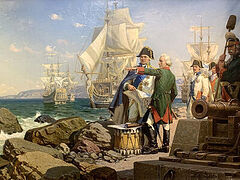
His victories over the Ottoman fleet secured Russia’s position in the Black Sea, while his Mediterranean campaign culminated in the liberation of Corfu in 1799—an operation still regarded by military historians as one of the outstanding naval achievements of its time.
Yet military success alone does not explain why his name continues to be honored more than two centuries later.
Many commanders have won wars. Very few became saints.
Those who served under Ushakov remembered his humanity with which he exercised command. Contemporary accounts describe a leader who rejected unnecessary cruelty, cared personally for wounded sailors and believed that authority carried a responsibility to protect the people entrusted to him.
That conviction became especially evident during the devastating plague epidemic in Kherson.
Rather than distancing himself from the danger, Ushakov organized strict quarantine measures, secured food and medical care for his crews and remained alongside those under his command. His leadership during the epidemic was recognized as an act of exceptional service—one that demonstrated that safeguarding lives could be as important as winning battles.
After retiring from the Navy, Ushakov settled near the Sanaksar Monastery, where he devoted the final years of his life to prayer, charitable works and service to those around him.
Visitors no longer encountered the celebrated admiral. They met a man whose authority was expressed through humility rather than rank, and whose faith shaped every aspect of his daily life.
When the Russian Orthodox Church canonized him in 2001, it was recognizing more than an exceptional military commander.
It honored a life in which courage was inseparable from compassion, discipline from mercy and victory from humility.
Although St. Theodore Ushakov is revered as one of Russia’s greatest naval commanders, his story belongs as much to the Mediterranean as it does to the banks of the Volga.
It was here, in the closing years of the eighteenth century, that his reputation extended beyond the Russian Empire. His victories against the Ottoman fleet and the liberation of Corfu in 1799 reshaped the political landscape of the eastern Mediterranean and earned him the respect of allies and adversaries alike.
More than two centuries later, traces of that history remain.
A monument to Admiral Ushakov stands in nearby Villefranche-sur-Mer, overlooking the same waters where Russian naval squadrons once sailed. Just a few kilometers away, the St Nicholas Orthodox Cathedral has become one of the most enduring symbols of the historic ties between Russia and the French Riviera.
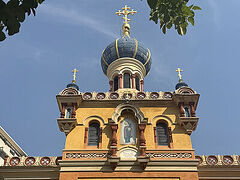
Built in the early twentieth century for the growing Russian community in Nice, the cathedral continues to welcome not only Orthodox Christians from across Europe but also thousands of visitors who come to admire one of the city’s architectural landmarks.
For its parishioners, however, St Nicholas Cathedral is far more than a historic landmark. It is a living church, where baptisms, weddings and memorial services mark the rhythm of life, and where people come to seek comfort, strength and hope in moments of joy, sorrow and uncertainty.
It was also here that Mikhail Nefedov, a Russian philanthropist from Monaco, discovered that his own life could begin again.
“I never imagined that I would one day become part of something like this,” he recalls. “Everything started with a simple desire to give thanks.”
Several years ago, he first walked through the doors of the St Nicholas Cathedral at one of the darkest moments of his life.
“I came here carrying a burden that had become impossible to bear,” he says quietly. “I was struggling with addiction. My life had reached a point where I could no longer see a way forward.”
He pauses before continuing.
“It was here that I truly learned how to pray. For the first time, I realized that I wasn’t facing my problems alone. I found hope—and with that hope came the strength to begin again.”

The cathedral became the turning point in his life. It was there that his recovery began, despair slowly gave way to faith, and gratitude grew into a determination to give something back.
“My parents were doctors with the Red Cross. They served in Yemen and Ethiopia, caring for people without asking who they were, where they came from or what they believed. Watching them as a child taught me that mercy has no borders.”
Years later, while reading about Saint Theodore Ushakov, one episode affected him more deeply than any account of the admiral’s victories at sea.
During the plague epidemic in Kherson, Ushakov organized quarantine measures, ensured that his sailors received food and medical care, and refused to abandon those entrusted to him despite the personal risk.
“For me,” Nefedov says, “that tells us far more about the man than any military victory ever could.”
“It is easy to admire an undefeated commander. It is much harder to understand the greatness of someone who never stopped caring for other people.”
His gratitude towards the cathedral had already inspired the giving of one important gift.
In 2017, with the blessing of His Holiness Patriarch Kirill of Moscow and All Russia, Metropolitan Methodius presented the St Nicholas Cathedral with an icon created by the brethren of the Vysotsky Monastery in Serpukhov. Before its journey to France, the icon was blessed by Fr Igor Balabanov before the monastery’s revered miracle-working icon of the Mother of God.
For Nefedov, that image became inseparable from his own story.
“It became an icon of hope,” he says. “During my recovery in Russia, we prayed before it many times. When I later moved to Monaco, I realized how important it would be for people on the French Riviera to have that same place of prayer.”
The arrival of the icon strengthened the spiritual life of the parish, but it also planted another idea.
If the cathedral had become a place of hope for so many people, perhaps it should also receive an icon of Saint Theodore Ushakov—the admiral whose courage was matched by humility, and whose victories never came at the expense of his humanity.
“I believe God brings people together when something truly needs to be done. Everyone who became part of this project arrived at exactly the right moment. I pray,” Mikhail says quietly, “that anyone who stands before this icon—whatever burden they may be carrying—will discover what I found here. Because sometimes one prayer can change an entire life.”
Once the decision had been made, the project brought together people whose skills reflected centuries of Orthodox artistic tradition.
The icon was entrusted to Sergei and Alla Smirnov, artists from Rybinsk, whose work in iconography and church art has earned recognition throughout Russia.
For the Smirnovs, the commission carried particular meaning.
“We knew this icon was destined for St Nicholas Cathedral in Nice,” Sergei Smirnov says. “That alone made it a special responsibility. The cathedral is one of the spiritual symbols of the Russian Orthodox presence in Western Europe.”
The work demanded far more than technical mastery.
Following the traditions of Orthodox iconography, every stage—from preparing the wooden panel to applying pigments and gold leaf—was completed by hand and accompanied by prayer.
“An icon is never simply a painting,” Smirnov explains. “Its purpose is not only to depict a saint, but to invite people into prayer.”
Alla Smirnova believes that an icon truly begins its life only after it reaches the church for which it was created.
“Our work ends when the icon leaves the workshop,” she says. “Its real life begins when people stand before it with faith, gratitude or hope.”
When the final brushstroke had been applied, the icon began the long journey from the Volga to the Mediterranean.
One important task, however, still remained.
To complete the gift, master restorer Ivan Aniskin was commissioned to create a reliquary that would house a relic of Saint Theodore Ushakov.
For Aniskin, whose work has long focused on the restoration and conservation of ecclesiastical treasures, the commission required both artistic precision and profound respect for Orthodox tradition.
“A reliquary should never draw attention to itself,” he says. “Its purpose is to serve the shrine. Everything must exist in harmony.”
Inspired by the architectural character of St Nicholas Cathedral, he designed an elegant setting that complements the icon without overwhelming it. Every decorative detail was crafted by hand, balancing refinement with restraint.

When the reliquary was finally fitted to the icon, months of work by clergy, artists, craftsmen and benefactors came together in a single offering.
The journey that had begun in Rybinsk was now approaching its destination.
On 16 November 2025, the bells of St Nicholas Orthodox Cathedral welcomed parishioners to a celebration that many had been waiting for for months.
Clergy, benefactors, artists and members of the parish gathered to witness the presentation of the completed icon of Holy Righteous Warrior Theodore Ushakov—a gift created through the shared efforts of people in Russia and France.
Welcoming the gift, Fr Andrey Eliseev, Dean of St Nicholas Orthodox Cathedral in Nice, reminded those present that the Church honors St. Theodore Ushakov not simply because he was an exceptional naval commander, but because he remained faithful to Christ throughout his life.
“People often associate holiness with monasteries or deserts,” Fr Andrey said. “St. Theodore reminds us that holiness is also possible in the midst of responsibility, public service and difficult decisions. He fulfilled his duty with courage, but he never allowed power to overcome compassion.”
Reflecting on the significance of the new icon, he added:
“Every icon becomes part of the life of a parish. People will stand before it in moments of joy and in moments of sorrow. Some will come seeking answers. Others will come simply to pray. My hope is that St. Theodore Ushakov will become for them not only a historical figure, but a living example of faith, humility and steadfastness.”
Fr Andrey also expressed his gratitude to everyone who had helped bring the project to fruition.
“This icon is the fruit of many hands and many hearts. We are deeply grateful to all those who offered their time, their talents and their generosity. Together they have given our cathedral a gift that will serve generations to come.”

As the Divine Liturgy concluded, the icon was carried to its permanent place within the cathedral. The first parishioners approached quietly to venerate it. Others simply remained where they stood, contemplating the serene countenance of the saint whose story had travelled from the banks of the Volga to the shores of the Mediterranean.
Each year, the Orthodox Church commemorates the canonization of Holy Righteous Warrior Theodore Ushakov.
Since 16 November 2025, his icon has stood in St Nicholas Orthodox Cathedral in Nice. Every day, new faces stop before it. The journey from Rybinsk has ended. Everything else is still unfolding