In the name of the Father, and of the Son, and of the Holy Spirit!
Dear brothers and sisters in the Lord, we cordially greet all of you on the feast of the Transfiguration of the Lord! St. Theodore the Studite emphasizes that all the Lord’s feasts, with the exception, of course, of the Resurrection of Christ (which stands apart), are about the earthly life of the Savior. But the feast of the Transfiguration of the Lord is about the mystery of the age to come.
What is this mystery? We know that the first coming of Christ was a state of humiliation, and His Second Coming will be in glory. What does “in glory” mean? When Christ took His disciples to Mount Tabor and was transfigured in front of them, as the Holy Fathers emphasize, the change did not happen in Christ, but in the disciples. He opened their minds and spiritual eyes so that they could see. What did they see? His Divine glory.
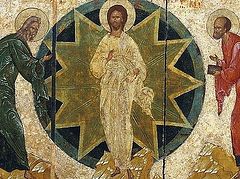
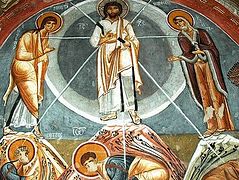
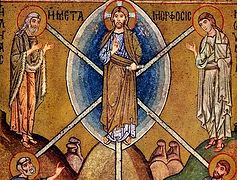
What happened to them? The iconography speaks very eloquently about this. Look at the icon, look at what happened to them: they were literally terrified. But the important point is that, though they were in terror, they felt good. The Apostle Peter said: Lord, it is good for us to be here (Mt. 17:4). And then he added a strange thing: If Thou wilt, let us make here three tabernacles; one for Thee, and one for Moses, and one for Elias (ibid), and stay here forever. They even forgot about themselves!
We know that there will also be the Second Coming of Christ, which is mysteriously revealed in the Book of Revelation, that when Christ comes a second time in glory, all will be in terror, but none of those who live in lawlessness will experience any joy. It says: And said to the mountains and rocks, Fall on us, and hide us from the face of Him that sitteth on the throne, and from the wrath of the Lamb (Rev. 6:16).
Christ said, I am come a light into the world (Jn. 12:46), and those who do good deeds and have kind and virtuous souls gladly come to the light so that their good deeds may be seen. But those who hate good and do evil hate the light, because their evil deeds are exposed, and they do not come to the light. And Christ said that this is the Judgment that will take place.
Here on earth we know that (as it seems to us) we can hide many things from God, from ourselves, and from other people—we keep silent about our evil deeds. A man can cheat on his wife or a wife on her husband—people can conceal this. A person can steal something—and no one may know about it.
But when Christ comes, this will no longer be the case: everything inside a person will be revealed at once. Why is it called the Last Judgment? Because of the scale and quality of what will happen. People will see not only themselves, but also each other, because everything will be in the light. This light will warm, comfort, and delight some people, and they will go towards it with joy—while for others that will not be the case.
Therefore, of course, brothers and sisters, on this feast-day I would like to remind you that the most important thing for us in this life is to cleanse our souls. In what sense do we cleanse them? To learn to love goodness. True, we all make mistakes, we all sin, we are all drawn to something bad and wrong. Doing evil is always easy. But we must force ourselves to do good.
Nevertheless, as the Holy Scriptures says: My son, give Me thine heart (Prov. 23:26). We must educate our hearts to love goodness and God, and to hate evil. But sometimes we even have to hate ourselves, in the good sense of the word, in order to humble ourselves.
There is such a moment in the writings of St. Silouan the Athonite. He once commented on the apparition of the Mother of God to St. Sergius of Radonezh. St. Sergius was not alone but with his disciple—St. Micah (Mikhei) of Radonezh. Micah was also a saint, but when the Queen of Heaven appeared, She appeared in Divine glory, and St. Sergius greeted Her standing, while Micah, despite being a saint, could not bear this glory—he fell to his knees and covered his face with his hands.
We can draw such an analogy, brothers and sisters, regarding ourselves as well, because the Feast of the Transfiguration of the Lord is about us too. In what sense about us? In the sense that St. John the Theologian said that when Christ comes a second time, we will be like Him. This is a very important point: We will be like Him. The Apostle Peter emphasizes that Christ has granted us to be partakers of the Divine nature. What a great purpose and immense prospects all of us share!
But just as Christ’s earthly life was a state of humiliation, and the future in glory, so for us, brothers and sisters, this life takes place in a state of lowliness. In what way? Firstly, we know that, as St. John the Theologian said, The whole world lieth in wickedness (1 Jn. 5:19); and, as the Apostle Paul taught, all that will live godly in Christ Jesus shall suffer persecution (2 Tim. 3:12). And secondly, according to the Apostle Paul, Be not overcome of evil, but overcome evil with good (Rom. 12:21). This requires self-abasement as well.
We also know, when we study the commandments, that what the Lord calls us to is the way of life we ought to lead. Here is the ideal that Christ left us: meekness, the spirit of humility, the spirit of love, and the spirit of self-sacrifice—this is always associated with self-emptying; we will always have to humble ourselves. Besides, the Lord allows sorrows, illnesses, and so on, for each one of us individually to cleanse our souls and for our spiritual growth. That is, our earthly life is always associated with humility and self-abasement.
And sometimes it happens that we have a very superficial attitude towards our lives, and we keep waiting, thinking, “When will Paradise finally come to earth?” But it does not come. And it will never come, brothers and sisters, no matter how hard we try, because we are all sinners. I will repeat that, as the Apostle John the Theologian said, the whole world lieth in wickedness.
St. Ignatius (Brianchaninov) instructs: “Do not try with your weak hand to stop the mystery of iniquity.” But when we begin to view everything that happens around us and to us spiritually, then everything changes. But the spiritual meaning of our whole life—where the Lord is guiding us, including through various sorrows and difficulties—is precisely this ineffable Divine glory.
But why don’t we see it now? For example, St. John Chrysostom wrote, “Once a person is baptized, he shines like the sun.” If we could look spiritually, we would not even be able to cast a glance at a newly baptized person! He shines like the sun! That is, we become partakers of Divine glory already here on earth. We read the Lives of the saints, and they, here on earth, beheld Christ, Heavenly mansions, and angels—everything was revealed to them. Why is it not revealed to us? Because, simply, brothers and sisters, we must understand that we cannot bear it.
Even Elder Paisios the Hagiorite—a truly humble and holy man—to whom Christ once appeared, and the phenomenon lasted for several seconds, said, “If it had lasted a few moments longer, I would have died, simply unable to bear it.” What can we say about us sinners? On the one hand, we certainly will not be able to bear it. And on the other hand, quite simply that the pride that lives in all of us will destroy everything. Therefore, as long as pride is in us, we will not be able to bear it; in fact it would not even be useful for us.
For example, none of us ever truly knows his own spiritual state. A person performs some tiny spiritual labor, and he does not even know the real value of that labor. There is a little story from the Patericon about a disciple who never went to sleep without his elder’s blessing. So, he was sitting there, and the elder fell asleep, but the disciple did not want to wake him, nor did he want to leave without his blessing. Then he grew very tired. He once wanted to leave, then a second, third, fourth, and fifth time, but he still waited it out. The elder woke up, the disciple received his blessing and left.
The elder saw his disciple leaving, wearing seven crowns of Heavenly glory. He called him back and wondered, “What have you done?” The disciple answered in confusion, “Nothing.” The elder went on asking, “What do you mean, nothing? Tell me, what have you done?” (What must have happened for Christ to grant him crowns of glory?) The disciple replied, “I just really didn’t want to leave without your blessing.” And that’s all!
What a seemingly insignificant thing, brothers and sisters! And yet even this small thing has weight in God’s scales. All the more so when a person endures a severe illness, suffering, and various sorrows in order to preserve his family for Christ’s sake, or for a neighbor’s sake endures and forgives betrayal, and so on; all the more is it clear that the Lord will reward us.
Brothers and sisters, we should be inspired by all this, remember it when we have a hard time, try to look at our lives and at ourselves spiritually, and try to awaken from the vanity and grayness of hard daily life, which is filled with labors and difficulties. We are going to Divine glory provided that we are with Christ.
Therefore, dear brothers and sisters in the Lord, we pray that on this feast-day in the church we may partake of the joy of Christ, which is given to the humble; that we may rightly accept everything that happens in our lives—with God’s help, of course—and that we may become heirs of the Heavenly Kingdom.
Happy feast to you all!