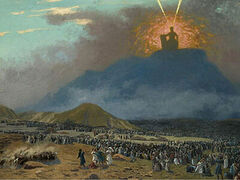
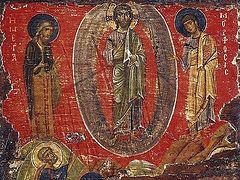
Lord, it is good for us to be here (Matt. 17:4).
Every year on August 6 according to the Old Style, we celebrate one of the greatest Christian feasts—the Transfiguration of the Savior on Mount Tabor.
Truly great is this feast, for there on Tabor, as in a flash of lightning, the Savior revealed His divine glory to His Apostles. Until then, the holy Apostles had seen only His miracles and the signs of His divinity, which were great and mighty, and they marveled at them. Yet in their hearts they still regarded the Savior as a man—a great prophet, the greatest messenger sent by God among men.
But after the Transfiguration on Tabor, the holy Apostles became forever convinced that their great Teacher was not merely a man of God, but true God Himself. They would never forget what they saw and experienced on Mount Tabor.
This event took place during the final year of the Savior’s earthly life, several months before His Crucifixion. As the first three Holy Evangelists—Matthew, Mark, and Luke—relate, it happened in the following manner. Jesus was traveling south through the Holy Land toward Jerusalem, and along the way He spoke to His disciples about the sufferings that awaited Him there, His death upon the Cross, and His Resurrection.
When He came to Mount Tabor, He left the multitude of His disciples at the foot of the mountain and took only three with Him: Peter, James, and John—the most faithful of the Apostles, who would also witness His prayer in the Garden of Gethsemane. The other Apostles and disciples remained at the foot of the mountain, while He ascended with the chosen three to pray.
And as He prayed, the Apostles, heavy with sleep, suddenly awoke to an unprecedented sight: the Savior’s appearance was changed, His face shone like the sun, and His garments became white as snow, whiter than anything on earth could make them. Stranger still, in the midst of this light two men were speaking with Jesus about His sufferings and death in Jerusalem. They were the great Old Testament prophets Moses and Elijah.
As if gone a little mad with wonder and amazement, Peter said to Jesus:
Lord, it is good for us to be here: if thou wilt, let us make here three tabernacles; one for thee, and one for Moses, and one for Elias (Matt. 17:4)—not knowing what he was saying.
Before Peter had finished speaking, the Apostles witnessed something still more extraordinary: a bright cloud overshadowed them, and from the cloud they heard a voice saying:
This is my beloved Son, in whom I am well pleased; hear ye him (Matt. 17:5).
Overcome with fear, the disciples fell on their faces. But Jesus came to them and said:
Arise, and be not afraid (Matt. 17:7).
And when they lifted up their eyes, they saw no one except Jesus alone. He then commanded them to tell no one what they had seen until He had risen from the dead. Thus do the Holy Gospels relate the event of the Savior’s Transfiguration.
We may ask ourselves: What was the significance of this event for the holy Apostles, and what does it mean for us? What does the Savior wish to tell us, living today, through this event?
First of all, it must be said that today’s feast is, above all, a feast of light. Light is the face of the Lord Jesus, shining like the sun; light is His raiment, dazzlingly white like snow; light is the very cloud that overshadows them all with such an extraordinary radiance that the Apostles become afraid and fall on their faces to the ground.
But what kind of light is this? Is it ordinary, physical light? St. Gregory Palamas and the other Holy Fathers of the Church tell us that this is the unapproachable light in which God dwells. It is the light with which He clothes Himself as with a garment. It is the light of heavenly love, the light of divine glory.
This light of the Savior’s Transfiguration did not come upon Him from without; it proceeded from His divinity. This light was always within Him, but out of love for us, throughout His earthly life the Savior concealed His divine nature beneath the veil of an ordinary human body. He deliberately did not allow it to shine forth, for had the Savior’s face and entire being continually radiated such light, it would have blinded those around Him, and they would have been unable to draw near to Him. But at the Transfiguration, the Savior allowed His hidden divine glory to shine forth in all its radiance.
It must be emphasized once again that the Savior’s light on Tabor was not a borrowed light coming from without. On the contrary, it burst forth like a flash of lightning from that immeasurable divinity which the Savior possessed in its fullness but had kept concealed.
It was this wondrous light that moved the holy Apostle Peter to say:
Lord, it is good for us to be here (Matt. 17:4).
The Transfiguration is regarded in Christianity as the feast of divine light visibly poured forth upon our earthly world.
For these reasons, the Transfiguration is regarded in Christianity as the feast of divine light visibly poured forth upon our earthly world.
We also ask ourselves: Why did the Savior reveal this vision?
Of course, we cannot know everything, but from the Holy Gospels we learn that the Transfiguration took place not long before the Savior’s Passion, His Cross, and His death on Golgotha. Knowing what was about to take place in Gethsemane and on Golgotha, and knowing human weakness, the Lord now gives the three Apostles—and through them, all of us—clear proof that He is not only true Man, but also true God.
By the radiance of His divinity, He wishes to show them that His death on the Cross will be the path to the Resurrection.
Thus, through the radiance of His divinity, He wishes to show them that His death on the Cross will not be a tragic end, but the path to the Resurrection, for His Passion was in truth suffering that He accepted voluntarily and freely—out of love for mankind and for their salvation.
The radiance of the Savior’s countenance was therefore the supreme encouragement the Apostles needed in order to overcome the great trials that awaited them. It was the radiance of this countenance that Peter would remember after denying Christ—and he would weep bitterly. It was apparently the radiance of this same countenance that the Apostle John remembered in his unwavering faithfulness and steadfastness as he followed Christ to the foot of the Cross.
The light of the Lord’s countenance revealed on Tabor foreshadows the countenance of the risen and glorified Savior, shining like lightning—the countenance that would overwhelm Paul on the road to Damascus and utterly transform him from a fierce persecutor into a most glorious Apostle.
Finally, the countenance that shone forth on Tabor is a foreshadowing of the countenance with which we ourselves shall rise on the day of the universal resurrection. Throughout history, the countenance of the Savior has awakened love in the hearts of all God-bearing men and women, fathers and brethren, both in the world and in monasteries.
And one final question: What does the Savior wish to tell us today through His Transfiguration?
In Scripture, the span of time from the Savior’s Resurrection until the Lord’s Second Coming in glory at the end of history—the very age in which we now live—is presented as a time of transfiguration, of the continual renewal of man, of life, and of the world, through service born of boundless love for mankind and through the power and energies of the Life-giving Spirit.
Throughout this entire age, Jesus Christ, the Son of God, risen and glorified, works unceasingly in mankind and in the world, while fully respecting the freedom of His creatures. Through the energies of the Holy Spirit, Jesus Christ, risen and ever-living, continually illumines all things, penetrates all things, purifies and transforms people and their works, all that exists—the whole of His creation.
He desires always to be with us, to be present and at work in all things:
And, lo, I am with you alway, even unto the end of the world (Matt. 28:20), He assures us.
And He adds:
For where two or three are gathered together in my name, there am I in the midst of them (Matt. 18:20).
For Him there are no closed doors. Christ can enter into all things—and therefore into us as well. But because He respects the freedom of each person, He waits for us to purify ourselves and prepare a place for Him in our lives, in our families, and in our society.
This is precisely what today’s feast calls each of us to do: to undergo an inward transformation, to be purified and enlightened, and to bring our lives into harmony with the holy will of God, who always desires what is good and blessed for us and for all mankind.
The divine voice heard today on Tabor calls us to this very thing, saying:
This is my beloved Son... hear ye him (Matt. 17:5).
It is as though God the Father were saying to us:
“Be transformed from within, all of you and all things, according to the image of My Son. Be meek and lowly in heart, as He is. Be forbearing toward one another. Do not hate or despise one another, but live in peace, harmony, and love, as brothers and sisters, as My true children—I, your Father, say this to you. Love one another; love one another in deed and in truth, as I have taught you, for your own good and blessedness.”
When we hearken unto Him and fulfill His commandment of love, the everlasting light of His countenance will shine upon us as well.
When we hearken unto Him and fulfill His commandment of love, the everlasting light of His countenance will shine upon us as well. Let us not forget, Christian brethren, that the Savior’s Transfiguration began while He was praying. Our own inward transformation must likewise begin with prayer and with the help of God’s grace, for by our own strength alone we cannot change ourselves.
Therefore, let us never cease to pray to God, to the Mother of God, and to all the heavenly hosts, that they may illumine our minds, our hearts, and our lives with the light of the truth and love of our God, so that we may overcome and transform all that is evil within ourselves and in our human life, and that the light of good works, surpassing every other light, may shine forth in us, for the good and joy of mankind and to the glory of our God. Amen.