Church of the Transfiguration of the Lord in Star City. Photo: Tatiana Georgievna / Fotokto.Ru
Preparations for manned spaceflight in the Soviet Union began in the spring of 1960. At that time, the concepts of “cosmonautics” and “religion” were regarded in the public consciousness as incompatible and mutually exclusive. The state persecuted believers for their religious convictions, most churches had been closed or destroyed, and atheistic propaganda was widespread. And yet, almost all the cosmonauts of the first group were baptized Orthodox Christians.
The rapprochement between Orthodoxy and the Soviet space program began in 1964, when the first cosmonaut, Yuri Alexeyevich Gagarin, visited the Holy Trinity-St. Sergius Lavra together with Nikolai Kopyltsov, a former classmate from flight school, and Valentin Vasilyevich Petrov, an instructor at the Air Force Academy and the Cosmonaut Training Center. Gagarin invited Valentin Petrov to accompany him because he knew that Petrov occasionally brought students from his courses and cosmonauts interested in Orthodox culture to the Lavra—even though any mention of religion could have cost him his position. Indeed, after the visit to the Lavra, Valentin Petrov received an official reprimand for “attempting to draw the first cosmonaut on the planet into religion.”
During this visit, Yuri Gagarin saw a model of the Cathedral of Christ the Savior in the Church Archaeological Museum of the Moscow Theological Academy. His impressions of the Lavra were so profound that, speaking at a plenary session of the Central Committee of the Komsomol in December 1965, Gagarin condemned the destruction of the Cathedral of Christ the Savior, calling it an act of barbarism.
 Valentin Vasilyevich Petrov
By 1988, Vladimir Georgievich Titov, commander of the Mir space station, was able to openly congratulate the people of the Soviet Union, directly from orbit, on the Millennium of the Baptism of Rus’. Once again, Valentin Petrov had played a part.
Titov had previously experienced two unsuccessful launches and, before his next mission, wanted to seek spiritual support from a clergyman. Valentin Vasilyevich brought him to Metropolitan Philaret (Vakhromeyev), who presented the cosmonaut with a commemorative Church calendar dedicated to the Millennium of the Baptism of Rus’. And from aboard the Mir space station, Vladimir Titov congratulated his fellow countrymen on this great anniversary!
The solemn celebration of this anniversary in the Soviet Union was made possible in part through the efforts of one of the pioneers of cosmonautics, the scholar Boris Viktorovich Rauschenbach. During Gagarin’s historic spaceflight, Rauschenbach had shocked his superiors by making the sign of the Cross at the cosmodrome’s command post:
“My mind was preoccupied with the possibility that some instrument might fail, that some system might break down… That was what occupied my thoughts, not the fact that something epoch-making was taking place. I felt at ease only when the spacecraft’s telemetry transmitted from space that all the systems were functioning normally. When I realized that everything had gone well, I stood up and crossed myself—to the great astonishment of everyone present…”
 Boris Viktorovich Rauschenbach Then, in 1987, a year before the anniversary, when everyone—writers, scientists, and cultural figures alike—remained silent about the approaching event, an article by Boris Rauschenbach entitled, “The Millennium of the Baptism of Rus’,” suddenly appeared in the journal Kommunist. It was immediately reprinted by numerous foreign media outlets, including The UNESCO Courier. Then, in February 1988, Rauschenbach delivered a paper entitled, “The Theology of the Icon,” at an international theological conference in Leningrad, an event widely reported in Soviet newspapers and magazines. As a result, in the spring of that same year, Mikhail Gorbachev met with His Holiness Patriarch Pimen and members of the Holy Synod to discuss the program for the forthcoming celebrations. A special concert was even held at the Bolshoi Theatre to mark the occasion, attended by the country’s highest-ranking officials and representatives of various religious confessions.
The widespread response generated by Rauschenbach’s groundbreaking article also made it possible to teach the history of Orthodoxy to the cosmonaut corps. The leadership asked Valentin Petrov to address the anniversary and give lectures at the Cosmonaut Training Center and the Air Force Academy. Several years later, the Minister of Defense authorized the introduction of a new subject, the History of World Religions, at military institutions of higher education. With the blessing of His Holiness Patriarch Alexy II, courses for military catechists were established at St. Tikhon’s Orthodox Theological Institute. Thus, Orthodox instructors began teaching the history of religions to military personnel, including cosmonauts.
In the 1990s, cosmonauts and employees of the Cosmonaut Training Center began making regular visits to the Holy Trinity-St. Sergius Lavra. The abbot of the Lavra, Archimandrite Theognost (now Metropolitan of Kashira and vicar to His Holiness the Patriarch), assigned monks to accompany them during services and on tours of the monastery. Most often their guide was Igumen Job (Talats). With the blessing of the abbot, Fr. Job began serving molebens in the Lavra’s Holy Trinity Cathedral before crews departed for Baikonur. At the cosmodrome itself, a tradition also arose of blessing launch vehicles and spacecraft on the launch pad before liftoff.
 Igumen Job (Talats) in zero gravity
In 1997, Vasily Yuryevich Simakhin, deputy head of the Cosmonaut Training Center, invited Archimandrite Theognost to tour Star City. Valery Grigorievich Korzun, who conducted the tour and discussed with the abbot of the Lavra the possibility of establishing a church in Star City, raised the matter with the head of the Cosmonaut Training Center. His request was denied on the grounds that “our state is a multinational.” Vasily Yuryevich and Valery Grigorievich then wrote to His Holiness Patriarch Alexy II, who blessed the construction of a church “under the spiritual care of the Holy Trinity-St. Sergius Lavra.”
Remarkably, the land on which Star City stands once belonged to the Lavra. In 1522, the executors of the boyar Ivan Fyodorovich Khomutov donated it to the monastery for the commemoration of the souls of the departed boyar and his entire family.
 Valery Grigorievich Korzun Nevertheless, plans to build a church in Star City progressed extremely slowly and with great difficulty. Permission had to be obtained from the Ministry of Defense, and the Ministry would not grant it. Yet this long and difficult process was clearly providential, for in the end not one but three new churches appeared in Star City and the surrounding area.
As early as 1993, an Orthodox community dedicated to the Kazan Icon of the Mother of God had been established, comprising residents of Star City, the settlement of Bakhchivandzhi, and the village of Leonikha. In 1998, Archpriest Alexander Butrin (now a cleric of the Transfiguration Cathedral in Balashikha) was assigned to the community. The search began for premises that could serve as a house church or for a plot of land on which a church could be built.
Fr. Alexander repeatedly appealed to the leadership of the Cosmonaut Training Center for assistance. No one refused him outright, but neither did anything come of his requests.
In 1999, the command of the Chkalova military garrison accommodated the needs of the faithful by allowing services to be held on the second floor of the Sputnik store in the settlement of Chkalova. Regular services were held there in a prayer room equipped by the parishioners themselves.
Later, a plot of land was allocated in Chkalova, and on March 16, 2001, Metropolitan Juvenaly of Krutitsy and Kolomna blessed the construction of a church dedicated to Tsar Nicholas II the Passion-Bearer. The first Divine Liturgy was celebrated there on July 17, 2001.
The parishioners of the village of Leonikha resumed their search for a suitable building site, and by 2003 a church dedicated to the Kazan Icon of the Mother of God had been erected there.
The residents of Star City had to wait the longest.
In 2007, a significant meeting took place that would ultimately determine the outcome. Yuri Valentinovich Lonchakov, commander of the cosmonaut corps, met Anatoly Nikolayevich Kuznetsov, who would later become the builder of the church. It turned out that the Kuznetsov brothers had already financed the construction of four churches and were preparing to build a fifth. At the last moment, however, a decision was made in Moscow to build a stone church instead of the planned wooden one.
It was then decided that the materials already prepared for the wooden church would be used to build a church in Star City. The plans were shown to Bishop Theognost, who approved the project. That same year, 2007, Vasily Vasilyevich Tsibliyev, head of the Cosmonaut Training Center, gave his approval for the construction of a church in Star City.
 The Laying of the Foundation Stone
When the Ministry of Defense learned that the church was being built, Ministry representatives arrived to meet with the head of the Center, Vasily V. Tsibliyev, prepared to issue an order halting construction and dismantling the portion of the church that had already been erected. The situation seemed critical, and Vasily Vasilyevich resorted to extraordinary measures: From the adjoining office, he personally telephoned Patriarch Alexy II. His Holiness asked him to give him one hour. An hour later, the telephone rang in the office of the head of the Center. It was the Minister of Defense, who demanded indignantly, “Why are you setting us against the Patriarch? No one in our Ministry is opposed to the construction.” The bewildered Ministry representatives departed empty-handed.
 Vasily Vasilyevich Tsibliyev Valery Grigorievich Korzun also provided invaluable assistance by appealing to the Commander-in-Chief and obtaining his permission for the construction. By December 2008–January 2009, the church’s domes and crosses had been blessed and raised into place.
The architectural design of the church was brought to life by Rodion Islamov, a talented woodcarver from the Krasnoyarsk Region. Built of Angara pine and cedar in the Old Russian style, the church stands 39 meters high and covers an area of 212 square meters. The structure is crowned with thirteen domes, symbolizing the Savior Himself and His twelve Apostles. From the outside, the church resembles a rocket soaring toward the heavens.
The first Divine Liturgy in the Church of the Transfiguration of the Lord was celebrated by Abbot Job on Forgiveness Sunday, February 14, 2010. Since then, the services of the daily liturgical cycle and all the Sacraments of the Church have been regularly celebrated there.
In July 2010, an intricately carved iconostasis made of Siberian cedar was installed in the church. Because of the church’s unusual shape, the iconostasis is positioned noticeably closer to the center of the building, creating a special sense of the nearness of the heavenly realm to those at prayer.
While the church was under construction, Patriarch Alexy II would ask Valentin V. Petrov how the work was progressing and promised to give the community two icons—of St. Elias of Murom and the Holy Great-Martyr Barbara. But he did not live to fulfill his promise… Only two years after the repose of His Holiness did his cell attendant manage to locate Valentin Vasilyevich and fulfill the Patriarch’s promise. Thus, the church received two icons that had traveled into space aboard the unmanned Kobalt spacecraft.
 The Great Consecration of the Church
On November 28, 2010, His Holiness Patriarch Kirill of Moscow and All Russia performed the Great Consecration of the church. At the conclusion of the solemn service, His Holiness thanked Abbot Job for his labors in establishing the church and granted him the right to wear a jeweled cross. The Primate of the Church then announced that the Church of the Transfiguration of the Lord in Star City had been granted the status of a Patriarchal Metochion.
Church honors were then presented. Anatoly Nikolayevich Kuznetsov, the builder of the church, was awarded the Order of St. Sergius of Radonezh, Second Class. Heroes of Russia and pilot-cosmonauts Vasily Vasilyevich Tsibliyev and Yuri Valentinovich Lonchakov were awarded the Order of St. Sergius of Radonezh, Third Class.
His Holiness Patriarch Kirill addressed warm words to all those present at the service and expressed particular gratitude to the cosmonauts of the older generation—Valentina Vladimirovna Tereshkova and Alexei Arkhipovich Leonov.
On August 4, 2008, Igumen Job (Talats), a monk of the Lavra, performed the rite of laying the foundation stone for the church. A capsule containing a commemorative document was placed in the foundation of the future church, recording the date of its founding, its dedication, and the name of His Holiness Patriarch Alexy II. A rectangular stone—the “unshakable foundation of the church”—was also laid in the foundation. The stone had been specially brought from the Holy Land, from Mount Tabor, where our Lord Jesus Christ was transfigured.
“Dear Fathers, brothers and sisters!” the Primate addressed the faithful. “Churches are not built simply because someone happens to want to build them... Churches are built because there is a need for them… The Holy Fathers, the interpreters of the biblical texts, unanimously affirm that the word ‘Earth’ should be understood to mean the entire created cosmos, the whole universe. This means that the Lord has set before us the task of filling both our planet and the entire universe and possessing it. Therefore, man’s aspiration to reach the stars is not a whim, a fantasy, or a fashion, but a certain program implanted by God in human nature… That is why a church in Star City is so important—so that everyone who sets out for space may understand that this is not merely a job, but something special.”
Since December 2007, in accordance with a resolution of His Holiness Patriarch Alexy II, the Church of the Transfiguration of the Lord has been “under the spiritual care of the Holy Trinity-St. Sergius Lavra.” His Holiness Patriarch Kirill later confirmed this practice, stating:
“I consider it important to preserve the tradition whereby the parishioners of the Patriarchal Metochion at the Church of the Transfiguration of the Lord in Star City receive spiritual care from the brethren of the Holy Trinity-St. Sergius Lavra.”
At present, the warden of the Patriarchal Metochion in Star City is a Hero of the Russian Federation, pilot-cosmonaut, and Major General Valery Grigorievich Korzun. Hero of the Russian Federation and test cosmonaut Sergei Nikolayevich Ryzhikov also serves an obedience as an altar server at the church. During his spaceflight from October 14, 2020, to April 17, 2021, video conferences between the church and the International Space Station were organized for the first time, allowing the cosmonauts to speak with the clergy and parishioners of the Metochion.
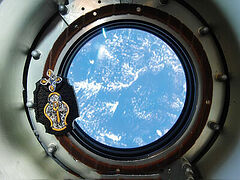
In a period brief by earthly standards, the Church of the Transfiguration of the Lord in Star City has acquired many sacred treasures. Some of them have traveled into space and orbited the Earth. Altogether, the church houses particles of the relics of more than one hundred saints of God.
 Church of the Transfiguration of the Lord in Star City
The establishment of the Church of the Transfiguration of the Lord marked a new stage in the development and spiritual revival of Star City. Under the spiritual care of the brethren of the Holy Trinity-St. Sergius Lavra, a strong Orthodox community has taken shape here, bringing together not only cosmonauts and employees of the Cosmonaut Training Center, but also residents of Star City, who labor with love for the glory of God and undertake various parish obediences according to their abilities.