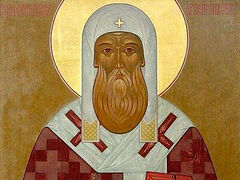
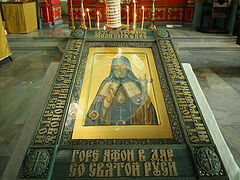
On August 7/20, the Russian Orthodox church commemorates the uncovering in 1832 of the relics of the Holy Hierarch Mitrophan (also spelled Mitrofan, Metrophanes), in the great schema, Macarius (Makary), Bishop of Voronezh and Yelets.
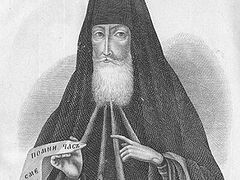
 St. Mitrophan
The future saint was born in 1623 in the village of Antilokhovo, Vladimir province (now in the Ivanovo region), into the pious family of Priest Vasily and his wife Maria. The parents named the boy Mikhail in honor of the holy Archangel Michael. His father was a rural priest. Mikhail spent his childhood and adolescence right at his father’s church. As the saint later wrote of himself in his Spiritual Testament, he was “born into this world of pious parents and raised in the unshakable piety of the Eastern Church in the Orthodox faith.” Afterwards, following his father’s example, he married and was ordained priest. Priest Mikhail’s place of ministry was the Church of St. John the Baptist in the village of Sidorovskoye (now in the Ivanovo region). He served as a priest until the age of forty, when his wife passed away. He tenderly loved his only son, and for his flock he was a good shepherd who gave his life for the sheep (Jn. 10:11).
Widowed, in 1663 Fr. Mikhail moved first to the St. Nicholas-Shartoma Monastery,1 and then to the Holy Dormition Zolotnikovskaya Pustyn Monastery, which was famous at that time.2 There, he took monastic vows with the name Mitrophan in honor of St. Metrophanes of Constantinople. In this beloved monastery, the newly tonsured monk devoted himself to monastic labors, humbly performing his obediences, fasting strictly and praying with zeal. He struggled there for only three years. Word of his strict, ascetic and virtuous life spread beyond the monastery. At that time, the brotherhood of the Monastery of St. Cosmas of Yakhroma3 had lost their abbot and petitioned the Church hierarchy to appoint Fr. Mitrophan their abbot and spiritual father. The future saint humbly accepted this appointment as God’s will for him. Becoming abbot of the monastery, he ruled it in the spirit of piety for ten years. In the first year of his abbacy, a beautiful, richly decorated Gospel book appeared at the monastery, where it is kept to this day.
In 1675, His Holiness Patriarch Joachim, who knew Fr. Mitrophan as a devout and charitable servant of God, appointed him abbot of another monastery—on the River Unzha,4 elevating him to the rank of archimandrite. At that time, the monastery was famous and under the patronage of the Romanov Dynasty. Under Archimandrite Mitrophan, a new church was built at the monastery, generously adorned with utensils and icons. The abbot especially venerated St. Macarius of Yellow Lake and Unzha, whose relics rested (and still rest) at the monastery. At the end of his life, he took the great schema with the name Macarius in honor of this saint.
But for now; on April 2, 1682, Archimandrite Mitrophan was consecrated Bishop of Voronezh. This took place at the wish of Tsar Theodore (ruled from 1676 to 1682), who favored the pastor. The diocese of Voronezh was new and poor, established for the most part to combat the spread of the Old Believers. At that time, the land of Voronezh was troubled because of the “bespopovtsy” (priestless Old Believers), involuntary settlers from other places, and the local people with lax morals. The task of restoring order in the diocese was a serious challenge for the saint.
Arriving in the diocese, the saint first of all sent a message to the clergy, which read: “Honorable priests of the Most High God! Leaders of Christ’s flock! You must have bright, intelligent eyes, guided by the light of understanding, to lead others on the right path. By the word of the Lord, you must be the light itself: Ye are the light of the world (Mt. 5:14)… When entrusting the holy Apostle Peter with the tending of His sheep, Christ the Savior said to him three times: Feed My lambs (Jn. 21:15). This is obviously so that pastors may tend the flock entrusted to them in a threefold manner: by the word of teaching, by prayer, and by the power of the holy sacraments, and finally, by their way of life. Diligently perform these three types of ministry: Teach the people the word of instruction, show an example of a good life in yourselves, and fervently offer up prayers to God for the flock entrusted to you, strengthening them with the Holy Mysteries; and above all, enlighten the unbelievers with Holy Baptism and bring those who have sinned to repentance. Take good care of the sick to ensure they do not depart from this life without partaking of the Holy Mysteries and the anointing with holy oil.” This message shows how merciful St. Mitrophan was to his flock and how zealous he was in his ministry. By his example, he tirelessly instructed believers in faithfulness to the teachings of the One Holy Apostolic Church.
Caring about the moral and spiritual state of his flock, the holy archpastor paid great attention to ensuring that people lived in chastity and entered into Christian marriage according to all the canons, as unlawful marriages were widespread. Clergy and churches were critically lacking in the vast diocese. Even with limited diocesan funds, the saint built many new churches, including the five-domed Cathedral in honor of the Annunciation of the Most Holy Theotokos in the city of Voronezh. The Romanov family helped him in this pious endeavor. The cathedral was magnificently adorned. Under St. Mitrophan, two new monasteries were opened in the diocese. The Bishop of Voronezh also took special care of the discipline of monastics, as monasticism in this area had been in decline before him. Under him, a convent was established in the city of Yelets (now in the Lipetsk region) and a strict life in accordance with the Typicon was instituted.
St. Mitrophan also established good relations with Tsar Peter I the Great (ruled from 1682 to 1725). In the 1690s, the Tsar began building a shipyard in Voronezh for his campaigns against the Ottoman fortress of Azov. Diocesan funds helped the monarch in this task, earning the saint the title “of Azov”, later changed to “of Voronezh and Yelets”. The sovereign esteemed the archpastor, who enjoyed royal favor until his repose. The Bishop of Voronezh also supported Peter the Great in the idea of founding a new capital on the banks of the Neva River. He blessed the Tsar with the Kazan Icon of the Mother of God with the words: “It shall protect the new capital and all your people. No enemy shall step foot into the city as long as this icon is there.” Subsequently, the Cathedral in honor of the Kazan Icon was built in St. Petersburg; and St. Mitrophan is unofficially considered the godfather of this city.
 Bishop Mitrophan visits the Tsar
St. Mitrophan served in the Diocese of Voronezh for twenty years. He lived a very simple and unworldly life, eating and dressing modestly. After his repose, no personal money remained even for his funeral. In his Spiritual Testament the saint wrote: “And I have no money in my cell... I keep neither gold nor silver to give for prayers for the memory of my sinful soul.” As a true monk, he always kept the remembrance of death. In August 1703, the saint felt his approaching death and took the great schema with the name Macarius. He fell asleep in the Lord in November of that same year. Tsar Peter I himself carried the coffin with his mentor’s body, saying: “I no longer have such a holy elder. May his memory be eternal.”
In 1831, St. Mitrophan’s relics were found incorrupt. The following year, the Bishop of Voronezh was canonized. His relics were kept at the cathedral in a cypress shrine. His mantle (mantiya) was kept there as well; it was placed over the sick, and they were healed. In the Soviet era, the monastery in Voronezh was closed and looted. In 1919, the Soviet authorities carried out a blasphemous opening of the saint’s relics to “put an end to the priests’ tall tales about holy relics.” The monastery’s brethren and the faithful wept as they watched the events unfold, powerless to stop them. The godless authorities made an inventory of the relics, designating them as “socialist property”. Starting in 1929, the holy relics of St. Mitrophan were kept at the Voronezh Museum of Local Lore for several decades. Only in 1989 were they returned to the Russian Church, and today they rest at the Holy Annunciation Cathedral of Voronezh.
Believers of the twenty-first century continue to honor the memory of the good pastor, St. Mitrophan of Voronezh. Thus, in 2024, a monument to St. Mitrophan and Emperor Peter the Great was unveiled in the center of Voronezh. As the governor of the Voronezh region stated during the ceremony, “the erection of the monument serves as a reminder of the values that St. Mitrophan embodied—care for people, preservation of traditions, and charity. This place will become ... a symbol of the unity of a society striving for goodness and enlightenment.” In his Spiritual Testament, the saint left his followers the words that remain relevant for our contemporaries: “For every person, the rule of wise men is as follows: work hard, practice moderation, and you will be rich. Drink temperately, eat little, and you will be healthy. Do good, flee evil, and you will be saved... My brethren and children, love the Divine Scriptures and learn from them: reading the Scriptures is the opening of Heaven.”
Let us pray to St. Mitrophan with the words of the troparion to him: “Thou hast been a rule of faith and a model of meekness by thy word to thy flock, O humble-minded Father Mitrophan. Brighter than the sun thou didst shine in the radiance of the saints, adorned with the crown of incorruption and glory. Pray to Christ our God that our land and thy city may be saved in peace.”
Bibliography:
The Lives of Sts. Mitrophan of Voronezh and Tikhon of Zadonsk. The second, corrected edition. Moscow: Publishing House of the Sretensky Monastery, 2010.
Do Good, and Flee Evil. The activity of St. Mitrophan in the Voronezh Diocese / Archbishop Dimitry (Sambikin). Moscow: Publishing House Named after St. Ignatius of Stavropol, 2003.