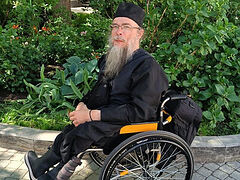
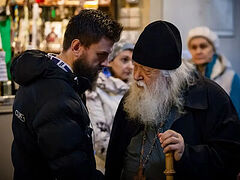
The faith of every man is written on his face. The rest is just words.
***
Christianity ends where the desire to punish another appears.
Whether we wish him death, imprisonment, sickness, or some kind of punishment, we must know that we’re no longer a neighbor to him, but an enemy.
***
All campaigns in which people were incited to demand punishment for someone, or “rights” for themselves, resulted in a de-Christianization of society.
We no longer live today in the world of mercy and non-condemnation brought by Christ, but amidst the crowd shouting: “Crucify Him, crucify Him!” If Christ forgave those who hammered nails into His palms and prayed for them, then who are we to demand punishment for people online whom we don’t even know?
God is the Judge, and non-judgment and non-condemnation are firm signs of faith in the coming recompense and the seal of humility with which we ourselves await judgment for our evil deeds, committed in knowledge or ignorance.
Forgive and you’ll be forgiven. A heart that’s quick to forgive is the only true confession of an Orthodox Christian. Everything else is teaching passed down orally.
***
Change begins with words, because In the beginning was the Word (Jn. 1:1). Adam was given the authority to name things. Through the names of things, we’re able to convey judgments about them. That’s how thinking is formed, and through thinking, we’re able to pass on knowledge.
Nowadays, we’re witnessing the renaming of things. For example, cunning and deceit are called “double standards,” betrayal is called “compromise,” God is being turned into “the universe,” and so on. All the key words have been swapped out in the “cult” language of the press, diplomacy, and business circles. By creating these new words and phrases, meaning is given to lies and evil, and people don’t even notice that they themselves are becoming fluent speakers of these new meanings.
The Church, in turn, has a language that was formed back in the time of the Apostles. This language also suffers attacks from the anti-Adam, who’s on the prowl to rename things in order to cloak lies with power.
The problem of the hidden meaning of words isn’t a matter of faith, but a matter of reason, without which no knowledge could be passed on. From the Greek philosophers to modern French poets, mankind has known and developed the science of the power of words, depending on their soul, origin, and semantic content acquired over time. The Germans even talked about the “enchantment of words” (Hugo Friedrich in The Structure of Modern Poetry). Therefore, replacing old words with synonyms just to make it easier to read (for whom?) is a dangerous and irresponsible thing, which, unfortunately, we see being done to the Orthodox heritage of the Romanian language.
A little diligence, a little love, a little curiosity can turn a few dozen old words and a handful of seemingly foreign linguistic formulas into a poetic and spiritual delight—one that lets us sense that we’re part of the rational flock whose journey began in Paradise, when Adam devised the first words to give names to things.
 Adam naming the animals
The end of the world will come not from the increase of sins, but from the inability to forgive. The distinguishing feature of a Christian is forgiveness. Among those who gathered to stone the woman caught in sin, there were many sinners, but Christ reproaches them not for their sins, but because they couldn’t forgive. He didn’t expose anyone publicly, and the All-Seeing Christ didn’t expose anyone’s sins.
He Who sees all sins didn’t reveal a single one, but we who see nothing speak of others’ sins with such pleasure… The stone we have to throw is our very heart. Petrification is the great and hardest sin to overcome, because a petrified heart can’t forgive.
Christ is born to teach us how to feel. He took on our body to awaken in it those feelings with which He experienced this world: cold, exhaustion, alienation, the fear of death. For our sake, He became, in our body, a stranger, hungry, sick, and even imprisoned, to teach us how to feel. To feel without a hint of the petrification we all suffer from. To have a sense of others as ourselves; to rejoice when they rejoice, and weep when they weep. That’s love. This is the meaning of God’s birth in our bodies. May Christ, God and Man, our Good Savior, be with us all!
***
Censorship is closely related to stupidity. The stupider the people in power, the stricter the censorship they impose. That’s why smart, intelligent, and kind people in any sphere eventually come into conflict with the system. That’s how it’s always been and it’s still the case today.
Why? Because the intellect is inclined towards knowledge. As stupidity is fed by ignorance, so intelligence is fed by knowledge. The most vibrant source of knowledge is intelligent people, with whom you can never talk enough.
Therefore, the intellect is dependent upon dialogue; it generates and consumes dialogue. But stupidity is exactly the opposite! Stupidity shuns dialogue, because dialogue reveals how stupid or how smart you are.
That’s why stupid people prefer to do the talking, to shout, to beat, to censor, and exile anyone who thinks. Because thinking itself is synonymous with freedom, while slaves have no need for thinking, since others think for them (isn’t that right?).
Whenever you don’t know the answer to a question, open a book instead of shutting the mouth of the person asking you.
***
If it’s necessary to demonstrate that such and such a person is bad, then even what’s good in him will seem bad. But if you have to demonstrate that someone is good, then even what’s bad in him will seem good. That’s how an idol-worshipper’s mind works. The idols that the pagans worshiped devoured their children in fire, constantly demanding ever more sacrifices from among their best people; but despite all this, the crowds worshiped and adored them.
Don’t look for meaning in idolatry, because the spell that takes power over idolatrous minds destroys any trace of meaning.
There is one Meaning, Truth, and Life, and He’s not of this world!
***
It’s clear that grace is being taken away from Christians when lies are increasingly taken for the truth, and the voice of those crying in the wilderness is drowned out by the crowd shouting: “Crucify Him!”
The word “flock” has never been more appropriate for people than it was then, in Pilate’s time, and now. But both then and now, blessed are the few who continue to stand at the Cross, and woe to the multitudes who merge with the stream of hatred!
***
But deliver us from the evil one (Mt. 6:13).
We ourselves guard against evil, but we must be delivered from the evil one. Cunning is evil appearing in the guise of good. There’s no greater evil than that which we perceive as good, for we have almost no time left to be delivered from such evil. That’s why we pray to the Lord to deliver us from the evil one, that is, from the evil we tend to confuse with good.
***
Wooden language is a set of words, easily recognizable and insistently used by political systems with the aim of creating a “new man”—obedient and fanatical—who is activated every time he hears the terms of wooden language.
***
The only really big problem is that we’re no longer united by like-mindedness.
Faith has become an occasion for discussion, not unity. It’s easier today to understand the meaning of the petition: “Having asked for the unity of the faith and the communion of the Holy Spirit, let us commit ourselves and one another and all our life unto Christ our God.”