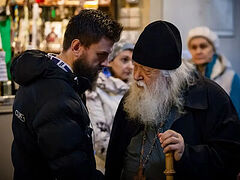
Schemamonk Panteleimon (Volkov) graduated from Moscow State University in his youth. He showed great promise as a scientist, but became a monk and went to Holy Mount Athos, where he has lived for twenty years now. Fr. Panteleimon talks about life on Mount Athos, Elder Nikolai Guryanov and other topics.
 Schemamonk Panteleimon (Volkov) —Father Panteleimon, when you were young, you received an excellent education at Moscow State University and took a postgraduate course. Why did you decide to abandon the world and become a monk?
—As a student I was ill for a very long time and underwent various operations. I was thinking about my future. Then my friend and I fell in love with the same girl. I went to Zalit (Talabsk) Island with him and another friend to visit Elder Nikolai Guryanov. At that time I had no idea just who Orthodox elders are. I went there after a serious operation and believed that I was going to die soon.
It was the Leavetaking of Pascha, 1998. When I approached Fr. Nikolai, he asked me, “You probably want to get married?” I looked at my friend and thought that if I said yes, he wouldn’t say anything. So I replied, “No, Father, I want to go to monastery.” He blessed me in a sweeping gesture and said, “I bless you.” Then my friend asked him about that girl. This was my starting point for becoming a monk. I was twenty-nine years old. The first monastery I went to, where I lived for a short time, was on Mount Athos. Afterwards I lived in that cell for twenty years. Then came the Pskov Caves Monastery, and another in the Ivanovo region.
—Please tell us about life on Mount Athos. How did it come to pass that you stayed there?
—I lived at a skete attached to the Simonopetra Monastery, namely in the Cell of St. Modestus of Jerusalem. It is called a “kathisma” in Greek. It has a church, monastic cells, and a small garden. It’s like a branch of a monastery. I arrived at the cell and received a blessing from the abbot, Hieromonk Avraamy (Orlov), to live there for six months. Six months later, Fr. Avraamy told me, “Stay.” I replied, “All right, father. I’ll stay.” And that’s it—I stayed there.
The right hand of St. Mary Magdalene Equal-to-the-Apostles is kept at the Simonopetra Monastery. It is always warm, maintaining a temperature of approximately 36.6 degrees Celsius. Interestingly, there are relics that exude fragrance. Myrrh flows from the relics of Greatmartyr Demetrius of Thessaloniki. Something resembling drops of dew accumulate on his relics, which lie in a glass sarcophagus. Then bishops and priests come, and people gather. They open the sarcophagus and collect this myrrh with pieces of cotton wool. 10,000 people gather, and then these pieces of cotton wool are distributed to all those present. There is also the skull of Greatmartyr Panteleimon at St. Panteleimon’s Monastery, which exudes fragrance as well. Every holy relic has a specific smell. It’s like roses, lilacs etc. They are they can’t be compared with anything else.
I remember my first winter on Mount Athos was snowy. There was a lot of snow: it was beautiful, like in Switzerland. Palm trees, cypresses, everything was covered in snow. Then that snow melted a little near us, by the sea, but remained on higher ground. It was fabulous! And, of course, the starry sky… The Milky Way, meteors—everything was visible. And silence. There were times when no birds, nothing could be heard—it was so tranquil. And you look at this sky…
—Perhaps the presence of God is felt very keenly at such moments … Or is it always this way on Mount Athos?
—No, not always. There is a spiritual law: When you come to some holy place, a church or a monastery, and you feel grace, you feel good there, it is a sign that there are very great temptations there. It’s the same on Mount Athos. First, the Lord gives you some “candy”, as if saying, “Look how good it is.” And when the “candy” is gone, He may not give you another one, in the sense that you must live by what you have experienced. Do you remember what that “candy” was like? And it will be the same in Paradise—it will be waiting for you there. Then temptations begin. And…
—They’re serious.
—Yes, very serious. I had a neighbor (now he is a monk) we with whom I shared a house. He struggled very zealously: he came to all services on time, performed all obediences and his prayer rule diligently. One ascetic labor is the struggle with sleep. He also struggled with sleep, and he was a real ascetic. And just imagine, one night (there were thin walls there) I heard him screaming in his sleep. And about five feet away, a gruff voice could be heard... I asked him the next day, “Do you experience it often?” He replied, “Yes. Sometimes demons throw me out of bed.” They bothered him. Unable to do him any harm directly, they sent people to do it, and he eventually had to leave. There are such temptations and demonic attacks. There’s also a jackal there. It is afraid of people, but it comes up to the door and starts howling around four in the morning right when you are sleeping soundly. And you jump up from fear.
Of course, there are also consolations on Mount Athos. But there is a very harsh climate there, and winds so strong that trees start breaking and falling apart. If it’s raining and windy at the same time, it’s a nightmare. But everything in our skete was fortified. Fr. Avraamy thought everything out very well and made a concrete road. We had a supply of drinking water as well. In general, water on Mount Athos is scarce and worth its weight in gold. If there is one or two rains over the summer in Greece, that is very good. There is usually a drought and no rain in winter or in summer. Then there are such wildfires that you can’t see the sun because of the smoke. And you can’t put them out, because there are a lot of olive orchards there. The olive tree is oily, and if it catches fire, it’s like charcoal. If you pour water on it, it will flame up even more.
What are one of the benefits of Mount Athos? There is freedom of thought there. You and I may have different political views and convictions, but nevertheless we do not try to make each other change our opinions. You have one point of view, I have another, but we are friends. Mount Athos is a spiritual school. Unfortunately, very few people read the Gospel in our country. But this is the main Book of this school, available also to laypeople.
—Is it easier to pray on Mount Athos than in our monasteries?
—It is the same.
—Is there the same struggle for prayer?
—Yes, maybe even more severe. What makes Mount Athos radically different from other places is that there is such a struggle with thoughts that... sometimes it leads to madness. Yes, you can go to your father-confessor every day to reveal your thoughts to him, but it doesn’t get much easier. You have to fight on your own, cutting off what comes into your head. Some of these thoughts are yours, while the enemy suggests others to you. For example, let’s take summer, for example. There are pleasure boats, ship cruises, pilgrims, and women who are not allowed to set foot on the Holy Mountain, but sail around it. They travel there and pray, and sometimes you can even hear them. And you sit and look at it all, thinking: “What am I doing on Mount Athos? Life is passing me by, slipping through my fingers. People live out there, but here I do nothing.” Do you understand? This is just one possible scenario.
 The Cell of St. Modestus of Jerusalem
—Are there such temptations at the initial stage?
—No. Everything is fine and you fly on your wings for the first two or three years. But gradually such a life pales for you, and the following thoughts appear: “I still have friends and siblings in the world. They share something with me, I keep in touch with them, and I have parents…” Thoughts about parents—you see? I know that some monks have left Mount Athos to take care of their elderly parents because there is no one else to do that. How can you abandon them?
In Russian monasteries, for instance, you can take your father with you, but it is very hard to do it on Mount Athos. We know that there was such a case with Sts. Simeon the Myrrh-Gusher and Sava of Serbia at Hilandar Monastery (they were a father and a son). But this was an exception. Therefore, of course, there is such a temptation. But if you are snowed under with obediences and work, or if you are passionate about something, these thoughts do not torment you so much. There is a very wise saying: fight fire with fire.
—Can you be passionate about your obediences? So it’s not always against your will?
—Certainly not. You are not always assigned something you dislike. Our abbot, Fr. Avraamy, sometimes gave me obediences. When I didn’t have time that day, I asked him: “May I finish it tomorrow?” He would reply jokingly, “You should have done it yesterday!” We had a lot of cats that fed on bread and dried crusts. I remember once, I was having a very hard time. I went up to him when he was feeding them. He looked at me and said, “Are you all right?” Fr. Avraamy was very thoughtful and didn’t break a novice’s will.
—Father Panteleimon, please tell us more about Fr. Nikolai Guryanov.
—He had a cell attendant, Schema-Nun Alexandra, who told me a lot about him. He loved his mother very much and was very keen to return to his native land—the Gdov district of the Pskov region. Once Mother Alexandra asked Fr. Nikolai’s blessing to leave his house for a while, but he wouldn’t let her go, saying she shouldn’t leave. She insisted, and in the end he surrendered and let her go, albeit without blessing her. He said, “Okay, go if you want.” When he blessed people, he always made the sign of the cross. Sometimes he would say, “Do as you want,” and that was the worst answer. So Mother Alexandra left, but when she came back, the new cell-attendant refused to let her inside. And there were already guards there.1
Someone told me how he once went to Fr. Nikolai. Arriving at his house, he saw the elder coming out, with all the birds around landing on his shoulders and head and “riding” on him as far as the church. Meanwhile, cats, dogs, and chickens accompanied him as well. As he went up to the church porch, the birds flew towards the roof, while the other animals remained near the church doors. After the service, they moved back in the same way. It was truly awesome!
You know, he had the ability… Every time I boarded the train to Pskov, I would realize that I had received answers to all my questions. There is a place from where all the boats go to Zalit Island—there is such grace in that place... The villagers come there to fish and other things. But in fact, they feel this peace and quiet, when one can hear what he needs to know.
I told one woman about Fr. Nikolai. After a while I wondered: “Have you been there?” She replied, “Not yet. But my daughter couldn’t bring herself to leave there.” She sat down next to his grave and “got lost”, becoming disconnected from this reality. He was certainly a great elder. I’ve been to Bari, Rome, Corfu, Georgia, and many places in Russia, but I’ve never seen anyone like Fr. Nikolai.
He was extremely clairvoyant. Clairvoyance is a natural property of a pure soul. I also saw his humility. Once there was a crowd of thirty to forty people, including priests, and he spoke to them first of all. Two women from Moscow, who were standing right next to him, couldn’t approach the elder. They started worrying and asked him loudly, “Father, can you come up to us and answer our question?” And what did he do? He came up and asked them humbly, “What’s your question?” They said something, and he answered with humility, calmly, and without any emotion.
Fr. Nikolai languished in prisons for his faith: first in the Kresty Prison in St. Petersburg, then in the forced labor camp in the Komi Republic. And he served a very difficult prison term in a place with an extremely high mortality rate. Afterwards he left for the suburbs of Leningrad, and then the Second World War broke out. He moved to his native lands; he crossed the lake in winter to Estonia and Latvia and struggled in the Baltic States. After a while, his mother wanted to return to the Pskov region. And so he went to Pechory, where St. Simeon (Zhelnin; 1869–1960) lived at that time. Elder Simeon blessed him to go to Zalit Island.
 Elder Nikolai Guryanov You can pray to Fr. Nikolai. Although the Church has not canonized him yet, it does not mean that he is not a saint. A saint is not a stamp (“we decide to canonize someone and then he becomes a saint”)—he was already a saint in his lifetime. Fr. Nikolai is like St. Simeon (Zhelnin) or Archimandrite Adrian (Kirsanov; 1922–2018) of the Pskov Caves Monastery.
I visited Fr. Adrian as well. He foretold everything to me. When I first came to him, I wanted to go to America. I had an option: to go either to Mount Athos or there. I asked him about it, and he answered, “No. My spiritual father didn’t allow me to go abroad to study, and I won’t allow you either. You’ll be infected with a lot of heresies there.” I said, “Father, may I go to Mount Athos then?” He replied,
“Which Mount Athos?”
“The Old One.”2
“You may go to the Old Athos.”
“How long may I live there?”
“As long as you can endure it.”
And then he added an interesting phrase: “You can live anywhere. As long as it is done out of love.” This applies to everyone, including laypeople.
—That is, laypeople should push themselves to ensure that everything is done out of love, say, in difficult life circumstances?
—Divine providence rules everything. Elders John (Krestiankin) and Adrian (Kirsanov) always said that God rules the world. Not a single process in the world is random. We need to be able to feel it inwardly. It’s like developing a ear for music.
—How can you develop this “ear for music” if you live in the world? There’s so much vanity, so many problems and worries everywhere.
—First and foremost, be vigilant towards yourselves and your lives. Do you ever have any moments of silence? In these moments, you can look back on your lives, at least a little. Experience comes from this, and experience, [worketh] hope (Rom. 5:4). And you begin to “read” Divine Providence, as if by syllables. The Lord called His followers “disciples”. These are those who learn something. What do we learn here?
—Love?
—I would say we learn eternal life here. Imagine that by a wave of the wand now we find ourselves in Paradise. And there will be people there whom we couldn’t stand or even absolutely detest. What’ll we do?
—We’ll put up with it somehow.
—But we must accept it already here on earth. Do you understand? We must humble ourselves before God for sending us these people and circumstances. That’s what life is all about. If you remove the bad and leave only the good, perhaps it won’t be life at all, but some surrogate. We often call “bad” what is unpleasant to our egos. But my “dear self” is probably very ill.
—Is this how God prepares us for Paradise?
—Surely. Everything here is just for Paradise—all meetings and events. Because Paradise is eternity, and we can be patient for its sake. St. Isaac the Syrian said: “Make peace with yourself, and Heaven and earth will make peace with you.” Come to terms with your life, that you have such a life, that you are like this—with your weaknesses. Because there’s nothing worse than pride. There are two things God cannot do in our stead: repent and be patient. As for everything else… He can help another person without us; He will feed him and do everything for him. Our prayers? But we read: For your Father knoweth what things ye have need of, before ye ask Him (Mt. 6:8). St. John the Baptist said, Repent ye, for the Kingdom of Heaven is at hand (Mt. 3:2).
—What is proper repentance for people living in the world?
—St. Sophrony (Sakharov) of Essex used to say this prayer, “Lord, save us fools, somehow.” And another saying often attributed to him is, “Lord, don’t put me where I’m not needed.” Just look at yourself from the outside. “Know yourself, and that will be enough for you,” as St. Ambrose of Optina used to teach. You won’t correct yourself. For example, if you have offended someone or put your foot in your mouth, then say, “I’m sorry—I didn’t mean to say this.” He’ll forget about it, and you’ll forget too.

—Do you mean that repentance is something simple?
—Even simpler. Learn from simple old village ladies. Whenever I visit Fr. Nikolai’s grave on Zalit, I see fishermen. They lead very simple lives and speak a simple language. As I look at them, I think: “If only I could exchange my shallow erudition for their simplicity!” Because the Lord gives to these people according to their simplicity. When you read the Scriptures, you can find the words “the righteous” and “the simple”. In the context of the Scriptures, they are almost synonymous. Such a person does not invent anything, does not lie, but lives in simplicity.
Christ said, Verily I say unto you, Except ye be converted, and become as little children, ye shall not enter into the Kingdom of Heaven (Mt. 18:3). Elder Nikolai, for example, could play with children and make jokes. I’ve never known any highly spiritual people, who don’t joke and laugh. Although they were very serious ascetics. This is a good property of the soul. Remember the words of St. Ambrose of Optina: “Where there is simplicity, there are angels in multiplicity; but where complexity has begun, there is not a single one.” Fr. Nikolai always reminded people of this.
—Thank you, Father Panteleimon!