We continue to introduce our readers to the previously unpublished answers of Schema-Archimandrite Mikhail (Krechetov; before monastic tonsure, Archpriest Valerian) to young people.
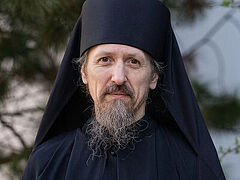
 Schema-Archimandrite Mikhail (Krechetov)
—Batiushka, when talking with children and teenagers at the church of a children’s hospital, I heard the following question: Why is the God of the Old Testament so “cruel”?
—In the Old Testament people were different from us today, and other measures were impossible in those cases. It is similar with other peoples—sometimes they were so depraved that they had to be destroyed to prevent this infection from spreading further. Now when people commit crimes, they are imprisoned. Then there were no prisons, while evil had to be isolated and stopped. We don’t know what the consequences would have been if the measures known from the Old Testament had not been taken—perhaps everything would have been much worse.
—It brings to mind parallels with modernity, with the current war…
—The main battle takes place inside each one of us. “Podvig is required for salvation,” said my spiritual father, Archpriest Sergei (Orlov; tonsured Hieromonk Seraphim). And for podvig you need courage. But people often misinterpret this concept, believing that those who perform certain heroic deeds have courage.
The great Russian military commander and generalissimo Alexander Vasilyevich Suvorov, who did not lose a single major battle, used to say: “If you conquer yourself, you will truly be invincible.” Do you know what he chose after retirement from his brilliant career? To help at the church. He became a reader, reading psalms and carrying the candle that symbolizes St. John the Baptist. And this was not at all because he couldn’t find any other way to apply his skills and strategic talents during periods of peace. He was actually among the greatest polyglots in the world; he reputedly spoke about forty languages. We can only marvel at how he found time for all this. Today, if you ask our children, they can’t even learn one language at school. Are they too busy doing something else? No, they don’t do anything at home either. Our generation worked much harder, and we had vegetable gardens to work in. When you work, you acquire skills and keenness of intelligence develops. And now they’ve invented the word “relax”. And they “have no time” to go to church. But, while a commander and leading the army, Alexander Suvorov would not miss a single church service and spoke so many languages. Enlightenment is from God.
—And “victory is given by God,” wrote St. Nikolai (Velimirovic) of Zica.
—Yes, even the best pagans were aware of that. Socrates asked his disciples: “What is true courage?” When they listed some valiant deeds, he would shake his head: “No, a courageous person is someone who is strong in the fight against cravings.”
There is a very vivid example in the Old Testament—the Assyrian military commander Holofernes of Nebuchadnezzar’s army of many thousands. He believed he could easily capture the Jewish town of Bethulia, but suddenly Judith, a young Jewish widow, appeared to seduce him on the eve of the battle—and Holofernes lost his head… First figuratively, and then literally—Judith beheaded him. Regardless of how great he was as a commander, he did not lay down his head on the battlefield, but shamefully on his defiled bed. And this is a lesson for all times: If you want to win, conquer yourself. This is what the Church teaches us, and the best soldiers and military leaders heed it.
—They were afraid of the title of a book of mine entitled, We Must Learn to Win with Love: it seemed “untimely” to them. And I like your example with the dandelion.
—Yes, once before Pascha, a benefactor asphalted a small area in front of the parish house at the Holy Protection Church in Akulovo. As Pascha approached, the sun warmed more and more. One day I went out, and lo and behold, tiny bumps had appeared on the freshly blackened asphalt area… One, two, three… And so the asphalt was “raised” and literally “broken through” by dandelions! It’s such a fragile flower, its tube is light green and so delicate, but it opened up this thickness rammed with heavy metal. Then it seemed to me that it was a symbol of love, which seems so inconspicuous and weak to everyone, but in fact has incredible inner power. Supernatural power!
—We should explain to young people what kind of love we are talking about—certainly not the one that toppled Holofernes. I recall the ever-memorable Archbishop Alexei (Frolov; 1947–2013) of Kostroma and Galich summarizing the Holy Fathers: “Grace is given through humility, which, in turn, is manifested by love” (I am citing from my book on him, Attain Love). Such love is the very power that depends on nothing in this world.
—In the book, The Tsar’s Testament, St. Nikolai (Velimirovic) relates how in his last moments on earth the holy Prince Lazar of Serbia (1329–1389) prayed to his guardian angel: “I am already on the threshold of death, but I still don’t know what to ask of God.” And the angel answered him: “From beginning to end, every day and every moment of your life you should ask for two things—the forgiveness of sins and the grace of the Holy Spirit.”
This is essentially the same thing that St. Seraphim of Sarov said to his young disciple Nikolai Alexandrovich Motovilov (1809–1879): “The meaning of Christian life is to acquire the grace of the Holy Spirit of God.” Although to do this, you must first purify the vessel into which the Spirit will enter. That is why we pray: Create in me a clean heart, O God; and renew a right spirit within me… Let the walls of Jerusalem be builded (Ps. 50:12, 20).
“The walls of Jerusalem” are an image of the regeneration of the temple of the soul. The whole temple of the body is desecrated, but it needs to be cleansed and prepared. When clergy receive Communion, a special prayer is recited in which there is a mention of the Heavenly Jerusalem. This Jerusalem above, prepared as a bride adorned for her bridegroom (cf. Rev. 21:2), was shown in the revelation to St. John the Theologian. It is into such a temple of a soul cleansed by repentance that the grace of the Holy Spirit enters.
 —And then a victory is given, a new great discovery is made, and a previously impossible accomplishment is achieved, right?
—All great people believe in God. Only the mediocre deny God. And all true men of genius are believers.
The celebrated German physicist Max Born, who was awarded the Nobel Prize, said: “Many scientists believe in God. Those who say that studying science makes you an atheist are probably ridiculous people.” He also noted: “Science has left the question of God completely open. Science has no right to judge this.”
Alexander Fleming, the great Scottish bacteriologist who discovered the effect of penicillin on bacteria, which saved countless lives, said at the ceremony where he was being honored: “You say that I have invented something; in reality, I just saw, I saw what the Lord created for man. The honor and glory don’t belong to me, but to God.” And all kinds of ignoramuses talk nonsense against God.
Dante Alighieri said: “I maintain that of all kinds of human bestiality the stupidest, meanest, and most harmful is to believe that there is no other life after this one; indeed, if we look through all the writings of philosophers and other wise authors, everyone agrees that there is something permanent in us.”
They say that “now we live, and one day we will be no more.” Yes, our bodies wear out, age, and eventually die. Is that the end? No! I personally communicated with, confessed, gave Communion to, and then buried a wonderful man named Vladimir Petrovich Sedov. He had two university degrees, in medicine and history. When I met him, he told me: “I’ve always been deeply religious; but now I don’t just believe, I know! I spoke with someone from another world just as I am talking with you now.” That’s a real fact. His relative, the holy Metropolitan Philaret (Drozdov) of Moscow and Kolomna, once appeared to him in reality. He came with a request: “Take care of my mother’s grave,” and he pointed out exactly how to find it and what needed to be done. At the end of their conversation he promised, “Anyone who hinders you will have to deal with me, and anyone who helps you will receive help from me.” Later, when Vladimir Petrovich was cowering before some Soviet official while fulfilling his holy relative’s instructions, St. Philaret appeared to him for a second time: “Who are you afraid of? We have decided. It will be on earth as we have decided!” And the official who had obstructed him died suddenly.

“It’s impossible!” that’s only what stupid people say. And all the great figures of science and art are absolutely religious. We’ve only named some scientists and writers here. And this is not to mention the illustrious statesmen glorified by the Church, such as the Right-Believing Princes Alexander Nevsky, Dimitry Donskoy, and others.
If I recall correctly, it was St. Silouan the Athonite who said that if someone who lives a spiritual life enters some area of earthly activity, he immediately becomes head and shoulders above his colleagues; spiritual life is so much higher than material life, and a spiritual person’s view embraces cause–and-effect relationships more broadly—things that secular specialists can’t grasp. But everything concerning the spiritual life and, above all, the true faith, is made taboo. Everything touching upon the spiritual life of scientists is hushed up as well. The truth is concealed from young people in particular.
Do many of the students of the Lomonosov Moscow State University know about the spiritual life of Mikhail Vasilyevich Lomonosov?1 Not likely. But he knew the whole Psalter by heart! 150 psalms! And he didn’t intentionally memorize them—he just prayed and read the Psalter regularly. Memory comes from God, but he himself treasured this sacred book. When someone has a spiritual disposition and pays primary attention to spiritual life, God gives him much more in all other areas.
The more spiritually enlightened you are, the more the talents given your soul by the Creator are revealed in you. Talents are given to everyone, but the question is whether you will bury them or let them reveal themselves with the help of God’s grace.