There is nothing in this world more loathsome than ingratitude, nothing more offensive or more destructive to the soul. For what could be more loathsome than the conduct of a man who remains silent about a good deed done to him, who seeks to bury it in oblivion? And what could be more vile than when a man repays mercy with mercilessness, faithfulness with faithlessness, honor with dishonor, and kindness with mockery? Such ingratitude rises like a black cloud between the ungrateful man on the one hand and the most pure Eye of Heaven on the other; for that Eye is Light itself, with no tint of darkness, and Goodness itself, with no tint of evil.
People can get angry at an animal for ingratitude, although the gratitude, sincerity, and faithfulness of animals often put men to shame. And what do men do for animals that might oblige them to gratitude? Almost nothing, apart from man’s calculated interest in giving little and receiving much. Despite the tenfold recompense with which animals repay men for all the care bestowed upon them, men expect gratitude from them as well. Still more indignant are people with an ungrateful person. For a man can render another an incomparably greater service than any animal can, but he can also experience incomparably greater ingratitude from another man than from an animal. In this world, gratitude acquires its true divine radiance—and ingratitude shows its true infernal hideousness—only in man, only within the human race. For no living creature in the world is capable of being either so grateful or so ungrateful as man. The more grateful a man is, the nearer he is to perfection. Gratitude toward all God’s creatures around him makes him a better citizen of this starry universe; gratitude toward his fellow men makes him a better citizen of human society; and gratitude toward the Creator of the universe makes him a worthy citizen of the Kingdom of God. But what are all the gifts of the universe and of all the people on earth that mortal man may receive, compared with the incomparable and innumerable gifts that he receives from God day and night? And what is all the gratitude that we owe to creatures and to men compared with the ineffable gratitude that we owe to God? For even all the good gifts that we receive from the world and from other people are, in truth, received from God through the world and through men. And how many other gifts does God bestow upon each of us directly, imparting them to our spirit without any intermediary, from birth—and even before birth—until the very hour of death! And with what gifts does our Lord Jesus Christ endow every baptized soul—with what spiritual treasures, what grace-filled power! To remain ungrateful for all this means not merely to forfeit one’s human dignity, but to sink lower than any animal; indeed, lower than any creature whatsoever, in the vast universe. Though He Himself had no need to do so, in order save the human race from falling into ingratitude, our Lord Jesus Christ often blessed and gave thanks openly to God before all (cf. Matt. 11:25; 14:19; 26:26–27). The holy Apostles did likewise, continually praising God (Acts 2:47) and thanking Him for blessings bestowed not only upon themselves personally, but also upon others. I cease not to give thanks for you (Eph. 1:16), writes the Apostle Paul to the faithful in Ephesus, while also instructing them to give thanks always for all things unto God and the Father in the name of our Lord Jesus Christ (Eph. 5:20). Likewise, following the example of the Apostles, the Church of God to this day ceaselessly offers praise and thanksgiving to God and continually exhorts her faithful never to forget, and never to grow weary of, thanking God for all that He sends them. There is no divine service that the Church does not begin with the words: Blessed is our God! And there is none that she does not conclude with the words: Glory to Thee, O Christ our God and our hope, glory to Thee! The Church does this so that the thought, the hymn, and the prayer of unceasing gratitude to God may be deeply imprinted upon the souls of the faithful, so that each may say of himself, together with David the Psalmist: His praise shall continually be in my mouth (Ps. 34:2).
Of all the examples of human ingratitude toward God, however, the darkest and most terrible is the ingratitude of the Jewish people toward our Lord Jesus Christ. The Lord Himself describes this example in today’s Gospel reading in the form of a prophetic parable—the parable of the householder and the wicked husbandmen. The Savior told this parable in the Temple in Jerusalem before the chief priests and elders of the people, shortly before His final sufferings and Crucifixion.
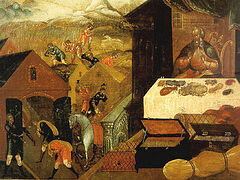
There was a certain householder, which planted a vineyard, and hedged it round about, and digged a winepress in it, and built a tower, and let it out to husbandmen, and went into a far country (Matt. 21:33). Just as elsewhere the Lord speaks of a certain king, so here He speaks of a certain householder, which planted a vineyard, thereby signifying the good Master of the House—that is, God. For however weak and humbled man may be in this world, God is not ashamed to call Himself a man. Despite everything, man is the foremost and most precious of all God’s creatures in the world. God therefore calls Himself a man in order to reveal both man’s superiority over every other creature in the world, and His own great love for mankind. Only the darkened minds of pagans and of those who had fallen away from God called God by the names of natural phenomena and created things: fire, sun, wind, water, stone, tree, and animals—but not by the name of man. The Christian faith alone has exalted man high above all created nature, and man alone has been granted the dignity of having the Most High Creator call Himself by his name. The vineyard signifies the people of Israel, chosen by God so that through them the salvation of the entire human race might be accomplished. God Himself calls the people of Israel His vineyard (cf. Isa. 5:1). The hedge surrounding the vineyard signifies the laws given by God to His chosen people, separating them like a wall from the other nations. The winepress signifies the promise of the coming Messiah, the true Savior of mankind—the promise from which God’s chosen people quenched their thirst throughout the centuries as from a life-giving fountain. The Lord Jesus Christ calls Himself such a life-giving fountain when He says: If any man thirst, let him come unto me, and drink (John 7:37; cf. John 4:14); and, he that believeth on me shall never thirst (John 6:35). The tower signifies the sacrificial Temple of the Old Testament, which prefigured the Holy Church of God after the coming of Christ. Both the Lord Himself (cf. Matt. 16:18; 21:42) and the Apostles (cf. Eph. 2:20) liken the Church to a building. The husbandmen signify the elders of the people, the chief priests, and the teachers. And what is meant by the words went into a far country? Can God truly depart and withdraw from His people? On the one hand, this means that having ordered and provided everything necessary for man’s salvation, God left men free to use all His gifts for their own salvation. On the other hand, His departure signifies God’s patience toward human sins and toward the foolish deeds by which men foil their own salvation—the patience and longsuffering of God, which surpass all human understanding.
And when the time of the fruit drew near, he sent his servants to the husbandmen, that they might receive the fruits of it (Matt. 21:34). Just as an ordinary landowner sends his servants at the appointed time to receive the fruit from the husbandmen, so God sent His servants, His chosen ones, to the people of Israel to seek the spiritual fruit of all that God had entrusted to that people to cultivate. The servants of God are the prophets, while the fruits of the vineyard are all the virtues that spring from obedience to the law of God. He sent His servants to the husbandmen—that is, first and foremost to the elders of the people, the chief priests, the scribes, and the teachers, who above all others had been called to instruct the people in the law of God, both by word and by example, and who were accountable before God both for themselves and for the people. For they had been given greater authority and greater wisdom, and unto whomsoever much is given, of him shall be much required. These rulers and leaders of the people, if for no other reason, then at least out of gratitude to God, should have received God’s messengers with the same reverence and love with which they would have received God Himself. But what did they do?
And the husbandmen took his servants, and beat one, and killed another, and stoned another (Matt. 21:35, KJV). See how men repay good with evil! See the black ingratitude of man! The prophets reminded the elders of the people of the law of God, the will of God, and the benefactions of God. The prophets proclaimed the saving power, beauty, and sweetness of God’s law, demanding that it be put into practice in the life of every individual and of the whole nation. In God’s name, they sought good works as the fruits of the divine law. But they found no such good works and came away empty-handed, like laborers who enter a vineyard to gather the harvest but find no grapes. And the elders of the people did not merely send them away empty-handed; they seized them, mocked them, reviled them, beat some, killed others, and stoned still others. Thus, for example, the Prophet Micah was beaten, Zechariah was slain before the altar, Jeremiah was stoned, Isaiah was sawn asunder, and St. John the Baptist was beheaded with the sword.
Again, he sent other servants more than the first: and they did unto them likewise (Matt. 21:36). These other servants were also prophets. The more God’s chosen people became corrupt and fell away from Him, the more prophets the merciful God sent to admonish them and rebuke their elders, lest they all perish like fruitless branches on the vine, which are cut off and cast into the fire. Yet these servants of God accomplished no more than the first. The elders of the people, the chief priests, the scribes, and the teachers likewise beat, killed, or stoned them. And the further God’s longsuffering extended, the greater and more loathsome became man’s ingratitude toward God.
But last of all he sent unto them his son, saying, They will reverence my son (Matt. 21:37). All God’s servants had been dishonored, all His admonitions rejected, all His benefactions despised. Human patience would long since have been exhausted. But God’s patience exceeds even that of the most patient physician treating a madman. For a tenth part of such ingratitude, men would have answered with an iron fist. But behold how the compassionate God acts—instead of an iron fist, He sends His Only-begotten Son! O inexhaustible goodness of God! Even the best of mothers could not show her own child as much mercy and patience as the Living God has shown toward the men whom He created.
But when the fulness of the time was come, says the Apostle, God sent forth his Son (Gal. 4:4). That is, when the fullness of time had come to await fruit from Israel; when the evil and lawlessness of the elders of the people had reached their fullness; and, finally, when the fullness of God’s patience had come. When the vineyard seemed scorched with blight, when the hedge around it had been broken down, when a pagan flood had poured into the vineyard, when its winepress had run dry, and when its tower had become a den of thieves—then suddenly the Son of the Householder, the Only-begotten Son of God, came into the vineyard. God knew beforehand that the husbandmen would have no more reverence for His Son than they had shown for His servants. Why, then, does He say, They will reverence my son? He says this to put us to shame—us who even today fail to receive the Son of God with the reverence and love that are His due. And He says it also to reveal the depths of shamelessness to which human ingratitude had sunk among the chosen people, upon whom God had bestowed so many mercies. Hear, then, to what abomination this God-hating shamelessness and forgetfulness of God descended.
But when the husbandmen saw the son, they said among themselves, This is the heir; come, let us kill him, and let us seize on his inheritance. And they caught him, and cast him out of the vineyard, and slew him (Matt. 21:38–39). What a perfect picture of what was soon to happen to our Lord Jesus Christ! Just as the wicked husbandmen killed the householder’s son in order to seize the vineyard, so the Jewish chief priests, Pharisees, and scribes killed our Lord Jesus Christ in order to keep the people entirely under their own authority. What do we? the leaders of the Jewish people deliberated among themselves. If we let him thus alone, all men will believe on him (John 11:47–48). And at the counsel of Caiaphas they resolved to kill Him. All the experience of a thousand years had taught them in vain that it is impossible to destroy a man of God by killing him; for once slain, he becomes more alive than before, poses a still greater threat, and awakens still sharper pangs of conscience. Their fathers had slain so many of God’s prophets—and afterward they were compelled to build tombs and monuments to them. Compelled, because after death the murdered prophets became more terrible to them than they had been while alive. They had eyes to see, yet they could not see. They had minds with which to remember what, over the course of a thousand years, had happened to those who were slain and what had happened to their murderers, yet they learned nothing from it and could remember nothing. Come, let us kill him. The easiest of human solutions—and the most futile—from Cain to Caiaphas, and from Caiaphas to the last murderer upon earth! To kill a righteous man is merely to send him back to God, from Whom he came. And this, in turn, means giving him an impregnable position in the battle, arming him with invincible weapons, and making him a thousand times stronger than he was when he walked the earth in the flesh. What more can be said? To kill a righteous man is to help the righteous man to victory while condemning oneself to defeat and ultimate destruction.
What did Caiaphas, the Jewish high priest, know if he did not know this? Less than nothing; for had he simply known nothing, even then he would not have dared to kill Christ and thereby cast—not Christ, but himself—into eternal perdition. Come, let us kill him. “For all the people are going after Him,” they said. “We are left alone—without authority, without honor, without money. Who will serve us? Who will praise us? Whom shall we deceive? From whom shall we extort? Therefore, come, let us kill Him and seize His inheritance: the people, our vineyard, which we possessed before, enjoying its fruits ourselves.” The wicked husbandmen quickly carried out their decision. And they caught him, and cast him out of the vineyard, and slew him. See how Christ foresees down to the smallest detail everything that will happen to Him. All the Evangelists relate that the Jews led Christ out of the city to the place of execution, Golgotha, which lay outside the walls of Jerusalem. This is what is signified by the words: Cast him out of the vineyard. But these words also mean that the Jewish elders would reject Christ, cut Him off from the people of Israel, disown Him as an Israelite, cast Him beyond the bounds of their nation, and hand Him over to foreigners as though He Himself were a foreigner.
When the lord therefore of the vineyard cometh, what will he do unto those husbandmen? (Matt. 21:40). Thus our Lord Jesus Christ questioned the elders of the people. When the lord... cometh, He says, whereas at the beginning of the parable He said that the householder went into a far country. The words when the lord… cometh signify the end of the householder’s patience. When God’s patience comes to an end, His wrath begins. But whom does our Lord Jesus Christ mean here by the Householder—Himself or His Father? It makes no difference. I and my Father are one (John 10:30). The essential point is that both God’s patience and the insolence of the husbandmen would soon come to an end after the murder of the Son of God.
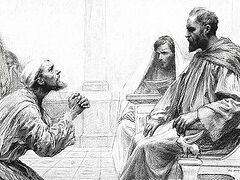
What will the Householder do to these wicked husbandmen? Who asks this question, and when? It is the Householder Himself who asks the wicked husbandmen. The One condemned to death questions His judges and murderers. How terrible is this conversation between the One who is to be slain and those who will commit the crime! Ordinarily, men condemned to death are confused and scarcely know what they are saying, while their judges—if they are righteous—remain calm. Here the situation is entirely reversed. Knowing the secret decision of the elders to kill Him, Christ is calm and knows exactly what He is saying, while His unrighteous judges are confused and do not know what they say. Thus every evil deed deprives a man of two things: courage and reason.
They say unto him, He will miserably destroy those wicked men, and will let out his vineyard unto other husbandmen, which shall render him the fruits in their seasons (Matt. 21:41). See—they do not know what they are saying! They pronounce sentence upon themselves! According to the Evangelists Mark and Luke, these words were spoken by the Lord Himself. But from the Gospel according to Matthew it is clear that the Lord asks them to say what they think. Since there can be no contradiction between the Evangelists, it is most likely that the Lord first said what the owner of the vineyard would do with the wicked husbandmen and with his vineyard, and then asked them for their opinion. At first they confirmed what the Lord had said and agreed with Him; but immediately afterward, as though realizing that it referred to them, they cried out, as St. Luke records: God forbid! How clearly this reveals their confusion and inconsistency! But who are these other husbandmen to whom the owner will entrust the vineyard? First of all, we must understand that not only the husbandmen, but the vineyard itself will be new. From the time of Christ’s earthly life onward, God’s vineyard will extend to the whole human race and will consist not only of the people of Israel, but of all the nations of the earth. This new vineyard will be called the Church of God, and its laborers, or husbandmen, will be the apostles, hierarchs, fathers and teachers of the Church, martyrs and confessors, bishops and priests, pious and Christ-loving kings and queens, and all the other servants of this vineyard of the Lord. They shall render him the fruits in their seasons. After the coming of Christ, they will become a chosen generation, a royal priesthood, an holy nation (cf. 1 Pet. 2:9). For with the coming of Christ the chosenness of the Jewish people comes to an end and passes to all who believe in Christ from among all the nations of the earth.
God forbid! Thus said the wicked husbandmen to the Son of God when they realized that this terrible parable referred to them. Without these words, recorded by the Evangelist Luke, there would be a gap in Matthew’s account, for it would not be clear why the Lord then said what follows. But after these words of the Jewish elders, Christ’s reply is perfectly understandable: Did ye never read in the scriptures, The stone which the builders rejected, the same is become the head of the corner: this is the Lord’s doing, and it is marvellous in our eyes? (Matt. 21:42). The Stone is undoubtedly Christ Himself; the builders are the Jewish elders, chief priests, and scribes; and the corner is the union of Israel and the Gentiles, of the Old Testament election and the new, of the Old Testament Church and the New Testament Church. Christ stands at this corner, at the end of the old and the beginning of the new. He calls both Israelites and Gentiles into His Kingdom with equal love, for at the time of His coming both had shown themselves to be barren fig trees. This was especially true of the Israelites, for they rejected Him as builders reject a stone they consider useless. How grievously the builders were deceived! They rejected the chief cornerstone of human life, of human history, and of the history of the entire created world! In truth, they did not reject Him, but merely attempted to reject Him—and were themselves rejected; while He was established as the head of the corner of a new building, a new creation. This is the Lord’s doing, and nothing could be wiser or more righteous. It is marvellous in our eyes. That is: when you read the Holy Scriptures (cf. Ps. 118:23), even to you it seems that this is from the Lord and is marvelous, because you do not know to Whom these words refer. You do not know how terrible this Stone is. For whosoever shall fall upon that stone shall be broken; but on whomsoever it shall fall, it will grind him to powder (Luke 20:18; cf. Matt. 21:44).
And truly the stiff-necked Jews were broken upon this Stone, and it ground them to powder. They stumbled over Him as over a stumbling stone, and were broken, even while our Lord Jesus Christ was still upon the earth in the flesh. Later, after His Crucifixion and Resurrection, this Stone fell upon them and crushed them. For soon after the wicked husbandmen had killed the Son of the Householder, the Roman armies under Titus attacked Jerusalem and destroyed the city, and the Jews were driven from their homeland and scattered throughout the world. And to the Jews befell something worse and more terrible than what had befallen the Assyrians, Babylonians, Phoenicians, Egyptians, and other peoples who sinned and perished in their sins. Something happened to the Jews resembling what had happened to Cain. For God permitted no one to kill Cain, but set a mark upon him as a murderer and drove him away to be a fugitive and a vagabond... in the earth (Gen. 4:12). But Cain suffered severe punishment immediately after the first evil deed he committed, whereas the Jews did not. They killed and stoned the prophets of God, one after another, yet God was patient, postponing punishment, awaiting repentance, and sending them ever more prophets. Only when they had killed the Savior did righteous punishment overtake them. Sometimes God punishes the transgressor immediately; at other times He postpones and postpones punishment, so that men begin to think that punishment will never come and that the transgressor will remain unpunished. When Miriam, the sister of Moses, spoke against her brother, she was suddenly covered with leprosy over her whole body: and, behold, Miriam became leprous, white as snow: and Aaron looked upon Miriam, and, behold, she was leprous (Num. 12:10). When Dathan and Abiram rebelled against their elders, the earth beneath them split open and swallowed them up: And the earth opened her mouth, and swallowed them up (Num. 16:32). Ananias and Sapphira appropriated and concealed property belonging to the Church, and therefore immediately fell down dead (cf. Acts 5:5).
But God does not punish every transgressor immediately. Quite the contrary, the greater part of crimes and sins are punished not immediately after they are committed, but later, or even after the sinner’s death. God’s punishment for sin is sent according to His all-wise providential ordering of this world. If God did not punish certain sinners immediately after they had sinned, we would despair of seeing God’s justice; but if God did not patiently postpone the punishment of other sinners, how would we learn patience toward those who wrong us? Finally, the fact that God does not punish certain hardened sinners during their earthly lives serves to strengthen us all in our faith in the future Judgment of God, which will not pass by even the sinner who has escaped every earthly judgment. Woe to him who enjoys his sins with impunity until the very hour of death! Do not envy him! He has already received what he desired in this life, and in the life to come there remains nothing for him to receive but condemnation. If our Lord Jesus Christ, though without a single sin, suffered so terribly and endured such torments, how can any of us sinners whom God loves even in the least expect not to suffer? But he who sins greatly and suffers not at all bears not the slightest resemblance to Christ, and therefore will have no part with Him in the Kingdom of God. Let us have fear, if our whole life passes without affliction and suffering, while we remain burdened with many unrepented sins. Let us rejoice if we have endured many afflictions and sufferings and have profited by them, repenting before God and amending our ways. And let no one say or think: “Since God is so longsuffering, I can postpone repentance. If He bore so long with the Jews, He will bear with me for another year or two.” Let us not deceive ourselves. In His Providence, God may indeed bear with our impenitence for another year or two; but He may also lay His heavy hand upon us in an hour or two—or in a minute. When repentance is postponed, it becomes more and more difficult, for the habit of sin takes ever deeper root within us, increasingly darkening our mind and hardening our heart. Then, even against our own will, we pass from grievous sin to sins more grievous still, like the wicked husbandmen, who first slew the prophets and finally slew the Son of God Himself. And what then can we expect for ourselves other than what befell the wicked husbandmen? The Cornerstone appointed by God for the house of our salvation will rise above our heads and crush us. For the Lord, mighty in mercy, is mighty also in justice.
Let us therefore hasten to make use of His mercy while it is still being poured abundantly upon us. Let us not wait until the hand of mercy is withdrawn from us and the hand of justice descends upon us. Let us not postpone the cultivation of the vineyard of our soul, so that when the servants of the Householder come, we may without delay give them the fruits we have grown and gathered. Every day the Angels of God gather the souls of men and bear them away from this world, as harvesters gather clusters of grapes from a vineyard. Our turn will not pass us by. O, may our fruits not prove “rotten”! O may our souls not prove barren! Guardian Angels, instruct us, strengthen us, and help us before the final hour strikes! O Lord Jesus Christ, have mercy upon us! For unto Thee are due honor and glory, together with the Father and the Holy Spirit, now and ever, at all times, and unto the ages of ages. Amen.