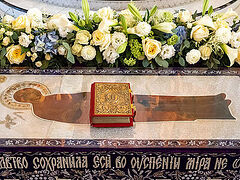
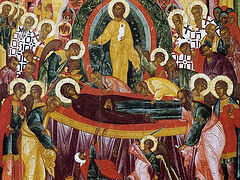
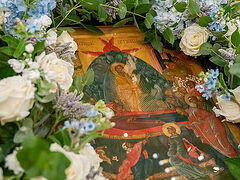
Dormition of the Blessed Virgin Mary. A fragment. Russia, XVI century
Every year at the end of August, the Orthodox world is immersed in the experience of an event that at first glance seems paradoxical. We celebrate death
Every year at the end of August, the Orthodox world is immersed in the experience of an event that at first glance seems paradoxical. The churches are decorated with flowers, the vestments change to blue, and the center of attention is… a coffin. We celebrate death. The day when the Mother of God Herself finished her earthly journey.
For a secular consciousness raised on the cult of youth, health and endless progress, this seems insane. Death is taboo, a topic that is usually avoided. And suddenly religion calls the day of death “Pascha,” “joy,”and “holiday”. It is in this apparent contradiction that the essence of Christianity is hidden, which not only speaks of the immortality of the soul, but also sanctifies matter itself, the body itself, and dares to call death sleep.
The puzzle of the name: why “Dormition” and not “death”?
The English word “Dormition” comes from the Latin word, “dormitionis”, which means, “to fall asleep”. This is the key to understanding the event. We do not say “the death of the Virgin” in the sense that we speak of the death of an ordinary person stricken with sin. We say she fell asleep.
To understand the difference, you need to turn to Christian anthropology. Death as we know it is the result of Adam's fall from grace. This is a rupture, a tragedy, a violation of human nature. God did not create death. Death entered the world as a parasite, as a punishment for falling away from the Source of Life. Death is terrible, because it separates the soul from the body, destroys the integrity of a person, and plunges him into corruption.
However, with the coming of Christ the Savior, the nature of death changed. Christ descended into hell and overcame it, and for those who are in Christ, death is no longer a dead end. It became a door. The door through which a person passes from the vale of sorrow to the Hall of Light.
And if for most people burdened with passions and unresolved questions, death is still a painful transition, often associated with fear and struggle, then for One Who was purer than the Cherubim, death was precisely “Dormition”—a quiet, peaceful sleep, passing from the hands of her Son to the hands of her Son.
Life as waiting before a meeting
Church Tradition has preserved details of the last days of the Virgin. After the Ascension of Christ, She lived in Jerusalem, in the house of the Apostle John the Theologian. Her life was one long prayer, waiting for a meeting. When the Archangel Gabriel, the one who had preached the birth of the Savior to Her, appeared and announced Her imminent departure, she wasn’t afraid. She was glad.
For Her, death was not an enemy, but a long-awaited friend who leads her into the arms of the One She loved more than life
Why was she glad? Because for Her, life without Christ was not life. She went through the agony of her Son’s cross. She stood at Golgotha, and a sword passed through Her soul, as the righteous Simeon prophesied. After the Resurrection of Christ, Her life on earth was a life of waiting. And now, the hour had come. For Her, death was not an enemy, but a long-awaited friend who leads her into the arms of the One She loved more than life.
This is a profound lesson for modern man. We are afraid of death because we live in the wrong way. We didn’t have time to love, we didn't have time to forgive, we didn’t have time to repent. We have too many “loose ends”. Death scares us like a sudden exam for which we are not ready. The Dormition shows someone passing the exam with the highest marks and flying colors.
The Deathbed as a Stairway to Heaven
Church Tradition preserves the miraculous details of this event. The apostles, who were scattered all over the world to preach the gospel, were miraculously transported on the clouds to Jerusalem to bid farewell to the Mother of God. There is a deep theological meaning hidden here.
The apostles are the image of the Church. They gathered around Her bed as children gather around a dying mother’s bed. But they did not weep inconsolably. There was light in the upper room. The Lord Jesus Christ himself, surrounded by a host of angels, appeared to receive the soul of His Most Pure Mother.
The iconography of the holiday depicts this moment with amazing power: Christ stands at the bedside and holds in his arms a small figure swaddled in white. This is the soul of the Virgin. The soul that gave birth to God is now being born into eternity.
Dormition of the Mother of God. A fragment. Russia, XVI century
The icon also contains the tragedy of unbelief: the episode with the Jewish priest Athonias, who tried to overturn the burial pier to insult the body of the Theotokos, and was punished by an angel who cut off his hands. He repented and was healed. This is a reminder to all: The grace of God can touch even the most hardened heart; but woe to those who encroach on holy things.
But the most amazing miracle happened on the third day. The Apostle Thomas, providentially late for the burial, grieved that he had not been able to say goodbye. The apostles opened the coffin for him… and found no body. There were only burial cloths.
The Church does not dogmatize this as a fact of “ascension” in the Scriptures, but the faith of the people of God; and the liturgical texts clearly say: The body of the Mother of God was resurrected by the Lord and taken to Heaven.
Why did this happen? Because this body was the source of life for the whole world. It contained the Uncontainable. It gave flesh to the Son of God. Such flesh could not fall prey to corruption.
This is the Christian’s greatest hope. If the body of the Virgin Mary, sanctified by the touch of God, has escaped corruption, then our bodies, united to Christ in the Sacrament of Communion, also contain the promise of the coming resurrection. We will not be disembodied spirits forever. We will be resurrected in new, transformed bodies. The Dormition of the Mother of God is an advance payment, it is the foretaste of our common Resurrection.
The Dormition’s lessons: What does this day teach?
The Feast of the Dormition does not allow you to relax in spiritual hibernation. It confronts one with some very tough and at the same time comforting questions and ideas.
What is a human?
We are used to self-deprecation: “I am a sinful person, I am weak.” But the Mother of God shows that man is able to contain God
Looking at the Mother of God, we understand the height of human vocation. We are used to self-deprecation: “I am a sinful person, I am weak.” But the Mother of God shows that man is able to contain God. Men can become gods by grace. The Holy Fathers said: “God became man so that man might become god.” The Dormition is the final point of this deification for the Virgin Mary. She went from a simple girl from Nazareth to the Queen of Heaven. So this path is open to everyone.
Humility is power.
What is the greatness of the Virgin Mary? In humility. She did not deliver loud sermons, write treatises, or perform miracles of her own will. She said, “Behold the Handmaid of the Lord; let it be unto Me according to your word.” And that was enough to change the course of history. In a world where everyone is fighting for power, for attention, for self-realization, the Dormition is a reminder of silence. God comes in silence. The death of the Mother of God was quiet, because Her whole life was quiet, filled with contemplation.
Preparation for a meeting.
In the Christian tradition, there is often a call to live as if every day is the last. But how many of us live like this? Dormition is the day when we look back on our lives. What if the Lord calls me today? Am I ready? Is there something holding me back? Resentment, envy, unrepented sins?
The Dormition Fast, which precedes the feast day, is a rehearsal for this transition. Believers fast, pray, and try to purify themselves. And on the feast day itself comes the realization: death is not darkness, but Light.
“In giving birth, thou didst preserve thy virginity…”
The divine service of this day is filled with amazing beauty, and the texts are profound. The troparion of the feast contains a paradox: “In giving birth, O Theotokos thou didst preserve thy virginity; in falling asleep, thou hast not forsaken the world…”
These words are the whole point.
The fear is not that we will die, but that we might die without Christ. The Dormition shows a death in which Christ is present
“In giving birth thou didst preserve thy virginity” is a miracle beyond the laws of physics. God was placed in the womb without destroying virginity. This means that nothing is impossible for God.
“In falling asleep, thou hast not forsaken the world”—that is the great joy of the feast. We don’t see Her off “to rest” like a museum piece. We don’t say goodbye to Her forever. She left, but she didn’t leave us. She became the Mother of all Christians. She stands at the Throne of her Son and intercedes for us.
The experience of the Church is the experience of the living presence of the Mother of God. It is not a memory, It is a reality. She is a Quick Hearer who hears every breath.
The icon of the Dormition is not an icon of parting, but of meeting. Christ came for His Mother. And He will come for each of us. The fear is not that we will die, but that we might die without Christ. The Dormition shows a death in which Christ is present. And if Christ is near, what difference does it make what is beyond the threshold?
Death as a homecoming
Man was created for Paradise, for living with God. We are exiles on this earth. The Dormition is a homecoming.
One day an old nun was dying. The sisters gathered around and wept. And as she lay on her deathbed, she smiled and said: “Why are you crying? I’m going home.”
These words hold the quintessential aspect of this feast day. Christianity sees life on earth as a business trip, and death as a return to the Father’s Home. The Mother of God went this way first, showing that the door of our house is open. Christ established this path through the Cross and Resurrection.
The Dormition is the Summer Pascha. We see the end of the path of a righteous woman. We see that death could not hold the One That bore Life. “Through the prayers of the unsleeping Mother of God and through the intercessions of the unfailing hope, the tomb and death will not hold.”
Death didn’t hold Her back. And if a man holds on to Christ, death will not hold him either
Death didn’t hold Her back. And if a man holds on to Christ, death will not hold him either
The Feast of the Dormition of the Theotokos is a call to collect treasures in heaven. In the daily hustle and bustle, in the pursuit of material things, in conflicts and anxieties, it is easy to forget about the main thing. But the day will come when everyone will have their own personal Dormition. Will we take our achievements, savings, and status with us? No. We will take only one thing—the state of our soul.
The Mother of God chose the “one thing that is needful.” She sat at the feet of Jesus and listened to His word. The Feast of her Dormition is a reminder that we should also stop, raise our heads from the ground and gaze at the heavens.
Today is not a day of mourning, but a day of hope. This is the day when the Church bears witness: Death is conquered, there is no separation, and with God all are alive. And if we learn to live this faith here on earth, then for us, too, death will not be a horror, but a dormition—a quiet, peaceful transition into the arms of the Loving Father.
Let this feast day become for all of us not only a beautiful celebration, but also a step towards the renewal of our own lives—towards greater love, greater humility and greater readiness to face Eternity.