In early 2013, I had just started working at Sretensky Monastery in Moscow. It wasn’t long before miracles began to happen. I had never had an international passport, and my meek attempts to get one at the dedicated government office quickly ended due to bureaucracy and long queues. In early spring, I had a clear thought, as if someone had clearly told me: “Get a passport.” The far-more-convenient My Documents service had already appeared, and I quickly and easily got my passport. And on the “summer” feast day of St. Nicholas, I found myself in Bari, even though I hadn’t expected to go—no one else could make it.
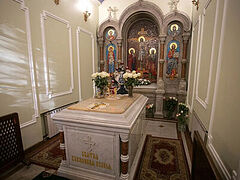
 Basilica of St. Nicholas
A little time passed. I received an email asking me to create a website for a parish on the Greek island of Corfu. I didn’t respond in time, and later it turned out that the request was no longer relevant. After that, everything got wrapped up in the daily work routine; there were also vacations, one of which I spent with my wife in the Holy Land, so that we could pray for a solution to a certain family problem. To resolve it, we also tried to meet with Father Iliy (Nozdryin) for advice, but without success.
 Chapel of St. Xenia
The new year 2016. Suddenly, I get a clear thought again: “Go to St. Xenia in St. Petersburg!” By that time, I was no longer just a sexton at my parish; I also ran two clubs at the youth club—a cycling club and a fishing club. I called the priest in charge of these matters, my friend. He was pleased with the idea and blessed me to organize a trip with the parish youth for the February 6 holiday, which conveniently fell on a Saturday that year.
The trip went well. After praying at the shrines of St. Xenia and Righteous John of Kronstadt at the St. John of Rila Monastery, our group split up—some decided to warm up in a café, while I, my wife, and another altar server went for a walk around the northern capital. He even went out onto the ice, writing “NIКA” in the snow that had fallen on the frozen Neva.
 "NIKA" on the Neva ice
We returned home early on Sunday morning. The choice was simple—either to sleep off the journey or to go to the Liturgy after all. Something inside prompted us to choose the second option, and we went to the church. After the service, the rector made an announcement: “If anyone wants to, come after the service to the site of the church that’s under construction nearby; we’ll be holding a prayer service, and Father Iliy will be there too.”
I was very surprised by this turn of events and immediately agreed to go. After the prayer service, the elder was about to leave, but I managed to ask him my question and received the answer that I needed to go to Mount Athos. If that’s what’s needed, then that’s what’s needed. From that day on, I started looking for people who could help with the trip, because up until that point, I had only been to Ukraine with my family in childhood, and also to Bari and Israel as part of an organized pilgrimage tour.
Months passed in the search. Nothing sensible came to light. Some people told me how to get there on my own, others agreed to go with me, but then changed their plans. One day, already completely desperate, sitting at my laptop, I prayed: “Lord, help me!” I typed the word “Athos” into the search bar on VKontakte, opened one of the first links, and found myself in a group for a pilgrimage trip that was exactly on the dates that suited me. I contacted the organizer, and it turned out that he was a deacon who was well acquainted with the priest from our parish who had married us, and he had even served alongside him for some time. We talked a bit more, discussed the details, and agreed on the trip. It turned out that they planned to visit monasteries that I wanted to see first, and after Mount Athos, they also planned to go to Corfu. And St. Spyridon is my favorite saint; he helped us find a place to live a few years ago.
After the conversation, I stared at the wall in a stupor for a few minutes (or rather, I seemed to stare right through it), trying to understand how such a thing was even possible.
Our guide to Mount Athos, Father Deacon, used to travel to Mount Athos every year (this was all in the pre‑COVID times) on his birthday and would take some acquaintances with him. He also helped with the air tickets and the visa. I didn’t really understand how to get it, because for Bari they did everything for me—back then there were fewer requirements.
 Ouranopolis. View of the Aegean Sea from the hotel
October 2016. It’s time to fly away. I’m on the air express to Sheremetyevo with my wife, who is seeing me off. After I go through security, she returns to Belorussky Railway Station, having met some Greek women and even having a little chat with them. Meanwhile, our small but interesting group gets on the plane and flies to Thessaloniki. We arrive, immediately get into the car, and head to Uranopolis. We check into a cozy hotel with a view of the picturesque Aegean coast. I really want to take a swim, but it’s not worth the risk: there are a lot of sea urchins in the water, and you could easily get injured and be unable to climb the summit of Mount Athos. In the evening, after celebrating our arrival at a Greek tavern, we conclude our first day in Greece.
 Ouranopolis in the early morning
 The Ferry “It is Meet”
Early morning. We need to get the Diamonitirion. We head to the office, and soon enough we’ll have the Athos visas in our hands. There’s still a bit of time before the ferry; we return to the hotel to have breakfast and pack our things. In the hotel, some pilgrims leave their staffs behind after returning—they use them to climb Mount Athos (a multi‑hour ascent is much easier with a staff), and those who cannot afford it or do not see the point in buying a staff for such a short time can take one and return it after the pilgrimage is over. I decided not to buy a staff and took one of those available. Anyway, it would have been inconvenient to carry it on the plane on the way back. After leaving some things at the hotel that would not be useful on the Holy Mountain and taking the staffs, we headed to the pier. The first pilgrims have already boarded the ferry named, “It is Meet”. We also boarded, showing our permits to visit the Holy Mountain.
 To Athos
Uranopolis remains on the shore, but a hungry cloud of seagulls follows us—they’re fed bread by pilgrims and monks. But it’s not just the seagulls that are hungry; we would also like a snack. There’s a café on board, and I order Greek coffee, which pleasantly surprises me with its good flavor.
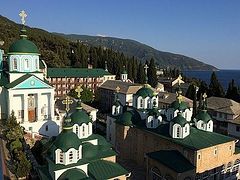
 At Dochariou
Our first stop is the Dochiarou Monastery. My first steps on Athonite soil begin with obedience—a certain monk asked me to help unload the luggage onto the shore. We enter the monastery, and we are greeted by the abbot Fr. Gregorios (Zumis) and his dogs. Unfortunately, at that time I didn’t know who he was and didn’t come forward to receive his blessing, which I later regretted very much. But a few years later, back in Moscow, I was invited to shoot a photo report about a special screening of the film “Where Are You, Adam?” dedicated to the monastery and Fr. Grigorios.
 At Dochariou
After check‑in, there are services and a meal. Sleep is allocated from 8 p.m. to 2 a.m. This time is quite sufficient to get enough sleep. The monastery houses the miraculous icon of the Mother of God “Quick‑to-Hear” It was then, in prayer before this icon that I first felt that the problem would be resolved. Moreover, I felt this in the subsequent days of my stay on Mount Athos in other monasteries. Services on Mount Athos are long. But for some reason, you don’t notice it; you just feel like praying, and no one forbids you from using the stasidia.
After the Liturgy and a delicious monastic meal, we were ready to move on, specifically to the nearby Bulgarian monastery of Zographou (which translates as “painter”), consecrated in honor of one of my favorite saints—Great Martyr George the Victorious. As we were leaving Dochiarou, we met a Russian monk who told us about the mosaic that was being assembled on the monastery gates while we were there. Unfortunately, Fr. Grigorios did not bless us to take a photo of it.
 The coastal road from Dochariou to the harbor of Zographou Monastery
It’s a short walk to the Zographou pier along a picturesque path by the shore. Unfortunately, it turned out that the patronal feast will be a day later, so we decided to head towards Hilandar. On the way, I learn some interesting details. One of the members of our group served in the altar with the priest from our parish who married us. Another worked for our rector from my Moscow parish, and the third worked in a Siberian town in the Krasnoyarsk region which is located next to the town my wife is from.
I really wanted to visit the Serbian monastery of Hilandar and pray there. Unfortunately, there weren’t enough places for everyone, and after a short rest, I was sent with part of our group to Esphigmenou, not far away. It was stormy at night. I hadn’t expected that the sea could make such loud noises that it prevented me from getting enough sleep.
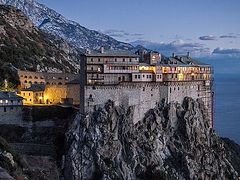
 Esphigmenou
In Esphigmenou, I witnessed an event. One Russian man was communicating in Greek with a monk as if it were his native language. “Wow!” I thought, and I also got the urge to learn Greek. Alas, I never got to serve at Hilandar. All I managed to do was write some notes in the church shop at the monastery gates while waiting for the bus that would take us to the Zographou Monastery pier.
 At the harbor of Zographou Monastery
 At the harbor of Zographou Monastery
The minibuses to the ferry were running according to schedule, so we rested a little on the shore while we waited. Some were praying, some were admiring the sea view, and some were examining the sea urchins. Nearby, we heard a beautiful and incomprehensible chiming sound. It’s far from the monastery. We got curious about what it could be, and behind the old pier building, we saw several donkeys with something covered with blankets on their backs. I supposed that it was these boxes that were making the sound. Finally, we’re at the monastery. There’s still a long time before the service, so we go for a walk around the area, taking photos. It’s no wonder the monastery’s name translates as “picturesque.”
 Zographou Monastery
When we were settled into the pilgrims’ room, I was once again surprised. In our room, photographs of a church hung on the wall—the church of my parish in Moscow, which is also dedicated to St. George the Victorious.
The night service on the patronal feast of the 26 Zographou Martyrs is very beautiful. They sing with two choirs—one in Greek, the other in Church Slavonic; and the chandeliers, on which real candles are burning, are swung around. It seemed to me that they served all night. I didn’t have enough strength, so from time to time I went to rest in the monastery guesthouse.
 Karyes
In the morning, after a festive breakfast which, in terms of the menu, was more like lunch, we set off by ferry to the Athonite capital, Karyes. Along the way, we saw several monasteries, including the Russian St. Panteleimon Monastery. In Karyes, the Athonite capital, we rented a car and visited several more monasteries. We were in Vatopedi, where we prayed before the “All‑Treasurer” icon, and then we went to Iveron. There was a certain quiet and cozy atmosphere around the Iveron icon. After saying a little prayer, I took some oil from the lamp, and then we visited the spring. It is located very close to the seashore, and the water from it is surprisingly tasty and smooth. We ended the day at St. Andrew’s Skete, where we spent the night. The skete used to be Russian, so the frescoes are signed in Church Slavonic, but the service is conducted in Greek. It was unusual.
 Skete of St. Anna
In the morning, we took the ferry to the Skete of St. Anne, so that later we could climb to the top of Mount Athos. Initially, I didn’t really want to go to the top of the mountain as much as I wanted to go this skete. But it wasn’t in vain. When we climbed up and I venerated the miraculous icon of the righteous Anna, the mother of the Theotokos, I couldn’t think of anything else; tears welled up in my eyes; I didn’t want to go anywhere, I just sat in the stasidia by the icon. They call me for lunch, but I didn’t feel like going anywhere. But I still had to stay with the group. I didn’t really have much of an appetite. I’d never experienced anything like this before.
 Sunset. View from the Skete of St. Anna
The sunset near the hermitage is picturesque. From a height, we watched as the sun set behind the mountains of the Sithonia peninsula, which is located opposite the Holy Mountain. After the sunset, I learned that it really wasn’t worth it to swim in the Aegean Sea. One of the pilgrims pricked himself on a sea urchin, and the needle got stuck deep in his foot. It was safely removed, but the wound prevented him from continuing on.
 At the summit of the Holy Mountain
Early in the morning, before dawn, around 4 a.m., we attended the Liturgy in the cave church. Since there were clergy with us, we were blessed to conduct the Liturgy only for our group, but we were given one monk from among the monastic community, which only added beauty to the service. Everyone received communion.
 Dmitry Kiryukhin at the Cross on the summit of the Holy Mountain
The service ended after sunrise. After refueling at breakfast and leaving our unnecessary belongings at the hermitage, we began our ascent to the top of the mountain. We walked for a long time. All sorts of thoughts crossed our minds, but dying of exhaustion in the forests of Mount Athos would have been too great an honor, so I boldly kept going, even though I had fallen well behind the others. We reached the Panagia cell around four in the afternoon. It turned out that most of the group had gone on to the summit itself, so we, a small group that had stayed behind to rest, continued our ascent. The ascent was more dangerous, but also more captivating; there were no trees, only rocks and a cliff, and the clouds were already below us. After climbing up, praying, resting, and even taking a few photos, we began to slowly make our way back down. It was already getting dark, and I was a bit afraid to lose the trail. In fact, I did lose it. But the cell was within sight, so I still made it safely down to it, albeit by roundabout ways. It turned out I wasn’t the only one who wasn’t following the main trail. It was hard to make them out. If the paths in the forest are usually clear, here they’re just worn‑down stones. After refueling with the supplies we’d brought with us, we went to bed.
 At the summit of the Holy Mountain. Panagia Cell
To catch the return ferry, we had to leave long before dawn. But you also want to celebrate the Liturgy in such a place. We started early in the night. I was the choir director. If someone had told me before the trip that I would direct a choir at the top of Mount Athos, I wouldn’t have believed it. It’s true, I do have some musical education—I graduated from music school, albeit not with very good grades, and I have at least some knowledge of the service, but still… Somehow we managed to get to the “Cherubimic Hymn,” and then the clergy joined in, singing it right in the altar. After the service, after a quick snack, we packed our things and headed down. I had a powerful bicycle headlight with a power bank; it really came in handy, illuminating the road very well. The journey to the hermitage took about three hours, and I had to walk very quickly the whole time, but it’s easier on the descent.
 Dionysiou
After taking a short break and gathering our things, we headed to the pier to set off for the last destination of our pilgrimage on Mount Athos—the Dionysiou Monastery. Unfortunately, we made a mistake and got off at the Saint Paul Monastery. The ferry had already left. What to do? We decided to order a boat. While were placing the order, we turned on the wi-fi hotspot function on the group’s smartphone to share the Internet with everyone. I received an email with something along the following lines: “Good afternoon! If you remember, a few years ago we asked you to create a website for the Iason and Sosipatra parish on the island of Corfu. We need help again. Could you assist us?”
This time, I didn't stare at the wall for a long time (there were no walls here), but at the sea, struck by the fact that this letter came to me right here, right now, and after a short while I replied: “Hello! I’m on Mount Athos. I’ll be in Corfu the day after tomorrow. I suggest we meet and discuss this.” The girl replies that she has already left, but I can meet and talk to the abbot, Fr. Spiridon; she gave me his contact details. However, I only speak Russian, while he speaks Greek and English. “Okay,” I think, “we’ll figure it out.”
While we were exchanging messages, a boat arrived and took us to Dionysiou—the last place we stayed on Mount Athos. We had already had more than enough impressions; I slept through the service. I went to the pier before the others to gather my thoughts. While I was getting ready, a man came up to me and asked me to take a photo of him with his camera. He turned out to be from Moscow, and his camera was a compact Fujifilm. I really liked it, and I wrote down the model number.
 Return to Ouranopolis
 Return to Ouranopolis
The ferry arrived, and after some time we returned to Kareya. A week had passed, and it turned out that on Mount Athos I had grown so unaccustomed to the presence of women that I had to get used to it again for a while.
We were accompanied by pilgrims visiting from Western Ukraine. They were kind, hospitable, and cheerful people. They set the table and, per their custom, treated us to some very tasty lard. It was very welcome, as it was lunchtime, everyone was hungry, and we had already effectively checked out of the hotel.
 Meteora
The car arrived, the things were packed, and we headed straight for Corfu. The Ukrainian pilgrims decided to go with us in their car, but they fell behind on the way, and we lost sight of each other. When we reached Meteora, we decided not to miss the opportunity and admired the monasteries and the landscape from the observation deck.
 Meteora
The next stop was in Ioannina. It was lunchtime, and we stopped at a café run by a woman from Romania and her husband. We had a priest with us who spoke Romanian, so our conversation with her grew into something more than just ordering food. We also decided to celebrate our guide’s birthday at the same café. Meanwhile, the Greeks at the neighboring table were celebrating the national day of Ohi. When we arrived in Igoumenitsa, I saw an old fisherman who was successfully fishing with a donk‑fishing rod. This kind of fishing interested me, and I really wanted to give it a try too. We didn’t wait long for the ferry; we loaded our car and set off to visit St. Spyridon. We arrived in Corfu late. After getting to the hotel, we immediately went to bed.
 Corfu. Church of St. Spyridon of Trimythous
In the morning, the first thing we did was go to the church of St. Spyridon. Shortly before that, I found out that the wife of Fr. Spyridon, with whom I needed to talk, was also there. After praying at the relics of the saint, I went up to her. She told me in English (unfortunately, I barely know it; a member of our group translated) how to get to the church of Apostles Jason and Sosipater, where her husband serves; she wrote the address on a piece of paper, and I set off alone to look for the church. We agreed that the pilgrims would arrive at the church a little later, in about fifteen minutes, by car.
 Corfu. On the way to the Church of Sts. Jason and Sosipater
It’s an interesting experience trying to find your way without knowing the language. But everything went well. Once I asked a street vendor for directions. They told me I was on the right track and pointed with their hand to indicate where to go next. The journey was actually pleasant, along the sea and along a well‑maintained promenade.
I reached the church, and Fr. Spiridon greeted me. Realizing that a dialogue would most likely not be possible due to the language barrier, we called that girl via messenger. We chatted for a while, but my company still hadn’t arrived. It’s clear that you can’t just sit on the phone for two hours, so we continued the conversation based on my meager vocabulary and complete lack of knowledge of grammar. Everything I had ever known came back to me. Two hours passed like that. We even managed to grab a bite of delicious and hearty Greek fast food, which the church warden brought.
Two hours later, our group arrives; it turns out they stopped by a pizzeria on the way. Fr. Spiridon gave us all a tour and also brought out the relics of the Holy Apostles of the Seventy, Jason and Sosipater, from the altar. After exchanging contacts and making a preliminary agreement on the website, we headed to the hotel. My wife later laughed, “You can’t leave me alone for a second!” Even on vacation, I find work for myself and handle some work‑related matters. When we returned to the sea, we decided to take a swim. It was the last days of October, and the sea had cooled down. Only one Greek woman was swimming. We got into the water, but I quickly got cold and left the water. The Greeks laughed: “You’re Russian, and you’re cold?”
With the priest from our group, we found a fishing shop, where we bought a fishing line and a pack of sea worms, and then went fishing. The fishing was good, but mostly we caught small fish. But even that was unusual and exciting. We fished until dark, and we gave the whole catch to the hotel owner for the cats.
 Early morning. Returning from Corfu by ferry
Early the next morning, we boarded the ferry and set off for Igoumenitsa, and from there straight to Thessaloniki. On the way, having almost reached the city, we stopped in Souroti, at the grave of Venerable Paisius of Mount Athos. The queue at his grave was short (I later realized we were lucky); we venerated the relics, prayed, and then went to look for a shop. Unfortunately, it was closed, and I couldn’t buy an icon (and yet, when I was in Iveron, for example, I could have bought one there). The sisters of the monastery, seeing my distressed face, gave me a paper icon. It still stands in my icon corner.
 Souroti. Grave of St. Paisios of Mount Athos
After wandering around Thessaloniki for a while, we found our hotel. There was a café nearby where, for a fixed price, you could get whatever you wanted and as much as you liked from a separate menu, so we treated ourselves to a feast.
Generally, Thessaloniki is an interesting city. There’s a lot of ancient architecture. They say that when they start digging the foundation for a new building, they often find some ancient artifacts or ancient structures. Then they stop digging and fence off the area around the perimeter. As a result, fragments of the ancient city can be found at every step.
 Excavations in Thessaloniki
After the meal, we went to the church of my patron saint—the great martyr Demetrius of Thessaloniki. The plans were as follows: first, to see him, then—to see St. Gregory Palamas, and after that, just to take a walk around the city. These plans were destined to be disrupted. When I entered the church, I realized that I didn’t want to leave anywhere. There was quiet joy, comfort, and peace, as if I had come to visit a close friend. I had just run to the hotel to get some money to write some prayer requests and to buy oil and myrrh. I didn’t go anywhere for the rest of the day.
 Relics of the Great Martyr Demetrius of Thessaloniki
I only returned to the hotel when it had already grown dark. It was a bit scary, though, walking through the streets of Thessaloniki; they’re quite narrow, poorly lit, and covered in graffiti; there are quite a lot of young people, and a lot of scooters as well. The next morning, after returning the rented car, we flew home to Moscow. At check‑in, I asked for a seat by the window so that I could enjoy the views one last time and take some souvenir photos. After takeoff, we were offered, as expected, in‑flight food, after which I seemed to fall into oblivion and only came to my senses when I felt that we were already descending. It turned out that I fell asleep right away and slept through the entire flight. That’s surprising, because I can never fall asleep on airplanes. At the airport, my wife was waiting for me with warm clothes and shoes—winter had come to the capital.
 Time to head home
 Time to head home
Upon returning, I was plunged back into my routine: work, home, work again… For my vacation in 2017, I initially thought about going to the Volga Delta to fish, but in the spring we quickly changed our minds and decided to go to Corfu. We stayed in Benitses, not far from Corfu Town—that’s what the locals call the island’s capital. This time, we often attended services at the church with Fr. Spiridon, and we also celebrated the Feast of the Exaltation of the Cross there. My wife has a good command of English, so while I was taking photos for the parish website (the one we talked about during my first visit), she managed to talk to the rector about theological topics. I really liked the Greek tradition of gathering with the parish after the service to drink coffee with treats that the parishioners bring with them. Unfortunately, I hardly know of any such parishes in Russia. I think it’s a good tradition.
 Church of the Holy Apostles Jason and Sosipater. September 2017
After returning from my second trip, I realized it was time to replace my camera: at the very least, smartphones took photos just as well. I spent a long time choosing a new camera, and at the same time, started learning the basics of photography. That’s how I got a new hobby, which became my main one, alongside fishing. I bought a compact camera—I really liked the format I saw at the pier near the Dionysiou Monastery.
 Corfu, Benitses. September 2017
Some time later, I enrolled in English courses at the Felix of Burgundy Educational Center, and a couple of years later, Greek language courses also opened there. My wife joined me, and now she knows Greek better than I do. After a trip to Corfu, she developed a liking for Greek music, to which she now often listens.
 Chapel of St. Xenia. February 6, 2022
In 2022, the feast day of St. Xenia once again fell on a weekend. I came to see her as if she were already a beloved and close person; I really didn’t want to leave the chapel, and I even had to make some effort. After I returned, I was invited to film the hierarchical liturgy at the Elokhovsky Cathedral. I didn’t want to go, but the rector blessed me to, and there was no way out. And imagine my surprise when I met Father Iliy in the altar! At the end of the service, I talked to him and asked why it happened that I went to Mount Athos, but the problem still hadn’t been resolved. He replied that the Lord wishes everyone well, and we just need to keep praying. And the Lord will arrange everything.
 Fr. Iliy (Nozdrin) serving at the Theopany Cathedral, February 20, 2022