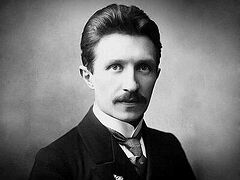
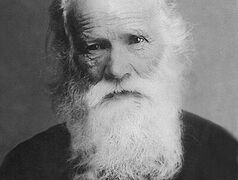
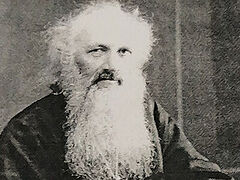
Hieromartyr Vladimir Moshchansky Hieromartyr Vladimir Moshchansky was born on June 15, 1866, in the village of Zaborovye, Yesenovsky District, Tver Province, into the family of the priest Dimitry Moshchansky. His mother, Anna, was widowed at an early age. A deeply devout woman, she fed the poor and needy, and when she died, they all came to her funeral. Only then did many realize how many people she had helped.
After graduating from the Tver Theological Seminary, Vladimir Dimitrievich married Evdokia, the daughter of the priest Ioann Dimitrievsky, and was soon ordained a deacon and assigned to the church in the village of Rogachevo, Rzhev District. They had a daughter and three sons. Evdokia Ivanovna died while giving birth to their fourth child. Fr. Vladimir was left with his young children, whom Evdokia’s unmarried sister, Alexandra Ivanovna, helped him raise.
Some time later, Deacon Vladimir was ordained to the priesthood and appointed to the Dormition Church in the village of Spasskoye, Kashin District. He served there until 1924, when the Bolsheviks closed the church.
Before the church was closed, a final divine service was celebrated. The church was filled with worshippers; everyone knelt, and many wept. The entire parish accompanied the priest as far as the nearest town, Kashin, walking the thirty kilometers on foot. Fr. Vladimir settled in Vyshny Volochyok in the house of his father, who by that time had already reposed. He served in the winter cathedral. Despite the intensifying persecution, he did not cease celebrating the divine services, and he walked through the town in his cassock, preaching the Word of God by his very attire. In his spare time, he devoted himself to the upbringing and education of his granddaughter Olga, teaching her every subject from old pre-revolutionary textbooks, but above all teaching her to pray.
When her knowledge was tested at school, Olga was admitted directly into the fifth grade. The child took everything with the simplicity and innocence of childhood. One day at school she was told to memorize a mocking ditty: “Today I didn’t go to church or confess to the priest; I don’t even want to see such a crocodile.” When she came home, she innocently recited the ditty to her grandfather. Alexandra Ivanovna gasped and exclaimed, “What is this?” Fr. Vladimir remained silent, looked intently at his granddaughter, and said, “Olya, did you stop to think that your grandfather is a priest?” She was overcome with such remorse that she fell to her knees and asked his forgiveness.
Fr. Vladimir’s health began to fail, and he was no longer always able to celebrate the Liturgy. Nevertheless, he continued to come to church to pray, baptized infants, and served memorial services at Pyatnitskoye Cemetery. He went to this cemetery on every Saturday of commemoration of the departed. His father had once served there at the Church of the Prophet Elias, and the Moshchansky family burial plot was located behind the altar of that church. But before going there, Fr. Vladimir would first make his way to another part of the cemetery, where at that time there were no graves. There he would serve a memorial service and pray, as though it had been revealed to him that he was destined to be buried not in the family plot, but in a prison grave.
Despite his venerable age—Fr. Vladimir was in his seventy-second year—he was arrested on February 13, 1938. He was accused of conducting anti-Soviet agitation. After questioning the usual “stock witnesses,” the investigator began interrogating the elderly priest. Fr. Vladimir did not admit guilt to the charge of anti-Soviet agitation, and out of all the points of testimony against him, he admitted only to speaking with eighth- and ninth-grade students in November 1937. At the time, Fr. Vladimir had said to the students, “Before his death, the scientist Pavlov left instructions that existing church buildings should neither be demolished nor turned into museums. You see, even scientists are turning to religion.”
The indictment was drawn up at the end of April. The trial took place on June 27, 1938. After hearing all the charges brought against him, Fr. Vladimir objected that whatever he might have said on various occasions, he had never said it for the purpose of agitation.
The judges sentenced him to seven years’ imprisonment, followed by deprivation of voting rights for three years. Fr. Vladimir filed an appeal, asking that the sentence be reconsidered. While the sentence was under review, he was confined in the prison at Vyshny Volochyok. The cells there were overcrowded, and the prisoners had to remain standing almost around the clock; there was not even enough room on the floor to lie down. Conditions were so cramped that when a guard opened the cell door, prisoners would involuntarily spill out into the corridor.
Fr. Vladimir observed the fasts strictly in prison and gave almost everything that Alexandra Ivanovna sent him in parcels to his fellow prisoners. His health steadily deteriorated, yet the prison administration took no measures to help him. Eventually, the prisoners in his cell became indignant and began pounding on the iron door and shouting: “Why are you tormenting the old priest? What is he guilty of? We also believe in God!” However the prison authorities did nothing to improve the priest’s conditions, and he remained in the common cell. Unable to withstand the harsh conditions of imprisonment, Archpriest Vladimir Moshchansky reposed on August 25/September 7), 1938.
The prisoners themselves made a coffin for him. Fr. Vladimir was dressed in clean linen that he had kept in prison in preparation for his death. The coffin was placed on a cart and taken to Pyatnitskoye Cemetery, passing by the priest’s house along the way. Alexandra Ivanovna did not know that he had died and continued bringing parcels to the prison for several more days.
After Fr. Vladimir’s death, his image began appearing to the chief prison administrator. Wherever the man went and whatever he did, the aged priest stood before his eyes. This continued even at night. At dawn on the ninth day after Fr. Vladimir’s repose, as soon as the darkness began to lift, the man set out along the street toward the cemetery. He did not know where Fr. Vladimir or his relatives lived, yet involuntarily, by the prompting of God, he stopped in front of the priest’s house and knocked on the window. Alexandra Ivanovna opened the small window and asked what he wanted.
“Come outside and get dressed. Your grandfather has died. I will show you his grave.”
He took her to the cemetery and showed her Fr. Vladimir’s grave. It was in the very place where Fr. Vladimir had served memorial services during his lifetime. A cross was later erected there, and the priest’s son and daughter, Vladimir and Olga, were also buried at that spot.
On September 6/19, 1999, he was canonized as a locally venerated saint of the Tver Diocese. At the Jubilee Bishops’ Council of the Russian Orthodox Church in August 2000, he was numbered among the Holy New Martyrs and Confessors of Russia for Churchwide veneration.