When writing articles about the New Martyrs of Russia, I have repeatedly noted how differently saints touch your soul. Some of them strike right into your heart by certain facts of their lives, others astonish you by the loftiness and fortitude of their spirit, others by the degree of their meekness and humility, others by the power of the love of Christ. And some amaze me with photos taken in their lifetime. This time my choice was determined by a photograph.
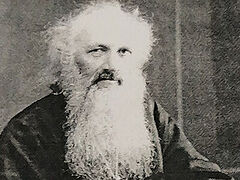
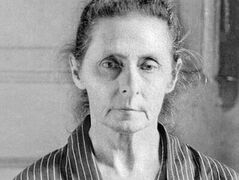
 New Martyr Tavrion (Tolokontsev) I don’t know what Fr. Tavrion must have gone through to make his face look like in a photograph taken at Butyrka Prison in 1930. At that moment, he was only fifty-nine: by our modern standards—not an old man at all. But a gray-haired eighty-year-old man looks at us from the photo. Once I was similarly shocked by photographs of the WWII years; you see an elderly man in a photo, but as it turns out this is a twenty-five-year-old young man who miraculously survived at the front and returned home; An aged woman with wrinkles characteristic of old age looks at you from another photo, but in reality she is a twenty-four–year-old woman who survived the horrors of the Nazi occupation… Suffering doesn’t even make you look older: it ages you both outwardly and inwardly.
So, extremely harsh trials fell to Fr. Tavrion’s lot, which left their cruel indelible marks on his face and alike.
The future new martyr was born into a simple peasant family on August 5, 1871. His birthplace was the village of Lenshino in the Nikolsk District of the Vologda province.1 The boy was named Matthew (Matfei) in Baptism. His parents, Gregory and Olga, despite the severity of peasant life in the late nineteenth century, were able to send their son to a village school where he studied for two years, which means he was taught to read, write and count, as well as the Law of God.
His Life is silent about how he lived until he was thirty-seven. I daresay that the Tolokontsevs were deeply religious people who instilled in their son a love for God, the Orthodox faith, and the Church of Christ. He lived a simple peasant life in labor and prayer. There is not a word about his wife and children in his biography. From time immemorial (and still as late as the turn of the nineteenth and twentieth centuries) peasants married their children offvery early, at the age of thirteen or fourteen. My great-grandmother, who was born in 1889 and whom I remember well, told me that her husband was a year her junior, and she was fourteen when they were married. Just like in Alexander Pushkin’s novel Eugene Onegin, where the main character Tatiana Larina’s nanny tells her about her own arranged marriage:
My Vanya
Was younger than myself, my sweet,
And I was thirteen.
For two weeks or so
A woman matchmaker
Kept visiting my kinsfolk,
And at last my father blessed me.
But St. Tavrion’s Life does not contain such details. Does it mean that he lived for several decades of his adult life as a monk in the world? God alone knows. But it was no coincidence that, having reached the age of thirty-seven, he decided to enter a monastery and chose one of the northernmost monasteries with difficult living conditions, but which had gained fame as a monastery of sublime spiritual life. On August 26, 1908, Matthew entered the Holy Transfiguration Valaam Monastery. Many peasants longed to live there to labor in monasticim for the salvation of their souls. Valaam was even nicknamed the “peasants’ monastery”. In accordance with the monastery rules, Matthew was a laborer there for four years. Laborers usually stayed in Valaam for a year, and then went back home. That was the established practice. The fact that Matthew stayed as a laborer for four years indicates that he expressed a firm desire to remain there, and his intention was blessed by the monastery abbot. Not many were blessed to remain in Valaam, but only those in whom piety and a penchant for monastic life were obvious. On June 26, 1912, Matthew became a novice of the ancient monastery.
The October Revolution of 1917 divided the history of our entire Fatherland—and as a result, the Valaam Monastery—into “before” and “after”. Some of the islands of the Valaam Archipelago suddenly ended up abroad—in Finland.
At that time Novice Matthew, by the will of God, stayed at the Dependency of the Valaam Monastery in Moscow, where some of the monastery’s brethren had had to move. Here he was tonsured a monk on December 23, 1920. Archimandrite Damascene (Orlovsky) explicitly notes in his Life of the New Martyr Tavrion: “His heart’s desire was granted.” This means that he had from the bottom of his heart truly aspired to the angelic rank on earth. Taking into account the date of his tonsure (the early 1920s coincided with the onset of severe persecutions of the Orthodox Church), it can be stated that his aspiration was sincere and genuine, which in itself was the feat of confession in the reality of that time.
He was tonsured with the name Tavrion in honor of Martyr Taurion (commemorated on November 7/20), who suffered under the Roman Emperor Julian the Apostate (361–363). He was beheaded for his faithfulness to Christ. The Life of this saint consists of only a few lines: “St. Thessalonica was the daughter of a pagan priest. When her wicked father learned that his daughter had become a Christian, he beat her mercilessly and kicked her out of the house, depriving her of all means of subsistence. Sts. Auctus and Taurion tried to intercede for the Christian girl and bring her hardened father to reason. The pagan priest denounced them, and they were captured. After confessing their faith in Christ before the tormentors and suffering severe tortures, the saints were beheaded. Soon after their martyrdom, St. Thessalonica died as well. Her body was buried with honors in the city of Amphipolis in Macedonia, along with the holy Martyrs Auctus and Taurion.”
 Sts. Auctus, Taurion and Thessalonica. Miniature from the Menologion of Emperor Basil II. 985
Martyr Taurion mercifully interceded for a defenseless girl and then fearlessly confessed his faith in Christ before the tormentors. Why was this rather rare name chosen for Matthew’s monastic tonsure? There could be no coincidences in this crucial question. Apparently, there were good reasons for that. It was precisely these qualities—mercy and steadfast confession of faith—that were especially strikingly manifested in the personality of the future new martyr.
Meanwhile, the Bolsheviks oppressed not only the monks in Valaam. In 1924, the authorities expelled the brethren from the Valaam Dependency in Moscow. Although services continued for some time afterwards, in 1925 the persecutors put an end to monastic life at the Valaam Dependency in Moscow.
Monk Tavrion and some of the brethren moved to serve at the Church of the Rzhev Icon of the Mother of God on Povarskaya Street in Moscow.2 They rented an apartment near the church, turning it into a monastic community with a rule, a common meal and obediences. Fr. Tavrion performed the obedience of a chorister.
Beyond all doubt, such an improvised monastic community could not escape the attention of OGPU.3 Of course, the monks were spied on, and relevant materials were collected on them. On October 7, 1930, their apartment was searched, during which the monks’ personal belongings and all the monastic money were confiscated. Once again, the authorities committed a banal robbery under the guise of procedural actions. The monks, including Fr. Tavrion, were arrested. They were put into Butyrka Prison. It was then that the above-mentioned photograph was taken, which shook me to the core.
It turned out that during Fr. Tavrion’s interrogation he was deprived of civil rights. It could mean that a criminal case had already been initiated against him and a court decision had entered into force. Otherwise, even in those brutal times people were not deprived of their civil rights.
An OGPU employee by the name of Drobyshevsky, considering Fr. Tavrion’s peasant origin, decided to give the monk a chance. Noting that he was not a priest and was “not as closely connected to the Church as the clergy,” Drobyshevsky asked Fr. Tavrion what he was going to do when he was free. But the monk foiled all the OGPU employee’s efforts with his answer: “I will serve the Church as long as it exists.” After such an answer, release from Butyrka was out of the question.
Nine days after his arrest—on October 16, 1930—Fr. Tavrion was interrogated.
From the interrogation protocol:
“I live in a community of monks at the Church of the Rzhev Icon, and I serve as a chorister in it. I receive a salary of five rubles a month, and the rest of my earnings go to our community’s general fund. There are about seventeen of us monks in the community. We all serve at the Church of the Rzhev Icon. All the priests, deacons, singers, caretakers, cleaners, and the whole staff of the church consists of us monks. The money taken from us during the search was shared by all the monks, and our steward (whom we had elected) was in charge of it... I and all the monks of our community often said to each other that ministers of religion were having a hard time under the Soviet regime; we were all deprived of rations—bread and other food given by ration cards. The clergy were being arrested, exiled, and even shot without any fault. But we believe that the Lord sent this government to our people for their sins. And the Apostle Paul in the New Testament said that There is no power but of God: the powers that be are ordained of God (Rom. 13:1); so we must pray, and God will grant that the Soviet Government will improve and treat ministers of religion better.”
From the indictment: “After the Moscow Dependency of the Valaam Monastery had been closed in 1925, a group of monks led by a monk-steward..., Having appropriated part of the monastery’s property and valuables, organized an illegal monastery at the Church of the Rzhev Icon. Having gained a foothold in this church, the monks carried out anti-Soviet work among the church people, spreading provocative rumors about the persecution of religion by the Soviet Government and the impending overthrow of Soviet power, claiming that this power was from the antichrist and that it was necessary to pray hard for its speedy fall.”
 The former Church of the Rzhev Icon of the Mother of God on Povarskaya Street As always, the testimony given during the interrogation was twisted around and presented in an absolutely different light. It sounded as if it was not the Bolsheviks who had robbed the Valaam Monastery, but the monks, who “conducted anti-Soviet activities in an illegal apartment monastery and spread various provocative rumors.”
The monks received various penalties. Fr. Tavrion was sentenced to three years of exile in the North. That’s how he returned home. Yes, he was sent to the Vologda region, where he was in his element. He stayed there after the end of his exile.
But in early 1937 Fr. Tavrion was called to Veliky Ustyug by Archbishop Pitirim (Krylov) of Veliky Ustyug. The monk came there and took up residence at the parish house of the Church of St. John the Baptist.
At the end of July 1937, the bloody order of the NKVD (“People’s Commissariat of Internal Affairs”) of the USSR No. 00447 was issued, by which a huge number of clergy, monks and lay believers were thrown into prison and shot.
There was no one to serve in churches; priests were being arrested in large numbers. There was the Dymkovo church near Fr. Tavrion’s place of residence,4 and other monks tried to persuade him to become a priest so that he could serve in this church. And he ventured to undertake this feat. Yes, it was a feat: it was obvious that any newly ordained priest was a candidate for arrest and inevitably for exile or execution. By that time, Archbishop Pitirim had been arrested, and Fr. Tavrion had to go to Moscow to resolve the issue. But for some reason, the monk returned with nothing, and they were already waiting for him in Veliky Ustyug… On December 3, 1937, Fr. Tavrion was arrested and interrogated on the same day.
From the interrogation protocol:
“I have not conducted any counter-revolutionary activities, so I cannot give evidence. In the autumn of 1937, I traveled to Moscow and Arkhangelsk to arrange for the opening of the Dymkovo Church where I wanted to serve as a priest, but my journey turned out to be fruitless. I was invited to the Dymkovo church by Stepanida Sergeyevna Lobova and other nuns who lived there. I can’t say anything else concerning this case. The protocol has been read to me, and I consider it correct.”
It was the first and last interrogation of Monk Tavrion. By striving for the priesthood, which he disclosed during the interrogation, he signed his own sentence: ten years of forced labor camps. The verdict was handed down on December 10, 1937—seven days after the arrest. Such were the timeframes for considering cases and deciding the fates of the confessors of the faith of Christ in the bloody year of 1937.
 Fr. Tavrion was not sent to the camp until the spring of 1939. It is unknown where he was held for more than a year. Most likely, in one of the “pre-trial detention centers” or NKVD prisons. Tiny cells with no air, packed with people, unsanitary conditions, infectious diseases, hunger, and violent cellmates. Too much is known about the horrible conditions in those NKVD prisons…
On Holy Tuesday—April 4, 1939—Fr. Tavrion arrived at the Novozero corrective labor camp, which by that time had been located in the buildings of St. Cyril-of Novozero Monastery5 (which had been closed and looted by the Bolsheviks) for ten years. So the merciful Lord ordained that Fr. Tavrion began and ended his monastic life within the walls of ancient and celebrated island monasteries of Russia’s north. April 9, 1939 was Pascha.
The monk’s health had been so undermined, and the conditions of detention were so inhumane, that he lived here for only two months. The Lord took Fr. Tavrion to His bright abodes on the tenth day after Pentecost—June 7, 1939.