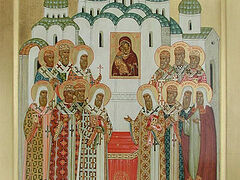
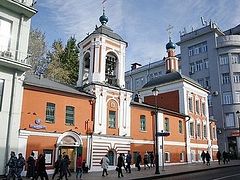
On the first Sunday of September, the Russian Orthodox Church celebrates the Synaxis of the Saints of Moscow. This feast was established in 1997 with the blessing of His Holiness Patriarch Alexei II of Moscow and All Russia. The Synaxis includes several dozen saints from different eras who lived and performed their spiritual feats in the city of Moscow. It includes holy Moscow hierarchs, monastics, princes and princesses, and holy fools of past centuries, as well as the New Martyrs who sacrificed their lives for Christ in the twentieth century. Hieromartyr Hilarion (Troitsky), the Heavenly patron of the Moscow Sretensky Monastery, is commemorated on this day as well. Let us look at the brief Lives of several lesser-known New Martyrs included in this Synaxis.
Hieromartyr Jonah (Lazarev), Bishop of Velizh
He was born in 1869 in the St. Petersburg governorate into a priest’s family. He graduated from the Novgorod Theological Seminary, then was tonsured a monk with the name Jonah (Iona) and joined the brotherhood of the Monastery of St. Savva on Storozha Hill.1 In 1895, he was ordained hieromonk, and later was elevated to the rank of archimandrite. In 1911, Fr. Jonah became the Abbot of the New Jerusalem Monastery (in the town of Istra near Moscow). In 1926, he was consecrated Bishop of Velizh (now in the Smolensk region), but due to circumstances beyond his control he was unable to assume his duties and was retired by order of Metropolitan Sergei (Stragorodsky), the Locum Tenens of the Patriarchal Throne. The saint moved to the village of Batyushkovo in the Moscow region (now near the town of Dmitrov). The faithful deeply revered the bishop and traveled to him for spiritual counsel.
 Hieromartyr Jonah (Lazarev) of Velizh
In the area where he lived, the Soviet authorities had established corrective labor camps that held a large number of clergy. Bishop Jonah provided aid to the imprisoned clergymen. Then came the year 1937. The bishop was arrested and charged with “conducting counter-revolutionary agitation under the guise of church sermons.” Bishop Jonah pleaded not guilty. In October of that same year, he was sentenced to death by shooting. The sentence was carried out at the Butovo firing range near Moscow. Hieromartyr Jonah was buried in an unmarked grave.
Venerable Hieromartyr Seraphim (Krestianinov),
He was born in 1875 into a peasant family in the Podolsk district of the Moscow governorate. In 1910, he entered the Gethsemane Skete of the Holy Trinity-St. Sergius Lavra, where he took monastic vows with the name Seraphim. He was ordained hierodeacon, and later hieromonk. In 1926, he moved to the Lavra’s Skete of the Paraclete (that is, of the Holy Spirit). In 1928, both the skete and the Holy Trinity-St. Sergius Lavra were shut down,2 and the agricultural artels (“labor cooperatives”) that existed under them were disbanded. With great difficulty, Hieromonk Seraphim found a position at the Holy Protection Church in the Zagorsk (now Sergiev Posad) district. Later, the saint was elevated to the rank of igumen.
 Venerable Hieromartyr Seraphim (Krestianinov) In November 1937, he was arrested along with Archimandrite Kronid (Lyubimov), a monk of the Lavra and future New Martyr, and sent to the Taganka prison. Fifteen other people were arrested alongside them, charged with “creating a counter-revolutionary monarchist group of monks and clergy.” The interrogation began, during which Fr. Seraphim responded: “We spoke about how few people attend church, how collective farms have emerged and people have stopped going to church services, and that we must work harder to explain the Holy Scriptures to people in order to draw them to the Church. Furthermore, for my part, there were conversations about how the Soviet Government arrests clergymen and believers simply for believing in God… I, as an active churchman, conducted church propaganda with the aim of drawing the masses to the Church.”
When asked about the conversations he had with other clergymen, Igumen Seraphim replied: “About how difficult life has become for working people under Soviet rule, and that the Soviet Government imprisons believers.” When questioned about his veneration of the Tsar, he gave the following answer: “A portrait of Tsar Nicholas II was indeed seized from me during the search. The Tsar is a person whom I acknowledge, but I did not praise him openly.” Based on Igumen Seraphim’s answers, the investigator considered his guilt before the Soviet authorities proven. In December 1937, Fr. Seraphim was shot at the Butovo firing range and buried in an unmarked mass grave.
The Venerable Martyr Andronik (Surikov), Hieromonk
He was born in 1885 into a peasant family in the Volokolamsk district of the Moscow governorate and studied at a parish school. In 1902, he entered the Luzhetsky Monastery in Mozhaisk.3 In 1916, he was conscripted into the army and sent to the front. Shortly after, the saint returned to the monastery, where he took monastic vows with the name Andronik. In 1920, Fr. Andronik was transferred to the Simonov Monastery in Moscow, and in 1928 he was ordained hieromonk. For a short period, he served at the Holy Dormition Church in Krutitsy near Moscow.
On December 28, 1930, over 300 clergymen, monks, and laypeople were arrested in Moscow, among whom was Fr. Andronik. They were charged with “anti-Soviet activity, providing aid to exiled like-minded individuals, delivering counter-revolutionary sermons, anti-Soviet agitation” and the like. Hieromonk Andronik was thrown into the Butyrka prison. He answered the investigator: “I have never belonged to any political parties, nor do I now. I have no acquaintances who are members of anti-Soviet parties… I don’t maintain acquaintances with anyone, but lead a secluded life.” Fr. Andronik was sentenced to three years of exile in Pinega (now in the Arkhangelsk region), where he worked as a logger.
 Venerable Hieromartyr Andronik (Surikov) On returning from exile, Fr. Andronik was appointed reader at St. Nicholas Church in the Shakhovskoy district of the Moscow region. In 1937, the Soviet authorities gathered testimonies against the saint, which stated that he “invites believers for talks on religious feasts, thereby undermining labor discipline, as believers do not show up for work on those days.” He was also accused of “organizing the singing of the church hymn ‘Christ is Risen!’ during the celebration of Pascha, which was sung on the streets of the village of Kholmets, and complaining that the Soviet regime had strangled the clergy with taxes.” Hieromonk Andronik was initially sent to the Taganka prison in Moscow and later sentenced to ten years in exile. However, the following year, his sentence was changed to the death penalty based on denunciations by secret informants. For six months, Fr. Andronik went to work in the labor camp, unaware of his sentence. In 1938, he was shot and buried in an unknown grave.
Hieromartyr Alexei Krasnovsky, Presbyter
He was born in 1886 in the Moscow governorate into the family of a church reader and attended a parish school. After the 1917 Revolution, he was ordained priest and served in various churches across the Moscow region. In 1937, Fr. Alexei was falsely denounced, including by a reader at the church where he served. His own brother signed all the false testimonies. And then shall many be offended, and shall betray one another, and shall hate one another (Mt. 24:10)… Priest Alexei was summoned for interrogation and charged with anti-Soviet activity. The priest was jailed in the Taganka prison and soon sentenced to ten years of forced labor in a correctional camp.
 Hieromartyr Alexei Krasnovsky The following year, a new case was initiated against him for “openly expressing anti-Soviet sentiments, organizing Gospel readings and the singing of church hymns in the barracks, and delivering sermons.” Fr. Alexei wrote to his wife from the camp: “I am writing to let you know that I am alive… I hope you will write back more often, for which I will be deeply, deeply grateful… Try to see the prosecutor in person and file a complaint on your own behalf, for which I will be grateful. Don’t be angry with me. Be my friend until death. I often see you in my dreams… Goodbye! I remain sincerely loving you until the last minute of my life, Alexei Krasnovsky.”
He and several other camp prisoners were handed a guilty verdict, which stated: “A group of prisoners consisting of nine former priests, seven sectarians, four kulaks, one industrialist’s son, and other monarchist and counter-revolutionary elements… united and systematically held gatherings, especially on Sundays..., sang religious songs and performed religious rites.” Priest Alexei was sentenced to death by firing squad, and the execution was carried out.
***
These are but a few brief Lives of New Martyrs of Russia included in the Synaxis of the Saints of Moscow. In them, the words of the Apostle Paul were fulfilled: And all that will live godly in Christ Jesus shall suffer persecution (2 Tim. 3:12). And they are not only persecuted, but also killed and tortured... But God is not mocked (Gal. 6:7). Now, these martyrs belong to the Church Triumphant, reminding us that he that shall endure unto the end, the same shall be saved (Mt. 24:13).