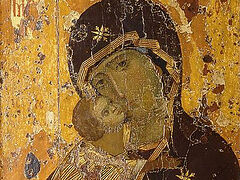
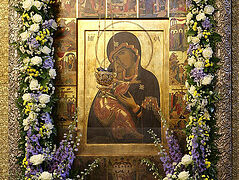
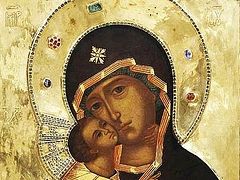
The Vladimir Icon of the Mother of God is the oldest and most significant sacred relic in the life of the Russian people. According to tradition, the Vladimir Icon was painted by the Evangelist Luke on a tabletop from the house in Nazareth where the Savior dined in His youth with His Most Pure Mother and the Righteous Joseph the Betrothed. On seeing this image, the Most Holy Theotokos declared: From henceforth all generations shall call me blessed (Lk. 1:48), and added: “May the grace of the One Who was born of Me and My own grace be with this icon.”
 The Vladimir Icon of the Mother of God
On the feast-day of the Vladimir Icon of the Mother of God, Ode 1 of the Canon to this icon reads: “Having painted thy most honorable icon, O Mother of God, the divinely speaking writer of the Gospel of Christ, the most divine Luke...”;1 and in ikos 1 of the akathist to the wonderworking Vladimir Icon, we read: “But neither hast thou left us upon earth, like a ray of light sending down to us thine icon first-written by Saint Luke. For of old thou didst say concerning it: ‘With this image, My grace and power shall abide.’”2
However, it should be noted that a wealth of historical, art-historical, scholarly, and restoration data, as well as stylistic analysis, indicates that this icon was first painted in Constantinople in the early twelfth century by a Byzantine iconographer (or iconographers).
Regarding this, the historian Yuri Pelevin wrote: “The church community preserves in its collective memory not so much factually accurate information about the Vladimir Icon, but rather the tradition surrounding it. In the written materials where this is recorded in the Book of Degrees,3 it is said of the icon: ‘The wonderworking icon of the Most Pure Mother of God, which is commonly called the Vladimir Icon, was painted by the God-voiced Luke.’ The tradition also entered later literature associated with the Church: for example, I. Sakharov’s Research on Russian Icon-Painting, the Encyclopedia of the Orthodox Icon, T. S. Eryomina’s Traditions of Russian Icons, and so on.”4
“The artistic execution of these faces far surpasses everything from Byzantine painting that has come down to us to this day,” wrote Viktor Lazarev, an expert on Byzantine and Old Russian art, about the Vladimir Icon of the Mother of God and the Infant Jesus. He noted that “the vivid texture of the Vladimir Icon undoubtedly stems from the Hellenistic tradition, which almost never died out in Byzantium. The emphatically vivid manner in which the Child’s face is executed traces its roots directly back to Hellenistic illusionism, which had already emerged on Greek soil in the third century BC and from there passed into late Hellenistic and early Christian art. That is, the first century AD—the lifetime of Luke the Evangelist...” comments the art historian O. V. Gubareva on these words in her book The Mother of God in Her Icons.5
The researcher Yu. Pelevin himself finds an answer to his perplexities in the work by Leonid Ouspensky, whose book on the theology of the icon has become universally recognized by both Church people and art historians. He writes: “Icons are not attributed to Luke the Evangelist in the sense that they were painted by his hand; none of the icons painted by him have survived. St. Luke’s authorship must be understood in the sense that these icons are copies (or rather, copies of copies) of icons once painted by the evangelist. Apostolic Tradition should be understood here in the same way as it is in relation to the Apostolic Canons or the Apostolic Liturgy. They trace back to the apostles not because the apostles themselves wrote them, but because they bear an apostolic character and are invested with apostolic authority. The same is true in regard to the icons of the Mother of God painted by Luke the Evangelist.”6 And Mikhail Dunayev, for whom “the problem under discussion simply does not exist”, wrote: “The question of whether this specific icon is the exact original from the brush of the Holy Evangelist is irrelevant and trivial for believers, because both the original and all copies made from it are one in the holy grace that abides in them and works through them.”7
Be that as it may, the hand of Divine Providence and the sacred mystery of this icon’s origin are clearly visible in its destiny. It is widely believed that this icon remained in Jerusalem until the first half of the fifth century, when, under Emperor Theodosius the Younger (ruled from 408 to 450), it was translated to Constantinople.
The Vladimir Icon of the Mother of God was brought to Rus’ from Constantinople in the twelfth century, likely around 1130, along with another great relic—the Pirogoshcha Icon of the Theotokos. The first mention of this famous icon appears in the Ipatiev Chronicle8 under the year 1155: “In that year, Andrei [Prince Andrei Bogolyubsky] left his father and went from Vyshgorod to Suzdal without his father’s consent, taking with him from Vyshgorod the icon of the Holy Theotokos, which had been brought from Constantinople alongside the Pirogoshcha Icon in the same ship.”9
For the latter, the stone Church of the Dormition of the Mother of God in Podol (also spelled Podil) was built in Kiev in 1132. Meanwhile, the Vladimir Icon was placed at the Convent of the Mother of God in Vyshgorod, a princely residence near Kiev.
At this Vyshgorod Convent—formerly the estate of Princess Olga Equal-to-the-Apostles, which became the appanage of Prince Andrei Yurievich, nicknamed Bogolyubsky, in 1155—the icon was still nameless. It apparently did not stay there long. This can be inferred from the fact that in Rus’, icons received their names just as they did in Byzantium—from the holy sites and cities where they were venerated.
 Prince Andrei Bogolyubsky with the Vladimir Icon
It was this very icon that Prince Andrei Bogolyubsky chose as his Guide and Patroness. At the Vyshgorod Convent, the prince prayed fervently before it and received Divine guidance for his future life. The icon at the church moved from its place on its own, and this happened several times; in this way, the Mother of God revealed God’s will to Prince Andrei. One night in 1155, without his father’s knowledge, the prince left old Vyshgorod, taking with him the icon—which was dearer to him than anything else in the world—to the land of Vladimir. On the journey from Vyshgorod to Vladimir, the icon performed many miracles.
The account of these events is contained in the Tale of the Miracles of the Vladimir Icon of the Mother of God, which was first discovered by the Russian historian Vasily Klyuchevsky (1841–1911) in the Menology, compiled by Priest John Milyutin in the 1640s, and published based on a copy from the Synodal Library manuscript No. 556.10
In Vladimir on the Klyazma River, the residents welcomed the prince with joy. From there he headed towards Rostov, but, as the story goes, after traveling over six miles from Vladimir, the horses carrying the icon came to a halt and refused to go any further; and no amount of force could move them. Prince Andrei prayed long and fervently in front of the icon, and at night the Mother of God appeared to him with a scroll in Her hand, revealing Her will that the icon remain in Vladimir and that a monastery in honor of Her Nativity be established at the site of this vision. Prince Andrei immediately founded a new church in Vladimir and soon after transferred his princely seat there from Rostov. He himself lived in Bogolyubovo, where the Mother of God had appeared to him; both his residence and the newly established monastery were located there.
Prince Andrei built the promised church very quickly—it was consecrated just two years later, in 1160. The Dormition Cathedral in Vladimir blazed, glowed and dazzled; the domes were covered in gold, the church doors were cast in gold, and the chandeliers shimmered with gold, silver, and pearls. To look at the cathedral meant to “behold a certain radiance.” It stood as a living sermon on the majesty and glory of the True God, glorified in the Trinity. In addition, a magnificent, jewel-encrusted riza was placed on the holy icon. As the Laurentian Chronicle11 recounts, the prince “wrought into it more than thirty grivnas12 of gold, besides silver, precious stones and pearls.” It means that the icon casing contained 1,228.5 grams of gold.
It should be said that in those days, solemn feasts were celebrated with colorful details drawn from Byzantine traditions. The streets of Vladimir were decorated with fabrics: luxurious princely garments and liturgical vestments, glittering with gold, pearls, and precious stones, were hung on ropes outside the Dormition Cathedral. They framed the path from the vestibule of the bishop’s residence to the northern doors of the cathedral, leading towards the wonderworking icon that stood inside in a gleaming golden riza.
Since that time in Rus’, the icon of the Mother of God that had left Kiev came to be called the Vladimir Icon. It is clear from the Tale of the Vladimir Icon that it was not merely a locally venerated relic; residents of Murom, Tver and Pereyaslavl traveled to seek its help.
On the day the icon of the Mother of God was installed at the cathedral, Prince Andrei declared himself Grand Prince (and ruled as the de facto sovereign of the lands of Rus’), proclaimed the city of Vladimir the capital, and the Dormition Cathedral became the main church in the entire Russian land. Thus, the Vladimir Icon of the Mother of God became a national shrine in Rus’.
When Prince Andrei Bogolyubsky, following the example of the Byzantine emperors, made the Vladimir Icon of the Mother of God the Russian palladium, a great miracle occurred. In the Tale on the Establishment of the Feast of the Savior and the Protecting Veil of the Most Holy Theotokos by Prince Andrei Bogolyubsky and the Byzantine Emperor Manuel I Komnenos, the Vladimir Icon is mentioned alongside the image of the Savior in an episode describing the Russian war against the Volga Bulgars13 in 1164.
Before the battle, Prince Andrei strengthened himself with confession and Communion and, praying before the Vladimir Icon, cried out to the Queen of Heaven: “None who place their hope in Thee, O Sovereign Lady, shall perish.” Following the prince’s example, all the Russian warriors kissed the icon with tears in their eyes and, invoking the aid of the Mother of God, marched into battle. The Bulgars were defeated, and after the victory a service of thanksgiving was celebrated on the battlefield before the Vladimir Icon. At that time, a sign was revealed: in full view of the whole army, a light flashed from the icon and the Life-Giving Cross, illuminating the entire area. On that very same day, according to tradition, the Byzantine Emperor Manuel also saw a light from the Cross of the Lord, and strengthened by this sign, crushed the Saracens’ army. By agreement between Prince Andrei and Emperor Manuel, the feast of the Procession of the Precious Wood of the Life-Giving Cross of the Lord was established on August 1.
The Vladimir Icon of the Mother of God has been written about in various eras, ranging from the compilers of tales to theologians and art historians. Clearly, the Vladimir Icon has invariably inspired both medieval scribes and modern scholars.
 The Praise of the Vladimir Icon of the Mother of God. From the collection of the Tretyakov Gallery
The first “collective author” of the Tale of the Vladimir Icon was the clergy of the Dormition Cathedral in Vladimir (the second half of the twelfth century). The earliest known work, The Tale of the Miracles of the Vladimir Icon of the Mother of God, was created on the basis of their records. Researchers link its appearance to the initiative of Prince Andrei Bogolyubsky, who saw this icon of the Theotokos as the Intercessor of the state he was establishing and of his new capital. It was Prince Andrei who initiated the chronicle of miracles performed by the venerated icon. The Tale describes the translation of the icon from Vyshgorod to Vladimir and instances of Divine help granted in various years.
The author of The Tale of Temir-Aksak14 (the fifteenth century) recounted the miraculous deliverance of Moscow from Tamerlane’s invasion in 1395. Grand Prince Vasily I, son of St. Dimitry Donskoy, on the advice of his mother, Princess Evdokia Dmitrievna (St. Euphrosyne), sent to Vladimir for the icon of the Mother of God, deeply venerated in Rus’. Throughout the journey of the Vladimir Icon to Moscow, the people knelt and prayed to the Queen of Heaven for Her intercession. When the holy Metropolitan Cyprian of Moscow, along with the “entire clergy and church choir,” the princes, and the people, met the wonderworking icon near Moscow in a cross procession, the enemy Temir-Aksak turned his troops around and retreated to his land without a fight.
It is worth noting that throughout Russian history up to the present day, God has always shown His mercy to our land whenever the people offered up their fervent prayers before the Vladimir icon. The author of the late sixteenth-century Tale of the Vladimir Icon of the Mother of God compiled earlier texts in it: the twelfth-century Tale of Miracles, the Tale of Temir-Aksak (Tamerlane), and The Tale of the Victory over the Bulgars. This turned the narrative into a monumental work that was included in the Book of Degrees and the Illustrated Chronicle of Ivan the Terrible. The idea of Heavenly patronage of Moscow and the chosenness of the Russian people was most vividly expressed in it.
Centuries later, theologians and scholars began to write and speak about the Vladimir Icon of the Theotokos. It was chronicled by renowned historians: N. M. Karamzin in The History of the Russian State; S. M. Solovyov in the Preface to the History of Russia from Earliest Times, The Russian Chronicle for Initial Reading, and The History of Relations between the Russian Princes of the Rurikid Dynasty; and A. N. Muravyov in The Life of Grand Prince Andrei Bogolyubsky.
The priest, theologian and religious philosopher Fr. Pavel Florensky, reflecting on the Vladimir Icon, wrote: “I look and say to myself: ‘Behold—She Herself—not an image of Her, but She Herself, contemplated through the medium, with the aid of iconographic art.’”15
In his work, Russian Chronicles and Their Cultural and Historical Significance, the brilliant Russian medievalist, linguist and cultural historian Dmitry Likhachev concluded that the chronicle writing of the twelfth–seventeenth centuries “was constructed as a chain of the Mother of God’s miracles” in connection with the veneration of the Vladimir Icon.16 For Likhachev, the Vladimir Icon was not merely a relic, but a powerful cultural and spiritual symbol around which the historical identity of the Russian people was centered.
 The Vladimir Icon of the Mother of God at the Cathedral of Christ the Savior. Photo: Patriarchia.ru / Oleg Varov
The art historian Ekaterina Gladysheva—who from 2006 to 2016 worked at the State Tretyakov Gallery in a team of specialists led by the restorer D. N. Sukhoverkov, which conducted a comprehensive study of the Vladimir Icon and made one of the most fascinating discoveries in the history of studying this monument—once said: “Why is it that when looking at the faces of the Mother of God and the Infant, we experience sorrow, mercy and boundless Divine love? The iconographer expressed these feelings through the language of painting with incredible clarity and fullness. He succeeded in revealing the reality of the spiritual realm and a Heavenly beauty that surpasses human understanding.”
It is heartening to know that some famous Russian writers and poets also dedicated their sincerest thoughts to the Vladimir Icon.
In the opening scenes of his tragedy Boris Godunov, Alexander Pushkin mentions the Vladimir Icon of the Most Holy Theotokos, venerated as the chief Intercessor and Helper, who extends Her protecting veil over Christians and strengthens its leaders.
The Council has resolved for the last time
To put to proof the power of supplication
Upon our ruler’s mournful soul. At dawn,
After a solemn service in the Kremlin,
The blessed Patriarch will go, preceded
By sacred banners, with the holy icons
Of the Don17 and Vladimir…
The mention of the Vladimir Icon of the Mother of God here is linked to a centuries-old tradition of Old Russian hymnographic texts. The poet’s familiarity with this ancient liturgical tradition is confirmed by his use of N. M. Karamzin’s History of the Russian State while working on the tragedy. Karamzin, in turn, drew on the 1598 Zemsky Sobor charter18 to describe the collective prayer of the people. It is evident that Pushkin utilized chronicles, as this collective public prayer is reflected in numerous codices and hymnography dedicated to the Queen of Heaven and Her icons.19
In 1929, the wonderful Russian poet, translator, and painter Maximilian Voloshin wrote one of the finest poems about this holy shrine entitled, The Vladimir Mother of God.
It is dedicated to the art historian and restorer Alexander Anisimov, who led the restoration of the Vladimir Icon and dedicated a monograph to this work.
Here are a few lines from the poem:
Not upon a throne—upon Her arm,
Embracing Her neck with His left hand,
Gaze to gaze, cheek pressed to cheek,
He insistently demands… I fall silent <...>
Who unclosed the lakes of these eyes?
Not Saint Luke the icon-painter,
As the ancient chronicler told us,
Nor an obscure icon-dauber from the Kiev Caves:
In the white-hot furnaces of Byzantium,
In the fierce days of iconoclasm,
In earthly colors from the element of fire
Was Her countenance embodied.
The poet first saw the Vladimir Icon of the Mother of God in the spring of 1924 at the State Historical Museum in Moscow. It had just been restored; the dark layers of soot had been removed, revealing the ancient painting beneath. Voloshin was so deeply moved by what he had seen that he returned to the museum for several days in a row, standing in front of the icon for hours. A photographic reproduction of the icon stood on his desk.
Soon after, his historiosophical work appeared, in which Russia’s tragic path is conceptualized through the imagery of the icon. Voloshin traces the key milestones of history: from princely feuds and Batu Khan’s invasion to revolutionary upheavals. The central motif of the poem is the spiritual blindness of the people, which led to the moment when “the blind people, in an hour of wrath, surrendered the keys to their own shrines.” The Vladimir Icon of the Mother of God emerges as the sacred guardian of the country, guiding Russia “through abomination, blood, and shame”, offering hope even in the darkest of times. The poet views the icon as a symbol: “In the future lies the countenance of Russia itself—despite all slanders and rumors.”
 The Vladimir Icon of the Mother of God with feast days in eighteen border scenes and ten faces of saints on the sides. A three-panel triptych folding icon
Another work dedicated to the Vladimir Icon of the Mother of God was written by Anna Akhmatova. In her 1922 poem Lamentation, the poet reinterprets the ancient legend, “The Newest Miracle of How the Most Glorious City of Moscow Was Saved from the Invasion of the Godless Tatars by the Prayers of the Mother of God and the Great Russian Wonderworkers.” The author of the legend attributes the miraculous salvation of Moscow to the intercession of the Most Holy Theotokos through Her wonderworking Vladimir Icon. However, Akhmatova’s poem speaks of the present. In her work, the holy hierarchs step forth to the sound of ringing bells, yet it is neither an alarm call nor a festive peal, but a farewell, funeral toll.
Akhmatova reinterpreted ancient history. The literary scholar and theologian Vasily Morov (N. N.), who provided a profound analysis of this poem by Akhmatova, wrote: “In Akhmatova’s “Lamentation,” the holy hierarchs and wonderworkers, on leaving the capital, in fact do not shake the dust of the earth from their feet to abandon Russia to its fatal destiny. The Acmeistic20 concreteness of Akhmatova’s Lamentation:
St. Seraphim—to the Sarov woods…
St. Anna—to Kashin…
transforms the nocturnal departure of the miracle-workers into a salvific mission, with which the holy intercessors of Russia march across the Russian land. The Mother of God Herself remains in the suffering city (‘The Mother of God sees them off, Wrapping Her Son in a shawl…’), never withdrawing Her intercession and protection from Russia…”21
We see that both Maximilian Voloshin and Anna Akhmatova perceived the Vladimir Icon of the Theotokos not only as a great relic, but also as a Heavenly symbol bound to the destiny of Russia and the spiritual path it walks.
We see that over many centuries of Russia’s history, the Vladimir Icon of the Mother of God was manifested not only as the Intercessor, Comforter and Sign for Her people, but also as a part of the living fabric of its religious culture—one of the spiritual pillars shaping the Orthodox worldview of Russian civilization.