In the name of the Father, and of the Son, and of the Holy Spirit!
Dear brothers and sisters, there are such words in the Holy Scriptures: For whom the Lord loveth He chasteneth, and scourgeth every son whom He receiveth (Heb. 12:6). And whom does God love? Again, the Holy Scriptures give us the answer: But to this man will I look, even to him that is poor and of a contrite spirit, and trembleth at My word (Is. 66:2).
Take St. John the Baptist. Unlike King Solomon, who having experienced all worldly pleasures and riches declared, Vanity of vanities, saith the Preacher, vanity of vanities; all is vanity (Eccl. 1:2), St. John was never tempted by any worldly seductions at all. He withdrew into the wilderness in his childhood, spending his time there in the strictest fasting, unceasing prayer, and Divine contemplation.
Tell me, brothers and sisters, what drives a youth, who still knows so little, to go into the wilderness and start such a life? And in the case of the holy Forerunner, this was no passing whim or spiritual delusion. After all, the Lord said of St. John, What went ye out into the wilderness to see? A reed shaken with the wind? (Mt. 11:7).
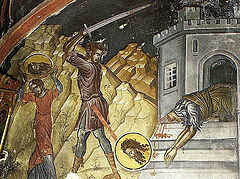
Here is such a pillar—truly a pillar of fire reaching up to heaven—who, having been a great ascetic since childhood, is subjected to an absolutely dishonorable punishment. We can understand when it is a host of martyrs—each of them suffered for Christ, defending their faith and proving it through patience in terrible suffering. But what about the Forerunner? He was imprisoned for denouncing Herod, his adulterous cohabitation with another man’s wife. And how was he slain? As a result of a vile, scheming woman’s intrigue.
This is why the Lord—as He Himself testified that the Forerunner is the first and greatest of the prophets—allows such dishonor to happen to His great chosen one. Christ Himself performed a similar feat, suffering outside the camp—that is, outside Jerusalem, through a shameful execution fit for a robber. The Forerunner merely foreshadowed Christ’s own sacrifice. And the very dishonor that he endured was the greatest honor before God.
Our earthly life is not measured by human concepts and categories. As the Holy Scriptures say: Surely men of low degree are vanity, and men of high degree are a lie: to be laid in the balance, they are altogether lighter than vanity (Ps. 61:10). God’s truth differs from human truth as the earth differs from heaven—from Heaven, where there is everlasting blessedness.
Therefore, as we endure various sorrowful or painful circumstances in this life, we must remember the example of the holy Forerunner of the Lord, John, who showed great love for God through his entire life. Yet, this is still not enough. The Forerunner demonstrated his love for God by accepting this martyrdom of dishonor. That is the key—to accept everything from God, even that which completely contradicts our own expectations.
If we are subjected to some kind of punishment or injustice, you and I, of course, understand perfectly well that it is for our sins. This is because we are exceedingly negligent, lazy, and passionate people, and we need all of this to be healed through sorrows. For otherwise, we simply will not be saved. We do not know how to struggle any other way: we perform no ascetic labors, nor anything good to set us apart from our passions. We are saved only by enduring sorrows and illnesses.
The Forerunner possessed every single virtue. And yet, he accepted these injustices and a shameful martyrdom. This is how a person walks towards God, towards perfection. May this example be a great encouragement to us in our own minor sorrows, which, unlike his, are fully deserved. May we accept them with joy and the awareness that God sends them to us; that His loving hand is sending medicine for our sick souls. May this realization always bring joy to our lives.
Today, we ask the holy Forerunner, as our dear and beloved saint, to grant us at least some zeal in the face of our negligence and infirmities, so that we may have the strength to fast, to withdraw from worldly vanity, to spend time in solitude, and to pray more while in that solitude. Of course, not according to his measure, but according to ours. We also need this, and we truly desire that through his prayers grace may be given to us to accomplish at least a small, even a tiny spiritual labor in this earthly life, to strive if only a little for the Kingdom of God. And let everything else be filled out by the sorrows sent to us by our loving God, without which no one can be saved, and in which we have yet another consolation.
As I have mentioned many times in my sermons, St. Gabriel of Samtavro received a revelation from God that Christ suffered in His humanity, whereas in His Divinity He cannot suffer. In His human nature, He co-suffers with us in our every sorrow even more than we ourselves suffer.
Why was there a revelation associated with the “Unexpected Joy” icon that we crucify God over and over again?1 True, as we read in the Canon of Preparation for Holy Communion (Troparion 1 of Ode 9): “Who… once offered Himself as an Offering to His Father.” Of course, Christ was immolated only once; yet in His soul, He grieves with us, suffers with us, and is crucified with us—with each one of us individually, in all His Divine love and compassion. Therefore, when we suffer, our God and Savior Jesus Christ suffers with us; and by His power and grace may we attain the eternal Heavenly Kingdom. Amen.