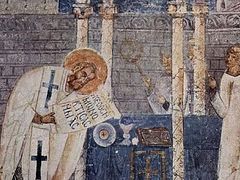
Khayrulinov I.S. A Mother's Blessing. Photo: culture.alregn.ru Analyzing the text of the Divine Liturgy, we’ve come to the Small Entrance or the Entrance with the Gospel. This was the starting point for the Liturgy in antiquity, when the clergy brought the Gospel book into the church and placed it on the holy altar. The Gospel wasn’t kept on the altar in those days, but in a separate room. Now, the entrance with the Gospel is done as follows: During the singing of the Third Antiphon, the priest bows before the altar, takes the Gospel from it and hands it to the deacon. They both exit through the north door of the altar, walk along the solea, and return into the altar through the Royal Doors. Lit candles are carried before the Gospel, symbolizing St. John the Baptist, who preceded Christ, Who is represented by the Holy Gospel.
During this procession, the priest quietly reads a prayer, which the congregation doesn’t hear. But it’s a very wonderful and important prayer in terms of its contents. Let’s read it:
O Master, Lord our God, Who hast appointed in the Heavens ranks and hosts of angels and archangels unto the service of Thy glory: With our entry do Thou cause the entry of the holy angels, serving and glorifying Thy goodness with us. For unto Thee is due all glory, honor, and worship: to the Father, and to the Son, and to the Holy Spirit, now and ever and unto the ages of ages. Amen.
As you can see, the carrying of the Gospel into the altar is accompanied by an important prayer, in which we clergy implore God to bless us, that our entrance might be with the entrance of the holy angels. In the same way, we ask God’s blessing on every other thing we do during the Liturgy.
It’s wonderful when the faithful have the good habit of asking God’s blessing for everything in their daily lives. I can say that back in the days of our grandfathers and grandmothers, Christians had the good habit of asking God’s blessing for their lives, their labors, every task they embarked upon, down to even coming and leaving from home, not to mention more serious things.
I remember how our grandmothers would cross themselves and ask God’s help before leaving the house in the morning. Before opening their cabinet, they’d make the sign of the Cross over it. They kept all their possessions in there: nuts, candy, clothes, money—they had everything in there. And on the cabinet doors, they’d inscribe important family events: children’s birthdays, when someone fell ill, when someone died. The cabinet doors were like a real records office. In one village museum I saw one of these cabinet doors. What wasn’t recorded there! A mass of information! The date of an earthquake, when the river overflowed and flooded the village, when a daughter was born… And before going to bed, our grandmothers and grandfathers would bless their pillows with the sign of the Cross. In general, in many life situations, they would resort to the sign of the Cross.
Whenever we bless ourselves with the sign of the Cross, we receive great benefit, because that’s how we entreat God to bless our acts and deeds. For example, if a man learns not to indulge in idle thoughts, slothfulness, self-indulgence, and the like upon waking from sleep, but to immediately make the sign of the Cross and call upon the name of God, saying, “Glory to Thee, O God!” then his whole day will unfold completely differently. If he manages to begin by praying in a whisper (in the first minutes after waking up, the mind is still half-asleep, and it can be difficult to pray any other way), then his whole day will pass in a prayerful spirit. This is very important for anyone who wants to learn prayer. Thus, the beginning of our day, all our affairs, and our whole life receive a blessing.
I’ve often been witness to the nervous agitation that people go to work with: hurrying, trying to overtake one another, exchanging curses. It’s early in the morning, and people are already on edge. Annoyed, a gloomy face, a cigarette in their mouths, they rush off to work. If the morning has just begun, why do you already look so gloomy? Of course, nothing like this would happen if people would seal all their comings and goings with the sign of the Precious Cross, calling upon the name of Christ, the Mother of God, and the saints. When a man doesn’t have a sense of God’s presence, then he quickly gets tired—physically, mentally, psychologically, and spiritually. But when a man wakes up in the morning and calls upon the name of Christ, blesses himself with the sign of the Cross, and his car, his work; when he feels God near him and entreats His blessing on all his deeds, then everything in his life is transfigured.
In monasteries, monks even make the sign of the Cross over the food they’re cooking. The cook blesses the pot when he puts it on the fire. Before pouring oil from a large barrel in the cellar or taking things from the pantry, they also bless them with the sign of the Cross. Everything is done with a blessing, with an invocation of the name of God, with gratitude to God for everything He’s given us, with praise. This is the only way our life can become an unceasing glorification of God. This is the only way we can be liberated from anxiety, stress, and the miserable spiritual state we’re in.
St. John Chrysostom advises parents to bless their children with the sign of the Precious Cross that they might receive sanctification and blessing, and their souls might partake of the grace of the Holy Spirit. Children shouldn’t get used to ugly, demonic things—they must be protected from all this. And now sometimes adults, without realizing it, themselves cause the “savagery” of their children’s souls, when they dress them in t-shirts with pictures of some kind of monsters on them. It’s better to put a t-shirt on them with something kind and joyful on it: the sun, the sea, flowers, some cute little animal… After all, a baby’s soul can get used to the sight of scary, monstrous things. Do you really think the sight of a monster won’t influence the child’s spiritual world? Of course it does.
When you enter a room with an icon of Christ, the Mother of God, and a lampada burning, the smell of incense filling the air, your soul feels peaceful and calm. If you go somewhere where there are images of demons and monsters, where everything’s black and gloomy, your soul will feel disturbed. Our surroundings affect our soul. The Fathers of the Church talk about this. So we shouldn’t have anything aggressive or destructive to our spiritual peace around us. Even the wall color in our homes should help us remain calm and preserve spiritual harmony.
But let’s return to the Liturgy. You might ask: “Why do we need to do the Small Entrance with such solemnity, bless it, and read a special prayer?” I don’t think we’d be wrong if we said the Church established all this, among other reasons, so our lives wouldn’t be routine and gray. There’s nothing good in a prosaic, gray life. The ancient Greeks used to say: “A life without holidays is like a long road without an inn” (a saying of Democritus). That is, when there’s nothing in a man’s life to decorate it, then it’s like a long journey where you can’t find a single inn where you can relax and have a bite to eat. Even now, when we travel by car, every three or four hours we need somewhere to stop and take a rest. This was all the more necessary in ancient times, when long-distance travel was extremely tedious, since people had to go on foot or horseback.
Every nation has something that beautifies life and brings diversity to it: Church and folk holidays, traditions and customs. It’s great if our families have something like this, if we celebrate the Church feasts and try to diversify the atmosphere in our homes.
I’ll give you an example from monastic life. Monasteries have a Typikon defining the specifics of every day in terms of worship and meals. After all, the church, with its services, and the trapeza as a continuation of the service is the center of monastic life. The Typikon says, for example: “Today is [such and such a feast]. The church is adorned. At the meal, consolation is provided to the brethren.” That is, some good dish is prepared. Or the Typikon notes that there’s a dispensation for oil, or perhaps fish, during meals today.
You go to church and you realize it’s a feast; The church looks completely different from yesterday, adorned with cloths and veils in the appropriate color, as each feast has its own color of vestments and altar and analogion coverings. For feasts of the Theotokos, it’s blue; for the martyrs—red; for feasts of the Lord—gold; for the feast of Pentecost—green; for Pascha it’s white vestments, and so on.
The church is decorated differently depending on the rank of the feast, from full adornment for great feasts to minor adornment for lesser feasts. Similarly, the number of lampadas lit differs according to the rank of the feast. On feast days, all lampadas are lit, and for weekday services, just three. It’s a whole science, a whole art.
So, every day of the liturgical year has its own special features, with more than a little variety between the days. And a man needs such variety. Imagine you go to church for the Nativity service, and everything in the church is exactly as it was the day before, and the day before that, and all preceding days. Or you go to a festive trapeza and the food is cold and tasteless, no different from the day before. There’s nothing good about that. It doesn’t help people.
Even in the desert, the ascetics tried to do something on great feasts to distinguish them from other days of the year. For example, there was an ascetic in Karoulia who never ate milk, cheese, eggs, or anything like that. And what did he do on Pascha? On Pascha he would paint boiled potatoes red. Traditionally, Christians paint eggs red on Pascha. Instead of eggs, which this monk didn’t eat for the sake of asceticism, he had red potatoes.
You might ask: “Do eggs absolutely have to be red? It’s not a big deal if they’re white. Why do we need this? Why do we need that?” All this is necessary because it beautifies our life. It’s important for families to have wonderful family traditions. Many modern families fall apart or are on the brink of it because they don’t follow these traditions.
Nativity and the Nativity season are approaching. Decorate your house accordingly; try your best to create a festive atmosphere. Don’t waste these days; don’t let your life go by in a gray, mundane way. Even the great saints would decorate their caves however they could on the most significant days of the Church year. The Church wants to give meaning to our lives, to not allow them to become prosaic and mundane.
I remember when we were living at New Skete on Mt. Athos. I, as a priest, had only one vestment: an old, worn-out red phelonion sent to us by a priest from Cyprus. We had nothing else. And Elder Joseph didn’t allow us to buy other vestments. Our brotherhood was poor—we simply had no money for such purchases. And anyways, the ascetic spirit of the desert and the skete didn’t tolerate excesses. So, for example, we served Presanctified Liturgy during Lent in red vestments. We celebrated the Nativity of Christ in red vestments. We celebrated Pascha in red vestments. Personally, it didn’t bother me at all. I didn’t care what vestments I served in. But the other fathers started complaining:
“Can’t you change your vestments and serve in something else at least once?”
“And where am I supposed to get other vestments?”
Fortunately, one kind woman sewed white vestments on her own initiative and sent them to us at the skete. Elder Joseph was reluctant to send the package back (usually he either sent packages back or gave them to someone else), and we kept the vestments. Thus, we got a second set of vestments, in white.
You see, even monks get tired of seeing the same color every day. Diversity and change have their point. Of course, everything should be done in moderation, reasonably. Because sometimes we go to the other extreme and our excess turns our house into some kind of circus. Excess isn’t beneficial, because it negates everything beautiful. May you have just one good thing, so you can value it. A thousand good things reduce them all to zero and devalues them.
The older ones will remember how great it was when children used to get new clothes or shoes as a gift for major holidays. This was when children changed their shoes no more than once or twice a year. New shoes were a big event for kids, so holidays were significant for them. They could put on new shoes and really enjoy them and show them to others. Especially when you’re already older and your old shoes are too small, putting on new ones is a real pleasure.
But if a modern child has 50 pairs of shoes, he'll toss the new pair aside with an indifferent look on his face. If he has a ton of games, he’ll break a new game in a second—it’s not interesting to him; maybe he doesn’t even look at it; he has 200 other games. Having too many things devalues everything for him. And then when such a child grows older, it’ll be impossible to satisfy him with anything. He’ll always be looking for something false for himself to try to find the meaning of life in it. Sometimes you see children from rich families who have everything, and they take drugs, smoke marijuana, or drink all kinds of garbage. Why do people drink? Because their lives are boring, colorless, tasteless. If you give someone fifty dishes, he won’t be able to eat anything at all; he’ll lose his appetite. He’ll get sick of the abundance of food, the very smell of it, and won’t even want to eat anything anymore. Whereas, with a hungry man, if you put just one or two dishes in front of him, he eats them with great pleasure, and he even grabs a piece of bread to clean his plate with, so he won’t have to wash it then.
I’m saying all this so we understand that the liturgical life of the Church can serve as an example for our daily lives. Let’s take care of our homes and families—not allowing our lives to get gray and monotonous, but filling them with color and diversity. Let’s bring a special beauty to certain days, so feast days aren’t like regular days, so the morning isn’t like the evening, so that every moment, every hour has its own beauty, its own characteristics, its own uniqueness. I could talk about this for hours, but time won’t allow us, and we’re not here for home economics lessons.