Do Thou Thyself now fulfill the requests of Thy servants to their profit
The Lord promised to fulfill the petitions of those who pray in His name. Everything that the Lord has promised, He fulfills, if only our petitions are truly beneficial for us. God alone knows what’s good for us. We ask God for many things: I want go there, I want to study here, I want to do this—and we think it’s all beneficial for us, that we need all this. But, in fact, only God knows if we truly need these things. Therefore, when we make requests of God, we always leave the decision up to Him. And therefore, we don’t fall into despair when nothing turns out as we wanted, but we simply and joyfully accept what the Lord sends us.
For example, we pray: “Lord, let everything be good with my company.” But things get worse day by day, and my business closes down. May it be blessed. Now I have to figure what to do in these new circumstances. After all, this is what’s been given to me to work on the salvation of my soul. Salvation is our main need; everything else is secondary. Of course, work and classes are necessary and useful; our whole life is spent in them. But even if we don’t manage to save our company, it doesn’t mean life is over, that we’re complete losers. What is luck, success for a Christian? It’s the salvation of the soul. If we have found salvation, then we have truly succeeded in life, and vice versa.
That’s why the prayer continues:
Granting us in this present age the knowledge of Thy truth
You see what the priest asks on behalf of the people: that God would grant us knowledge of His truth in this present life. That we would know what’s true, what’s genuine, what God wants from us, and not what’s false, vain, and misleading.
Wherein lies the truth of God? In that God became Man for the sake of the salvation of every one of us. This should be our focus in this present life.
In the Paterikon, we read about the holy ascetic Abba Isidore. He labored in the Egyptian desert, spending his life in the strictest abstinence and unceasing prayer. When he grew old and his bodily strength left him, the fathers told him:
“Give yourself some rest, Elder! You’re all withered up from asceticism. Give yourself some peace at last.”
And Abba Isidore answered them:
“If they burn Isidore and scatter his ashes to the wind, even then he won’t give himself any rest, because the Son of God became man for our sake.”
This saint came to know the truth of God in this present age. He knew and felt the meaning of the great event of God’s incarnation for our salvation. And if we understand that God became Man for all of us, that He saved us and gave us the chance to become gods, then we not only won’t commit sins, but won’t allow ourselves any relaxation in spiritual struggle. This is attested to by the ascetic experience of our Church.
We know many elders who, despite their advanced age, labor in asceticism, fast, make prostrations, spend whole nights in vigil for the sake of the love of Christ. On the Holy Mountain, we saw elders who had literally withered their bodies in asceticism, and because the fire of love for God hadn’t been extinguished or even weakened in their souls, their bodily labors didn’t weaken either.
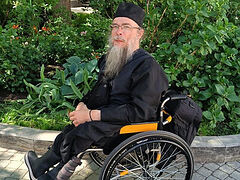
I well remember one such elder, Fr. Sergei, a Russian.
When we were living in Koutloumousiou Monastery in the 80s, I served as the gatekeeper, which meant I often met Fr. Sergei, whose path from his distant hermitage to the Athonite capital of Karyes passed through our monastery. His skete was located about an hour and a half or two hours from us on foot. A walk, it should be noted, not along the coast, but through the mountains, with alternating ascents and descents. The elder always had a large sack on his back, full of various things. They were purchases he had made in Karyes for the fathers of his skete and all those around. When the skete fathers needed something from Karyes, they’d confer: “Who should we send? Let’s send Fr. Sergei.”
This elder made several hours-long trips from skete to Karyes and back every week, with as much as ninety pounds on his back. He had a very simple character and spoke imperfect Greek. Every time he came through the monastery, I asked him:
“How are you, Elder? Would you like anything?”
And he always answered with childlike simplicity:
“I’d like to eat.”
The poor, impoverished ascetic. He never cooked in his cell, which was just a dilapidated shed with a leaky roof.
We’d give him something to eat.
One Monday, we had a small feast in our monastery, so we were allowed to use vegetable oil at trapeza (Monday is typically a strict fasting day for monastics). Elder Sergei came, yellow from excessive abstinence, exhausted and haggard from walking with a load on his back. I brought him something to eat. But as soon as he saw the oil in the food, he refused:
“I can’t have oil today.”
“Father, eat. It’s a feast for us today. Besides, it’s not Wednesday or Friday, but Monday…”
“No, no, I can’t.”
And he left without eating.
When this Elder died and we went to his skete for the funeral, the fathers there invited us:
“Come see what kind of man he was.”
They removed the shoes from the deceased Elder and we saw that the soles of his feet were literally rotten from ulcers — so many that the bones were exposed. And with these feet, at ninety years of age, he walked several hours with a large load almost every day, not allowing himself even the slightest indulgence. At the same time, he was always filled with peace, and the Holy Spirit illuminated his haggard face. He didn’t grumble, didn’t complain, never said: “I have to go alone every time? Let the other fathers go get what we need.” Nothing like that. He responded to every request with: “With pleasure.”
This was an example of a man who came to know the truth of God and understood what it means that God became man for our sake.
At every Liturgy, the priest prays to God to give us knowledge of the truth. Not so we could undertake some great asceticism, but that our souls might be filled with zeal and love of honor, and we might struggle at least a little in the most elementary things that we must observe as Christians, in order to obtain and retain the grace of God.
Granting us … in that [age] to come, life everlasting.
If we come to know the truth in this life, if we choose it for ourselves and follow it, then we’ll move on to a future life of blessedness. You see, the gifts of God begin with the present life. We don’t expect to know the Mysteries of God only when we cross into the other life. That’s not what the Orthodox Church teaches. Healing, salvation, Paradise, the Kingdom of God begin here. And if in this life we don’t sense the grace of God, the joy of eternal life, then we won’t feel all this in eternity. If we want to know what awaits us in the life of the future age, we have to look at what kind of spirit we have within us now. Do we love God? Do we desire Him? Do we labor for the love of God? If yes, then this love, this desire, will continue after we pass into eternity.
If our spirit is dead, if we don’t desire God, don’t love Him, don’t feel anything, don’t understand anything, it means something’s not right with us. Of course, if even in this state we don’t give up our spiritual labors, if we confess, if we try to keep the commandments of God, then we can be sure that the hour of our resurrection will surely come! Because the resurrection of the dead begins with this present life. First our dead soul will rise, and then, at the Second Coming of the Lord, our dead body will also resurrect.
Having quietly read the prayer of the Third Antiphon, the priest loudly exclaims its final words:
For a good God art Thou and the lover of mankind, and to Thee do we send up glory: to the Father, and to the Son, and the Holy Spirit: now and ever, and unto the ages of ages.
We ask all this of you, O God, because You are good, the lover of mankind, full of goodness, and there is not a single trace of malice or guile in You. You love man.
God loves us, has compassion upon us, awaits our conversion to Him, cares for us, and embraces us with Fatherly love. Since God is so disposed towards us, we can ask Him for all these spiritual gifts that we need for our salvation.