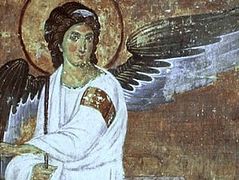
Let’s return to the prayer of the Small Entrance. In it, the priest addresses God, Who created the “ranks and hosts of angels and archangels;” that is, He created the spiritual world. According to the Church’s teaching, the angels are good spirits, created by God before the creation of the material world. And just as God is the God of order (cf. 1 Cor. 14:33), so the angels, being creations of God, were created in great order. There are ranks of angels, and every rank has received its own special gifts from God, its own measure of perfection. There’s a difference among the angels, depending on the degree of their perfection: There are angels who are closer to God, and angels who are farther from Him. At the same time, they all abide in direct communion with God.
Every angel receives his own particular obedience and labors from God. There are angels who are charged with protecting people. As you know, each person has his own guardian angel. Christ Himself speaks about it in the Gospels: Take heed that ye despise not one of these little ones; for I say unto you, That in Heaven their angels do always behold the face of My Father Which is in Heaven (Mt. 18:10). That is, the angels stand before God and pray to Him for us. There are prayers to our guardian angels in which we entreat that our angel preserve us, help us, and intercede for us before God. Angels have appeared to men many times.
Here’s something that happened one time when we lived at New Skete. Our Elder Joseph was coming up to our cell from the shore, and we, the brethren, saw two people coming up—the Elder and someone else. We thought someone was coming for a visit. It wasn’t just one or two brothers who saw this, but twenty or thirty. When the Elder finally made it, he was alone. We asked him:
“Geronda, didn’t someone else come up with you?”
“No.”
“We all saw two people.”
“It was me and an angel.”
And not just individual people, but entire nations have their own angel. The Old Testament tells us that when the Prophet Daniel was fasting and praying to God for the Jews’ deliverance from Babylonian captivity, an archangel appeared to him and said:
“You’ve been fasting for twenty-one days now, and your request will be fulfilled. However, the angel who intercedes for the Persians is opposed to this. He doesn’t want the Jews to depart from the Persians, because for the sake of the Jews who are in Babylon, God blesses the Persian people, and the Persians will come to know God” (cf. Dan. 10:2–13).
Although the Persians were pagans, they nevertheless had an angel who took care that they might gradually turn to God and that they had everything they needed for this. So, a person, a people, and a country all have angels. And every Orthodox church has its angel, which we mentioned in one of our first talks.
“Unto the service of Thy glory.” Why did God create the angels, archangels, and the other angelic ranks? Was He in need of them? No, God doesn’t need anything. He didn’t need any helpers. Why did He create the spiritual world of the angels, the rich material world of plants, animals, birds, and the rest, and after that, us, men? Every man is unique and unrepeatable. There are no two identical people. Why did God create all of this? In order to show the riches of His grace, His love, which extends to everything. It’s impossible to love and be alone. And conversely, someone who’s alone can’t love. Who is there for him to love? Himself? The more love is poured out, the more it grows. Distributing it doesn’t diminish it, doesn’t impoverish it. Thus, God created the angels and archangels to serve His glory, and also to serve man and help him obtain salvation.
Then the prayer has these words: “With our entry do Thou cause the entry of the holy angels, serving and glorifying Thy goodness with us.” Grant, O God, that our entry into the Holy of Holies might also be the entrance of the holy angels and archangels, that all the angelic powers might be with us, concelebrating with us, helping us celebrate the Divine Liturgy unto the remission of sins and the salvation of the entire world, glorifying Thee together with us and strengthening us in the praise of Thy goodness.
We’re not alone at the Divine Liturgy. The Mother of God, the saints, and the ranks of holy angels and archangels are present there. If God would open our eyes to see what’s happening in church during Liturgy, no one would be able to stay there, in a place so highly sanctified and filled with the grace of God and the presence of the holy angels and archangels. Many saints of our Church have been honored to contemplate the presence of angelic powers during the celebration of the Divine Liturgy.
I’ll tell you a story from our life on the Holy Mountain. We weren’t living in the skete anymore at this point, but in the monastery. According to our typikon, we would pray on our prayer ropes in our cells in the evening until midnight, and at midnight we’d serve Liturgy in the church. The fathers sang quietly, simply. At some point, when the chanter finished one hymn, the entire church was suddenly filled with a Heavenly, angelic chanting. There were angels at this Liturgy, like every Liturgy, and God allowed everyone to hear their wondrous chanting, which sounded like a giant choir singing. But there was no choir in the church; there were only a few of us there. Everyone at the service heard this angelic chanting.
Elder Iakovos (Tsalikis) from St. David Monastery in Evia often spoke (which we ourselves heard), with his characteristic simplicity, about the presence of angels at Liturgy. One day, during the service, he saw the entire church filled with angels. And he wondered: “How can I do the entrance? I can’t get through—it’s too crowded.”
Attending Divine Liturgy is of great benefit for us, since our souls receive sanctification and it’s a chance to be in communion with the saints, the angels, the Theotokos, and Christ Himself, and to glorify God, to Whom belongs “all glory, honor, and worship, to the Father, and to the Son, and to the Holy Spirit.”
As the priest and deacon approach the Royal Doors, the deacon addresses the priest, saying: “Bless, master, the holy entrance.” The priest, having finished reading his prayer by this point, makes the sign of the Precious Cross with his right hand before the Royal Doors and says: “Blessed is the entry of Thy holy ones always, now and ever and unto the ages of ages.” As you can see, everything is blessed, everything is sanctified, even holy things. The entrance into the holy altar is blessed in and of itself, but it still receives a blessing, and therefore it blesses us. When we say: “Blessed is our God,” we bless the name of God and receive a blessing from God at the same time.
To be continued…