Photo: Mikhail Zobov / fotokto.ru
In our last talk, we looked at the content of the prayer of the Small Entrance and talked about the importance the Church attaches to every action in the Liturgy. And we stopped at the point when the priest makes the sign of the Precious Cross in front of the Royal Doors, saying: “Blessed is the entry of Thy holy ones always, now and ever and unto the ages of ages.”
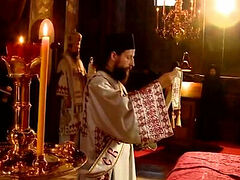
After that, the deacon raises the Gospel, which he carries during the Small Entrance, and exclaims: “Wisdom! Aright!” By raising the Gospel, he therefore points to it, drawing the gaze of the faithful to it. “Wisdom” refers to the Gospel, since it’s the word of God, true wisdom, the light of this world. The reading of the Gospel will follow soon, so the Church calls us to stand upright. We pray mostly standing up in church during Liturgy. In our private prayer at home, we can prostrate ourselves, kneel and pray for long stretches in a bowed position. But in church, during the Divine Liturgy, we should stand upright on our feet. The Church established this because we’re children of God; every one of us is the image of God, and it’s fitting that we gaze upon our Father standing upright.
We hear the exclamation, “Wisdom! Aright!” often during the services. And that’s no accident. Every time the Church proclaims, through the mouth of the deacon, “Wisdom,” it’s rousing us to turn our attention, our mind and heart to true wisdom. We see a lot around us that has the guise of wisdom: various philosophical trends, ideologies, theories, and the like. It’s always been like that—every era had its own thing. However, the true wisdom that should guide those who desire to be with God is the word of God. The word of God is every word that God speaks to us through the Prophets, Apostles, the saints of our Church, but it’s especially the words of the Gospel, describing the life and preaching of our Lord Jesus Christ.
Therefore, it’s important for all of us to read the Gospel and know how the Church and the Holy Fathers understand it, so it can serve as a yardstick and criterion for our lives. We often wonder if our words or actions are right, or if we should behave differently. If we would read the Gospel and know the New Testament, we’d have ready-made answers. After all, the word of God through the Holy Apostles shows us the character and disposition of Christ—the disposition that every man who desires to live in Christ should have. The Gospel doesn’t contain any obscure passages or anything that would cause you to doubt its truth. The Gospel is the purest truth, the true light that comes from the Sun of Truth, Christ.
I’m often asked: “How do we know that everything Christ taught is true? And why aren’t the teachings of other religions true?” It’s a logical question. Here’s my answer: Take the Gospel, read it, study it, and everything will become clear. Everyone can and should undertake this research. The Gospel itself urges us to “search the Scriptures” (Jn. 5:39). We shouldn’t be passive and indifferent. We should have the desire to find and comprehend the truth. Great riches and precious treasures are concealed within the word of God. To find these riches, you must, figuratively speaking, arm yourself with a hoe or shovel and start digging—that is, studying and researching the word of God.
For a man who has a good will and healthy spiritual sense, this reading will convince him of the truth of the Gospel. Because, as Christ says: The light shineth in darkness (Jn. 1:5). Light can be seen in darkness. Imagine if all the chandeliers in this hall went out and we lit one small candle. Its light will be seen in the darkness even from far away. However much darkness there is in your soul, even one ray of Gospel light will overcome the power of this darkness.
When you read the Gospel, you come to understand that Christ is the “true Light” (Jn. 1:9). Everything else is human, carnal, and simply doesn’t compare to the true light of the Gospel. In saying this, I’m not trying to disparage or condemn the scriptures and sacred writings of other religions. No, we come to this conclusion on the basis of our own experience, our own research. Nothing can stand before the light of Christ. It possesses a truth, inherent to it, that nothing can replace.
Every twenty to thirty, forty to fifty years or so the world is seized by one or another ideology (political, philosophical, religious, whatever) promising to reveal the great secret of success to mankind. But over time, all these ideologies become obsolete. Just as the sun sinks toward the horizon, dips below it, and disappears, so it is with ideologies. Christ’s true light, though, is a light that never sets; it knows no sunset.
When I lived on the Holy Mountain, I had occasion, as a confessor, to speak with young people who were interested in Eastern religions. I got the desire to see what the sacred books of Hinduism were about, and I asked our Elder Joseph if he’d bless me to read them. The Elder blessed it. Someone brought me the Mahabharata, the Bhagavad Gita, and some others—about a dozen books, and I started reading them. From the first pages, I had a feeling like I was sinking into a dark abyss. Darkness! Pitch black! And how much I pity those who suffer in this darkness. Meanwhile, the Gospel may seem simple at first glance, but in reality it contains an immeasurable depth of meanings that are revealed to those who study the Gospel correctly.
What does it mean to study the Gospel correctly? I definitely don’t mean intellectual research. The Gospel contains a mystery that God reveals to a man at a certain point in his life or reveals it constantly throughout his life (God alone knows how He does it), thanks to which he plunges into the depths of the Gospel. Recall how the Evangelist Luke, in describing the disciples encountering the Risen Savior, notes: Then opened He their understanding, that they might understand the scriptures (Lk. 24:45). Although the disciples spent three years with Christ, and being pious Jews, they read and heard the words of Scripture many times, nevertheless, until the moment they couldn’t penetrate the depths of their meaning. They heard the Scriptures, understood them with their minds, but they couldn’t comprehend them with their hearts. It’s only possible to penetrate into the depths of grace contained in the words of the Gospel through the gift of the Holy Spirit.
The Gospel is the purest truth. Comparing the teaching of Christ with that of other religions convinces you even more of what a pure light the Gospel is. In comparison with this light, everything else looks like darkness—just as sunlight looks like darkness in comparison to the Uncreated Light.
There’s a remarkable case in the life of Elder Paisios the Athonite. When the Elder was laboring in Katounakia, one night during prayer, he was vouchsafed to behold the Uncreated Light for several hours. When he finally came out of his cell and met the monk who lived next door, he asked him:
“Is it really not dawn yet?”
“Father, it’s 11:00 in the morning, almost noon,” the other monk answered.
But Elder Paisios thought the sun hadn’t even risen yet, because after contemplating the Uncreated Light of Divine grace, the created light of the sun seemed like real darkness.
Similarly, the Gospel is no way comparable to human attempts to connect with God, to create some kind of religion. After all, what is religion? It’s a man’s attempt to explain God to himself, to draw near to Him, to propitiate Him, to make friends with Him. That is, it’s the movement of man towards God. The Gospel moves the other way—the movement of God towards man. God reveals Himself to man, and man labors to heal his soul, to become capable of receiving and assimilating God’s revelation.
To be continued…