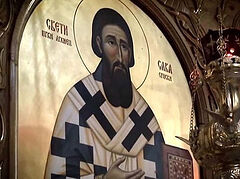
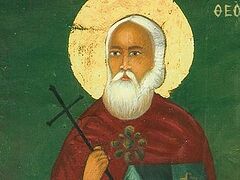
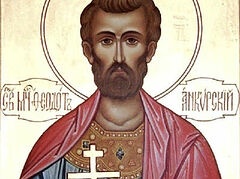
St. Prince Vladimir and the Martyr Eustathius Placidas. Frescoes by Dionysius at the Ferapontov Monastery.
October 3 is the feast day of the Great Martyr Eustathius Placidas.
This saint is not as widely venerated as he once was in Russia. There was a time when a solemn divine service was celebrated in one of the cathedrals of the Moscow Kremlin on his feast day. What, then, is St. Eustathius Placidas known for, and where in the modern world do we encounter unexpected reminders of him?
Called Like Paul
 Great Martyr Eustathius, his wife the Martyr Theopistia, and their children, the Martyrs Agapius and Theopistus. Placidas was a great Roman military commander whose very name struck terror into his enemies. He was wealthy, but generously spent his means on works of mercy. He loved helping others far more than fighting, yet he always fulfilled his military duty to the utmost. His wife was likewise kind and generous, although they both worshipped pagan gods.
Seeing into the very depths of the human heart, the Lord Himself chose to lead Placidas to the truth. One day the commander went hunting. As he rode his swift horse in pursuit of the largest and strongest stag, which had become separated from the herd, he suddenly saw a radiant cross between the animal’s antlers, and upon it Christ crucified. Struck by the miracle, the hunter heard a voice asking him, as it had once asked the Apostle Paul:
“Why dost thou persecute Me? I desire thy salvation!”
After this, Placidas embraced the Christian faith and received the name Eustathius. His wife, who had also experienced an extraordinary vision in a dream, and their young sons were baptized together with him.
From this point, events might have unfolded as they do in many other Lives of the ancient Christian martyrs: persecution, torture, demands to renounce Christ, and execution. But before any of this, the family still had a long trial of faith ahead of them…
He Suffered Like Job
Soon calamities befell the household of Placidas. His servants died of disease, his livestock perished, and his property, left unguarded, was plundered. Only recently he had been a wealthy and distinguished military commander; now he was a pauper. Yet he did not become embittered against the whole world or against God. Instead, he humbly repeated the words of the much-suffering Job:
“The Lord gave, and the Lord hath taken away; blessed be the name of the Lord!”
Perhaps, as a favorite of the emperor he might have regained his former greatness. Instead, he decided to move with his wife and children to a place where no one knew them and to live quietly and humbly among ordinary people, glorifying God.
The owner of the ship on which they set out toward Egypt was a man accustomed always to getting whatever he wanted. This time he took a liking to the former commander’s young and beautiful wife. What could Eustathius, burdened with two small children, do against the owner of the vessel and his crew? For a strong and courageous man, it was unbearably bitter to realize that he had been unable to protect his beloved wife…
Even more painful was the realization that he had failed to preserve his sons. To cross a turbulent river, he had to carry the boys across one at a time on his shoulders. When one son was already on one bank and his father was crossing the river to fetch the other, a lion carried off the first son, while a wolf seized the second.
Placidas was left completely alone. The Lord was his only support and consolation.
The Reunion
For fifteen years the Roman commander earned his bread by the hardest labor, devoting whatever strength and time remained to prayer. He did not know that his children, rescued by local inhabitants, were being raised in neighboring villages, nor that his wife, preserved by God’s providence from the lustful shipowner, was quietly living in a distant land in labor and prayer.
Meanwhile, Emperor Trajan, compelled to wage many wars and not always successfully, sadly remembered his missing commander. Two soldiers resolved to search for their former comrade-in-arms, though they did not immediately recognize him in the impoverished laborer. Before long, however, glorious reports of new and valiant victories won by Placidas once again resounded throughout the land.
Soon a military levy was proclaimed throughout the empire, and among those summoned to serve in Rome were Eustathius’s sons. As it happened, the two young men became friends; and the commander felt a fatherly affection for them as soon as he laid eyes upon them. Yet none of them discovered that they were related until they came to the distant village where their mother lived.
There, at last, the tangled knot of separations, losses, and sufferings was completely unraveled. Like the Prophet Jonah, those who had disappeared were found alive and returned. Like Joseph and his brethren, the family rejoiced at finding one another again.
The family was reunited.
But while they were all returning together to Rome, Emperor Trajan, who had favored Placidas, died, and in his place came a new emperor who hated Christians.
Memory
 Detail from a painting dedicated to the Holy Great Martyr Eustathius by the contemporary Serbian artist Katarina Feigel. On September 20/October 3, the Church commemorates not only St. Placidas, but also his wife and children. Together they accepted death rather than obey the pagan ruler’s demand that they worship idols. At first they were entreated to comply; then wild beasts were set upon them; but the animals would not harm God’s righteous servants. Finally, the martyrs were cast into a red-hot bronze bull to be burned alive.
When people came the following day expecting to find their charred remains, they discovered the bodies of the departed unharmed.
Placidas became one of the earliest Great Martyrs of Christianity. Although there is still no universal agreement as to whether this rank of sanctity is given to those who belonged to the nobility or to those who endured especially grievous torments, St. Eustathius fits both descriptions.
The faithful often turn to this saint when praying for the reunion of families and for children who have fallen into danger. He is loved and venerated by Orthodox Christians and Catholics alike. The former honor him as a victorious Christian—hence the comparisons drawn between him and the Byzantine Emperor Constantine and the Russian Prince Vladimir. The latter, incidentally, named one of his grandsons after the Great Martyr.
Catholics also honor Eustathius as a patron saint of hunters and foresters. Later, St. Hubert became better known in this capacity; according to his Life, he too encountered a stag with a cross between its antlers. This event is depicted on the label of a popular German liqueur. Yet it should not be forgotten that there was another saint who had the same happened many centuries earlier.
It is also noteworthy that Columbus named a Caribbean island after the saint.
Finally, one of the largest churches in Paris, built in imitation of the famous Notre-Dame and serving in part as its replacement during the cathedral’s restoration, is Saint-Eustache—the Church of St. Eustathius. Relics of the Great Martyr are found not only in France, but also in the Church of the Holy Sepulchre in Jerusalem, in Greek churches and monasteries—including on Mount Athos—and in Russia, at the Solovki Monastery and the Annunciation Cathedral of the Moscow Kremlin.
“Let Not Evil Separate Me from the Love of the Lord”
The story of the family of Placidas reads like an adventure novel. Yet the literary elements in the saint’s Life do not diminish the principal meaning of the account: Whatever misfortunes and calamities may befall us, there is no greater calamity than to reject God and lose hope in His protection.
Perhaps this is why the saint was so greatly loved from the days of ancient Rus’. Eustathius, a newly converted Christian who understood how difficult the path ahead of him would be, asked for only one thing:
“O Lord, if it is impossible for me to escape temptations altogether, then grant that I may endure these tribulations now; only send me Thy help, that evil may not overcome me and separate me from Thy love.”
The newly baptized land of Rus’ likewise had many trials awaiting it, and it too could repeat after the Great Martyr:
“Help us, O Lord, that evil may not overcome us and separate us from Thy love.”
And indeed, these words are no less relevant for us today.