In the name of the Father, and of the Son, and of the Holy Spirit!
Beloved brothers and sisters in the Lord! On this day, the Holy Church commemorates the Prophet Jonah, one of the Twelve Minor Prophets, who lived in the eighth century before the Nativity of Christ. His image is truly unique. Through his brief yet remarkably profound Book, the Lord reveals to us the truth of His mercy, the power of repentance, and the mysterious prefiguration of His Resurrection.
The Prophet Jonah, “the son of Amittai” (בֶן־אֲמִתַּי), hailed from the ancient town of Gath-Hepher in Galilee. He lived during the reign of King Jeroboam II of Israel (c. 793–753 BC; cf. 3 Kings 14:25; 4 Kings 14:25), a time when Israel enjoyed a brief period of political resurgence but was internally in a state of spiritual decay. As church scholars rightly note, his book is narrative in nature, revealing not only the prophecy of Nineveh’s impending punishment but also the inner drama of God’s messenger.1
The Lord commanded Jonah to go to Nineveh, the capital of Assyria—a nation hostile to Israel—to proclaim its destruction unless its inhabitants repented. But seized with fear, the prophet fled in the opposite direction and found a ship going to Tarshish (תַּרְשִׁישׁ): so he paid the fare (Jon. 1:3). The sea raged, the sailors cast lots, and the lot fell on Jonah. He confessed, For I know that for my sake this great tempest is upon you (Jon. 1:12). At St. Jonah’s own request, he was cast into the deep, and the tempest subsided. Thus began the prophet’s descent into the depths—both physical and spiritual.
As the Holy Scriptures tell us, Now the Lord had prepared a great fish to swallow up Jonah. And Jonah was in the belly of the fish three days and three nights (Jon. 2:1). There, in the darkness and confinement of the belly of the “great fish”,2 which prefigures Sheol, the prophet offered up a prayer: I cried by reason of mine affliction unto the Lord, and He heard me; out of the belly of hell cried I, and Thou heardest my voice (Jon. 2:3). This prayer is one of the Scripture’s first hymns of repentance, where a man on the brink of despair thanks God for a deliverance that has not yet come to pass. God commanded the great fish, and it vomited the prophet out onto dry land (cf. Jon. 2:11).
Then, against his will, St. Jonah fulfilled the previously given command: he went to Nineveh and proclaimed that Yet forty days, and Nineveh shall be overthrown (Jon. 3:4). The city’s inhabitants—from the king to the livestock—repented in fasting and weeping, and God revoked the punishment (cf. Jon. 3:10). But instead of rejoicing over the salvation of a great city, St. Jonah grieved that the prophecy had not come true; he left the city and hid in the shade of a plant. When the source of shade suddenly withered, and Jonah, facing the scorching sun and sultry wind, found himself once again on the brink of death, God answered him with words that serve as the epilogue to the entire Book: Thou hast had pity on the gourd, for the which thou hast not labored, neither madest it grow; which came up in a night, and perished in a night: and should not I spare Nineveh, that great city, wherein are more than sixscore thousand persons that cannot discern between their right hand and their left hand (Jon. 4:10, 11). These words reveal the central theme of the Book: God’s infinite mercy, which surpasses human understanding of justice.
Even in the early Church, the image of the Prophet Jonah became a symbol of death and resurrection. This symbolism was rooted in the words of the Lord Jesus Christ: An evil and adulterous generation seeketh after a sign; and there shall no sign be given to it, but the sign of the Prophet Jonah: for as Jonah was three days and three nights in the whale’s belly; so shall the Son of man be three days and three nights in the heart of the earth (Mt. 12: 39, 40).
Jonah’s three days in the belly of the great fish were an Old Testament prefiguration of Christ’s three days in the tomb. The churning sea represents the element that drags people down; the fish signifies the grave; and Jonah’s emergence represents the restoration to life.
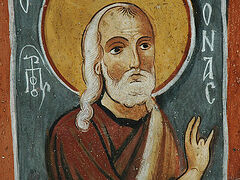
 The holy Prophet Jonah and the Whale. Fresco of the Church of St. John the Baptist in Derchi, Georgia. 17th c. The image of St. Jonah’s liberation from the shackles of death was so profound in deep antiquity that it became one of the first symbols of the resurrection in early Christian iconography. In the Roman catacombs of the third and fourth centuries,3 the scene of a giant fish spewing a young man onto the shore—his arms joyfully outstretched toward the heavens—was frequently depicted. Such images were placed on the walls of tombs and sarcophagi as a sign that death held no power over the faithful. This was further reinforced by the fact that in early Christian symbolism, the Greek word for “fish” (ἰχθύς) served as a cipher—an acronym characterizing the Lord: Ἰησοῦς Χριστός Θεοῦ Υἱός Σωτήρ, meaning “Jesus Christ, Son of God, Savior.” Thus, the Prophet Jonah emerging from the womb of the fish symbolized every believer delivered from the depths of death by Christ the Savior. On fourth-century sarcophagi, this scene was often placed alongside the miracle at Cana of Galilee or the Raising of Lazarus, all forming a unified iconography of hope for the life of the age to come.
In the works of early Christian writers—such as Tertullian, Sts. Irenaeus of Lyons, John Chrysostom, and Ephraim the Syrian—there is an idea that St. Jonah, having been “restored to obedience,” became a witness through his life to God’s victory over death. For instance, St. John Chrysostom noted: “Jonah was in the belly of the whale as Christ was in the tomb; Jonah came out alive, as Christ arose.”4 Blessed Jerome echoed this sentiment: “The three days of Jonah are a type of the Lord’s three days in the tomb,”5 and his emergence, consequently, was the firstfruits of the resurrection of all mankind. Thus, for early Christians, the Prophet Jonah was not merely a man saved by a miracle, but a witness to the fact that death can be conquered provided that you believe.
In the poetic homily of St. Ephraim the Syrian (†373), it is told how “Jonah prayed from inside the belly of the great sea monster, and, turning to God, was brought up from the depths to preach to a city submerged in evil. His prayer within the belly was accepted.”6
In the works of the Syriac poet Mar Jacob of Serug (c. 451–c. 521), God seems to educate Jonah, urging him to turn away from the outburst of anger that consumed him after God had forgiven the people of Nineveh. Mar Jacob’s memra contrasts “Jonah’s wrath” with “Nineveh’s repentance,” showcasing a pedagogy of mercy enacted on Jonah that culminates in his own repentance.7 From this, we can conclude that St. Jonah’s stay in the belly of the fish can be viewed not merely as a passive image of resurrection—independent of our will—but as a path of personal repentance, an ascent from the depths of disobedience to the light of forgiveness.
Dear brothers and sisters, the Prophet Jonah is each one of us when we run from God’s will, when we are unwilling to be sent to those we do not love. But like Jonah, “kicking against the goads” (cf. Acts 26:14), we do not encounter a calm sea, but a storm, and only repentance brings stillness to the soul. The path of Jonah is the path of every Christian: from flight to obedience, from fear to prayer, and from death to a new life.
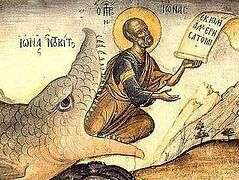
 The Life of the Holy Prophet Jonah. Byzantine miniature of the mid-tenth century. Three days in the belly of the great whale is not only a type of the death and resurrection, but also the mystery of our Baptism: immersion into the death of the old man and rebirth into a new life (cf. Rom. 6:4). St. Jonah, emerging from the womb of the whale, is like a person coming out of the baptismal font: he is born anew to live on earth according to the “new man,” in spirit and in truth. When we hear the Gospel of the “sign of Jonah,” we understand that the Lord is calling us to an inner transfiguration. For it is not so much external signs that save us, but our trust in God and the power of repentance. And even if Nineveh, a pagan city, heard the Word of God and repented, how much more should we, enlightened by the light of Christ, respond to the Gospel words with all our minds, with all our hearts, and with all our will.
May the memory of the Prophet Jonah strengthen us in hope and discernment. May we never cease to cry out to the Lord amidst the storms of our lives, just as St. Jonah did from the spiritual and physical abyss: Out of the belly of hell cried I, and Thou heardest my voice (Jon. 2:3). May each one of us always remember that there is no depth where prayer cannot resound, and no night that is not followed by the dawn of the third day—the day of Christ’s Resurrection. Amen.