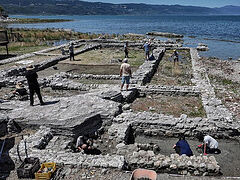
Altino, Venice Province, Italy, October 20, 2026
 Photo: unive.it
For centuries, ancient writers have spoken of a grand bishop’s church in Altino, but no one had ever found a trace of it. Now archaeologists say they’ve almost certainly located it, along with the bishop’s palace next to it.
The discovery comes from the 2026 excavation season by Ca’ Foscari University of Venice at the Altino Archaeological Park, together with findings from 2025. The church is a rectangular hall measuring roughly 98 by 66 feet, with no apse, and it faces east. Archaeologists date its founding to between the late 4th and the first half of the 5th century, the university reports.
To the east, the church connects to a large porticoed building with a complex layout, believed to be the bishop’s palace. It was probably two stories tall. The upper floor may have housed clergy, while the ground floor may have held privileged burials of bishops or other prominent figures, as suggested by remains of Late Antique mosaics.
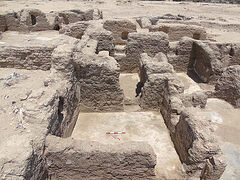
The foundations were built largely from paving stones pulled up from Roman roads.
The church is mentioned in the letters of St. Jerome to Heliodorus, Altino’s first bishop, and to his nephew Nepotian. In Letter 60, written in 396, St. Jerome describes the young priest’s care for the church’s altar, walls, floors, curtained doorways and sacred vessels. That matches the period when the newly found church was founded.
In the 6th and 7th centuries, a portico and a cemetery with brick-lined graves were added in front of the façade. Researchers found Christian artifacts too, including a small container decorated with a cross.
Archaeologists say the site stayed hidden because farming removed the upper layers of ruins, and because bricks and stones from Altino were carried off for building in Torcello and Venice. What survives are mostly “robber trenches,” dug to extract building materials, which leave the outlines of vanished structures. A provincial road also cuts through the middle of the church.
The find also changes the picture of how the episcopal seat moved from Altino to Torcello. Tradition holds that Altino’s nobility fled barbarian invasions. But Ca’ Foscari’s excavations at Torcello show the island served as Altino’s port, where a new religious building went up in the 7th century. The researchers say the move appears to have been a deliberate decision driven mainly by demographic and environmental factors, and that the Altino church was taken apart piece by piece by the first half of the 7th century, consistent with a Torcello inscription dated 639.
“For the first time, we can say with a very high degree of confidence where the church and the bishop’s palace of Altino stood,” said excavation director Diego Calaon. “Written sources told us they must have existed; now we have archaeological evidence to support this.”
Follow OrthoChristian on Facebook, Twitter, Vkontakte, Telegram, WhatsApp, and MeWe!