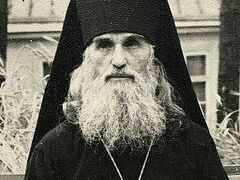
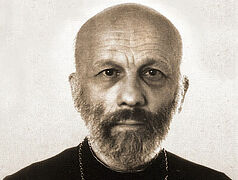
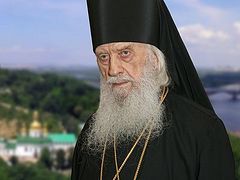
Time is the best indicator of truth, a contemporary philosopher once said. And indeed it is. The beginning of the new millennium, as if guided by the brush of a Heavenly Artist, uses wondrous, vibrant colors to bring forth a new galaxy of now reposed ascetics of piety from the recent past. Their lives bore the brunt of the twentieth century’s terrible trials—a century now gone into eternity—marked by persecutions, prisons, a bloody war, and, finally, the long-awaited freedom when the chains of atheism were cast off from the Church, allowing its finest representatives to open their hearts to the millions flocking back to the faith. One such soldier of Christ was Schema-Archdeacon Hilarion (Dzyubanin)—a Great Patriotic War veteran, a tonsured monk of the Kiev-Caves Lavra who later struggled in Pochaev and on Holy Mount Athos, a clairvoyant elder, and a spiritual father who fell asleep in the Lord on October 21, 2007. These lines offer a brief chronicle of his life.
 Schema-Archdeacon Hilarion (Dzyubanin). Photo: Sergei Fritsch
“I used to be a city vagrant… But I went to the front lines already a believer, and I survived…”
This was how Archdeacon Ignatius/Ignaty loved to describe himself even before he received the great schema with the name Hilarion at the Kiev-Caves Lavra shortly after its reopening in June 1988. The elder served his obedience as a tour guide in the monastery’s caves. He would often stop by the wall along the descent to the venerable fathers of the Near Caves, right where the aerial toll-houses of Blessed Theodora’s soul are depicted. “Here is the passion of lust, children,” he would tell the youth. “And here is the passion of love of money… But the most terrifying of all is pride, which reigns over this fallen world today… It is these very passions that stand as a barrier to the Heavenly Kingdom…”
 Performing his obedience as a tour guide
“In my youth, I used to be a vagrant, but then I ended up at the front. I was shell-shocked and wounded, but I survived. My generation, born in 1924 and drafted to the front lines in 1942, was almost completely wiped out… Once, during a meal between battles, I broke open a loaf of bread, and inside was a little slip of paper with a note inside: ‘Read this Psalm 90, soldier, and neither bullet nor bayonet shall touch you.’ Some Christian baker or a Christian woman was helping the soldiers on the front lines that way. And so, my children, I read this psalm, He that dwelleth in the secret place of the Most High, throughout the war…”
 Private Vladimir Dzyubanin It is hard to say what kind of a “vagrant” the elder had been in his youth, but a certain element of holy foolishness was inherent to him. He would share stories about the time he lived in a rented room in Kharkov, serving as a hierodeacon at the Church in honor of the Ozeryany Icon of the Mother of God after the Kiev-Caves Lavra was shut down in 1961.1 The landlady of the apartment was a loud woman who loved to scold everyone and everything. “So, she would yell at me, and I would answer her, ‘Lord Jesus Christ, Son of God, have mercy on me, a sinner!’ She would scold louder, and I would pray louder. And that was how she would calm down…”
It was there at the front, after the Battle of Kursk—where he as an artilleryman fought off tank attacks—that he made the ultimate decision to devote his life to God. He found inspiration and a role model for his life’s path in his aunt, Nun Nectaria. Before he left for the front, she had blessed him with a belt inscribed with Psalm 90, and that same loaf of black soldier’s bread later served as a second reminder of it. “And when I, an artillery corporal, found myself in what felt like the depths of hell during the brutal fighting at the Kursk Bulge in 1943, as bullets and shrapnel killed my comrades right beside me, I remembered my aunt’s blessing. I would recite this psalm, and time and again, the Lord saved me from inevitable death.”
He carried the memory of the war throughout his life, and among the great military commanders, he honored Admiral Theodore Ushakov above all, praying to him and holding him up as an example. He once illustrated his military bearing in the 1980s in Pochaev, where a group of officers arrived led by a general. Fr. Hilarion came out to meet them with a ring of keys (at the Pochaev Lavra, he also served as a tour guide, strengthening the Christian faith of many pilgrims and tourists through his conversations). “At-ten-tion!” the general commanded, introducing himself to Batiushka in proper military fashion, “Chief of Staff of the Red Banner Carpathian Military District, Lieutenant General Grachev.” Fr. Hilarion drew himself up as well and rapped out in response, “Soldier of the Heavenly King, Archdeacon Ignatius, of the Pochaev Monastery…”2
But Pochaev came later; after the front, he headed to Kiev…
At the Ancient Monastery after the War
 The Kiev-Caves Lavra’s post-war brotherhood. Third from the right is Hierodeacon Ignatius
In 1950, the Lord led the twenty-six-year-old war veteran to the Kiev-Caves Lavra, which had reopened during the war. Along with him, many battle-scarred soldiers entered the monastery. Among them were a friend of the young Novice Vladimir Dzyubanin (Batiushka’s secular name)—fighter pilot Vasily Rezvykh; the future Monk Rufus († 2009), who later became a widely revered man of prayer and ascetic; Yakov Korovay—the future Caucasus hermit; and the well-known elder, schema-archimandrite Isaiah († 2011). During this period, he met outstanding spiritual fathers who have since been canonized: the Glinsk elders—Seraphim (Romantsov; 1885–1975), Seraphim (Amelin; 1874–1958), and Andronik (Lukash; 1889–1973)—as well as Sts. Kuksha of Odessa and Amphilochius of Pochaev. These elders, in turn, drew spiritual nectar from the Optina Elders, Sts. Lawrence of Chernigov, and John of Kronstadt. Thus, the grace of God poured from vessel to vessel, passing monastic experience from one generation to the next.
 At the Lavra, late 1950s For about seven years, Novice Vladimir struggled at the ancient monastery until he was finally tonsured with the name Ignatius. Soon after, he was ordained hierodeacon. He accepted his diaconal ordination without murmuring; his soul was drawn to the altar of God, yet out of humility, he did everything he could to avoid the priesthood. Over time, he would tell his spiritual children that on Mt. Athos, as in some other ancient monasteries, the monastics are often guided by an ordinary elder-monk, who might even have a priest celebrating the Divine Liturgy as his novice.
Like many of his contemporaries who had fought on the front lines, Fr. Hilarion adhered to a strict, ascetic principle: unceasing prayer, rigorous fasting, non-possessiveness, humility, and labor. As a spiritual warrior battling the flesh and the evil spirits, the ascetic applied these same demands to parish priests as well. “In times past, men were not ordained before the age of thirty. And in Russia, priests—especially young ones—did not hear everyone’s confessions, particularly those of women. For this purpose, ‘confession priests’ were appointed, who were spiritually mature and experienced. Today, however, a clean-shaven young priest will go out to hear confessions and immediately fall into temptation himself…” As a zealous guardian of chastity, he once considered the presence of women in monasteries for monks, and men in convents, to be a violation of monastic rules. Over time, however, having received the grace of eldership, he became the spiritual father and mentor to numerous women—parishioners, pilgrims, nuns, and laypersons alike.
Pochaev, Kharkov, and Pochaev Again
As dark clouds began to gather over the Kiev-Caves Lavra and rumors of its potential closure spread, Fr. Hilarion left Kiev with the abbot’s blessing and moved to Pochaev.
In 1961, Yuri Gagarin flew into space, and the Soviet people rejoiced. However, the space age was deemed incompatible with “religious superstitions,”—Nikita Khrushchev and his team set out to wipe the Church off the face of the earth. Following the closure of the Kiev-Caves Lavra, a fierce atheistic siege of Pochaev began. Fr. Hilarion was summoned by the KGB3 and threatened with arrest. Yet, as a war veteran, he did not merely refuse to leave the monastery; he openly denounced the persecutors as betrayers of their fathers’ faith, warning them of God’s judgment. To protect him from arrest, the Abbot of Pochaev gave Fr. Hilarion his blessing to leave the Lavra and move to a quiet parish.
 With his mother, Nun Vera
For the next fifteen years, Fr. Hilarion served as a hierodeacon at the Church of the Ozeryany Icon of the Mother of God in Kharkov. Here he came into closer contact with the modern world, providing spiritual guidance to those who flocked to him. The Lord bestowed the gifts of spiritual discernment and clairvoyance upon him. He would reveal his visitors’ hidden sins and show them the path to amendment. The post-war devastation had left many people widowed, orphaned, homeless, or without a penny to their name. Hierodeacon Hilarion selflessly gave away the food supplies he received at the church, distributing clothes and money. All the while, he maintained his bonds with monasteries and his spiritual brothers. In 1977, weary of the worldly vanity, he returned to Pochaev. The ascetic loved nighttime prayer, dreaming of Mt. Athos with its all-night vigils and unceasing prayer for the entire world. Eleven more years passed. The Church authorities called him back to Kiev—to the newly reopened lavra where he had once begun his monastic journey.
Kiev, Mt. Athos, and Kiev again. Repose
 In the great schema
Here, he once again met his former brothers-in-arms—Fathers Rufus and Isaiah, as well as his spiritual mentor, Hieroschemamonk Damian, and other post-war tonsurees. It was during that period that I had the privilege of first seeing the elder. During a service in building 50, in the premises of the future refectory, the Hours were being read before the early Liturgy. In the dim light of the house church, I caught sight of a monk kneeling with a candle in his hand. He was taking packs of intercession lists out of a small black bag and praying, bending low over them. Then, after the initial liturgical exclamation, he stood up and hastened into the altar, kissing the shoulder of the young serving hieromonk with fatherly humility. Later, I saw him many times surrounded by parishioners and pilgrims, his face radiant with love and kindness.
 On Mt. Athos His cell was furnished with a simple bed—a narrow wooden board resting on four wooden posts. Nearby, against the wall, stood an open coffin, serving as a reminder of mortality. His spiritual sons who came to visit and stayed late at the lavra, whom the elder occasionally invited to spend the night in his cell, would find themselves at a loss when he asked them, “Where would you prefer to sleep—in the bed or in the coffin? In the coffin, we are closer to God…”
His long-cherished dream had come true. Having already received the great schema and having been named in honor of St. Hilarion the Schemamonk of the Kiev Caves, whose relics rest in the Far Caves, the elder began preparing for his journey to Mt. Athos. Before leaving, he would often tell his spiritual children about the life of his Heavenly patron, quoting the Kiev-Caves Patericon from memory, “St. Hilarion the Schemamonk practiced such abstinence that he ate only once a week, and even then but a little, emulating St. Theodosius, for he was his companion; offering up many prayers and supplications day and night with kneeling and tears, he well pleased the Lord God. But what about us? We sleep, we drink, we eat, and in this way, we shall never please God! Let us work out our salvation, beloved children, forgive, and love one another. For this world is sustained by love!”
As news that Elder Hilarion had left for Mt. Athos spread through Kiev, many were saddened by the absence of their beloved Batiushka. However, his time on Mt. Athos was short—only one year. The elder returned because he needed medical treatment. He never went back: some suggest it was due to his poor health, while others believe it was owing to obstacles created by the authorities.
Schema-Archdeacon Hilarion spent the final year of his life at the Holy Transfiguration Convent in the village of Steblyov in the Cherkasy region, a community under his spiritual care. Much like St. Ambrose of Optina, who founded the Shamordino Convent and passed away there, the elder left the Lavra with the words, “I am going to my Steblyov to die.” Remarkably, the funeral of the departed ascetic fell on October 23, the feast day of St. Ambrose.
“Love everyone, judge no one, forgive all, do not lose heart, do not despair, and thank the Lord for everything,” Fr. Hilarion would often remind others before his repose.
 At the Holy Transfiguration Convent, the last summer
He fell asleep in the Lord on an autumn day, October 21, when the earth was blanketed with yellow leaves like a golden carpet, as if specially woven for the departed ascetic.
Eternal memory to you, Father Hilarion!