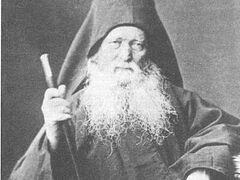
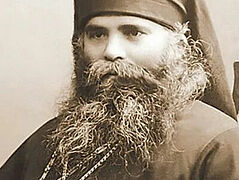
Thanks to the labors and prayers of Hieroschemamonk Ieronim (Solomentsov) and Schema-Archimandrite Makary (Sushkin), the second half of the nineteenth century was a time of true flowering for the monastic brotherhood of St. Panteleimon’s Monastery on Mt. Athos. After the repose of the elders, ascetics who were taught by them remained in the monastery, including Hieroschemamonk Agathodor (Budanov) (1845–1920), who later became the spiritual father of the monastery.
 Hieroschemamonk Agathodor (Budanov) The future Athonite was born on January 18, 1845, to a large, prosperous family in Moscow. He was named Alexander in Baptism. His father owned a factory near Danilovsky Monastery. The whole family would go to the Church of the Great Martyr Catherine on Malaya Ordynka Street on feast days. At age six, he started serving in the church, reading and singing on the kliros. When he got older, his parents sent him to a German school, where classes were taught in German, and he also studied several other foreign languages. His father wanted to prepare him for a career in trade, but God’s will for him lay elsewhere.
Alexander’s parents were deeply religious. In the evening, his father would read the Bible and the lives of the saints to the children, which had a beneficial effect on their souls. Three of their sons dedicated themselves to God, being tonsured as monks and ordained to sacred orders. Alexander’s mother died when he was eighteen, and his father soon followed. The eldest of the brothers (the future Hieromonk Uriel) informed the other two that he wanted to depart for the Holy Mountain. Alexander wanted to join him, but was apprehensive because of his poor health. But the middle brother, also a future Athonite (Hieroschemamonk Mina), encouraged him, saying: “God’s strength is made perfect in weakness.” Alexander later recalled: “After that, a weight was lifted from my heart, and trusting in the almighty power of God, I wasn’t worried anymore.” The two older brothers set off for the Holy Mountain, and the middle brother joined them some time later, having settled their earthly affairs and given their only sister in marriage.
On April 14, 1869, the God-loving brothers arrived on Mt. Athos and settled at the Russian St. Panteleimon’s Monastery. They were soon accepted as novices. At that time, the monastery was actively receiving new residents, and the spiritual life of the brethren was overseen by Elder Hieroschemamonk Ieronim (Solomentsov). Thus, he began to spiritually guide the newly arrived brothers as well. Novice Alexander was very glad about this and later said: “I asked the Lord to send me mentors according to His holy will. And the Lord fulfilled this, for He gave me the unforgettable Fr. Ieronim and Fr. Makary.”
The brothers’ paths on the Holy Mountain then diverged. The older brother chose the eremitic life in the New Thebaid desert, while Alexander remained at the cenobitic monastery, fulfilling obediences. He labored in the trapeza and library and sang on the kliros. He diligently attended the services, and for him the long all-night vigils were nothing less than a “spiritual feast.” In his memoirs, he wrote about the monastery’s long services:
After the All-Night Vigils, I felt a sense of calm, strengthening, and confirmation of soul for several days. Thus, they have a beneficial effect on the soul, for without this spiritual encouragement, it could become completely hardened. But by this means, it is enlivened, strengthened, and thus spiritual life, life in God, is sustained… If you delve into the divine words of the services, into the readings and hymnography, you gradually get accustomed to the long, tiring services. You can even come to love the particularly long vigils, and this love will sustain your attention and an undistracted mind, will be a vivid image of the presence of God, and prayer will flow more freely. Spiritual life will gradually begin to unfold, and there will arise a spiritual thirst, an insatiable longing, and the sweetness of abiding in the remembrance of God, in the words of the Psalm: I remembered God and I was gladdened (Ps. 76:3). And so the ecclesiastical-monastic life draws you like a magnet.
On the advice of Elder Ieronim, he memorized the troparia for the feasts in advance, and during the services, he listened intently to the Patristic readings. As a result, his spirit was drawn into the events being celebrated, and a grace-filled feeling warmed his heart. Two years later, the novice Alexander was tonsured with the name Agathodor. Over the next ten years, he left for Constantinople twice, where he fulfilled the obedience of a chanter in the embassy church.
In 1882, Monk Agathodor returned to St. Panteleimon’s for good and found himself under the spiritual direction of Elder Makary (Sushkin). The Spirit-bearing Elder promised the monk to ask the Lord for grace for him on the condition of his complete obedience. Completely surrendering himself to the guidance of his spiritual father, the monk zealously followed all his instructions, and God indeed generously bestowed His grace upon him. In November 1882, Fr. Agathodor became a hierodeacon, and soon afterward a hieromonk.
In 1883, he began his studies in Karyes, the capital of the monastic republic. He recalled:
The Karyes school only had five grades, so after finishing there, I began studying separately with a teacher, learning the following subjects, begun back at school: Latin; Greek, covering the last of the classical authors Thucydides, Sophocles, and Pindar (poets); anthropology (physiology, somatology, and anatomy); psychology; logic; rhetoric; physics; meteorology; stereometry; metaphysics; and theology. I’d already had Church history at school, but here I took theological subjects in particular: introduction to Holy Scripture, exegesis of Holy Scripture, hermeneutics, history of philosophy, and cosmography. Having gathered vocabulary from all these classes, I came to understand Greek books and conversation. I studied eighteen hours a day, and with God’s help and through the prayers of Fr. Ieronim and Fr. Makary, I managed in four years (1883–1887, from June to August) to master what would ordinarily have taken eight to ten years or more.
Having mastered Greek well, Fr. Agathodor was appointed to the obedience of representing St. Panteleimon’s Monastery at the Sacred Community of the Holy Mountain in Karyes. He labored in this obedience for ten years, but was then forced to leave it because of illness. After that, he became the monastery’s main confessor, one of the principal guardians of the spiritual tradition laid down by the great Elders Ieronim and Makary. As a confessor, Fr. Agathodor was attentive and affectionate, able to console the fainthearted and grieving. He was a true father to his spiritual children, and they loved him dearly. The door to his cell was always open to all. Monks and pilgrims of all ages flocked to his cell for the Sacrament of Confession. Elder Agathodor devoted the last twenty-five years of his life to spiritual fatherhood.
 St. Panteleimon’s Monastery, c. 1910
The Elder’s spiritual teachings have come down to us, some of which we will cite. In particular, he said:
Prayer must begin only with the aim of offering repentance to the Lord for our sins, giving thanks for the mercies received from Him, and entreating His help. Sometimes during prayer the Lord sends consolation, but we mustn’t begin praying in search of it, for the enemy can easily counterfeit such consolation, and we can then fall into delusion, mistaking the false for the true. We also shouldn’t seek gifts from the Lord other than the gift of forgiveness of sins. We must consider ourselves unworthy of the gifts of grace, deserving of punishment and eternal torment.
With constant prayer, the heart is warmed by love for the Lord, and delivered from passions and no longer admitting provocations, it feels a certain lightness and gladness, as though a burden has been lifted from it, for … the Lord becomes the life of the heart, without which it’s dead.
Listening attentively and diligently to the Church services greatly contributes to the development of inner spiritual life and prayer, as it warms the feelings that draw the mind to them (to the heart), and then our own prayer of the heart begins. So we must follow the content of the liturgical prayers and hymns with particular diligence, for in this lies the beginning of our own prayer; for at times, the grace of the service leaves such a strong impression that the feeling remains throughout the entire day.
Pray simply, be conscious of God’s presence, kindling feelings of reverence, the fear of God, repentance, contrition for sins, humility, tears of gratitude to the Lord, and love for all His mercies, and especially for His sufferings. We must guard the heart from anything sinful and filthy, keeping it unsullied, peaceful, and loving towards all, even those who have offended us, having committed our lives to God and His all-good providence. Then the grace of God overshadows such a man, kindling a flame in the heart and filling it with joy in God, hope of salvation, and every virtue.
We must accustom ourselves to being aware of God’s incomprehensible omnipresence, that the Lord constantly looks upon us and is always with us, which gives rise to the fear of God, lest we offend the Lord. We must make our petitions wisely: endure everything (like righteous Job), purify our hearts with repentance, choose what’s reasonable, refrain from condemning, be deaf and blind among men, and keep humility in all things, so that the Lord might accept this labor as something good. Because without humility, even great virtues won’t receive a reward from the Lord.
Idle talk causes much trouble. Through it, we slip unnoticed into condemnation, mockery, jesting, distraction, and coldness of heart; we become dissatisfied with the surrounding order of things, destroy our own spiritual disposition, and fall into a general apathy, with a heaviness on our conscience for transgressing the Lord’s commandments.
Idle talk, not only verbal, but also mental, is sinful. If someone is accustomed to idle talk in the mind, it’s even harder to struggle with than the verbal kind, because he can indulge in it both when alone and on any occasion. We must strive to cut off such hostile thoughts from the very beginning with God-pleasing ones: self-reproach, picturing the hour of death, our passage through the tollhouses, the Last Judgment, the condemnation of sinners, the despair of those departing to eternal torment, to separation from God, from light into eternal darkness and Tartarus. We must use such thoughts to rouse ourselves from spiritual slumber and bring our hearts to contrition, weeping, repentance, remembrance of God, and unceasing prayer of the mind and heart.
We mustn’t think that our own diligence and zeal can draw the grace of God into our hearts, which is given to the meek and humble alone. Rather, we must do all we can to humble ourselves before God, consider ourselves the greatest of sinners and unworthy of any gifts of grace and consolation, and entreat only forgiveness of sins and mercy. And if the Lord Himself, in His ineffable mercy, grants any consolations, we should consider ourselves undeserving of them, and we must never pray merely for their sake, but with repentance as our aim. For such prayer is safe. But if we desire gifts of grace and consolation, the enemy can always deceive us with counterfeit gifts, leading us into delusion, so that we take the false for the true.
There are many manifestations of grace, and they are tested by the feelings that accompany them. If, for example, there is humility, self-reproach, contrition for our sins, aversion to them, love for God and for every man, even for an enemy, and in general a desire for every good thing and a turning away from everything worldly and sinful, it’s evident that such manifestations are from God. But if the opposite feelings appear, such as pride, hatred of men, malice, lust, and the like, then the phenomenon is not from God, and therefore such things shouldn’t be trusted.
The will is weakened by constant self-indulgence, when a man doesn’t deny himself any of his desires, so much so that they become a habit, a passion. On the contrary, the will is strengthened when a man voluntarily cuts it off, denying himself various desires. If you’re hungry, deny yourself. If you want to read some harmful book, deny yourself. If you’re thirsty, wait half an hour. Then the will is subdued and becomes more obedient. And the longer you practice cutting off your will, the easier it becomes to struggle against your own desires. The need to cut off your own will lies in the fact that the passions can’t be uprooted in any other way. For sooner or later we must practice self-denial all the same, because it’s impossible to live by our own will forever. Therefore, it must be brought into accord with the universal will, the will of God.

We must especially remember the love of God, revealed in the Lord’s sufferings, and remember the Dread Judgment and eternal torment. The remembrance of the Lord’s omnipresence should produce the fear of God and caution in all our deeds, words, and thoughts. We must examine our actions and our whole lif. Have I been drawn away in any way from the love of God and eternal life? Am I seduced by temporary pleasures and gratifications? Have I become attached to any work, person, vain honor, or glory? We must indeed do good deeds, but only for the sake of the glory of God. Act according to the word: That they may see your good works, and glorify your Father Which is in Heaven (Mt. 5:16).
Troubles, temptations, sorrows, and illnesses are a healing salve that cures pride and despondency. To remain in good order, we must always maintain self-reproach and pray: “Grant me, O Lord, to see mine own transgressions!” For pride darkens our spiritual eyes, causing us to constantly stumble, as though blind.
In 1888, Elder Agathodor was tonsured into the Great Schema. In the last years of his life, he faced a trial: Because of the Name-Worshipping (Imyaslavie)1 controversy, he was removed from St. Panteleimon’s Monastery to the Thebaid, where he endured many sorrows. When the monks who had sowed discord were expelled from Mt. Athos, the Elder again became the monastery’s representative in Karyes and also served as its librarian.
In August 1920, he fell ill with a fever. In October, he was placed in the infirmary, given Unction, and communed of the Holy Mysteries of Christ daily. Yet this spiritual lamp of St. Panteleimon’s Monastery was gradually growing dim. Understanding that the end of his earthly journey was near, the Elder bade farewell to his disciples, giving them his final blessing and instruction.
On November 17 of that year, the Elder departed to the Lord, Whom he had lovingly served in the monastic order for fifty years. May the Lord grant rest to the soul of Hieroschemamonk Agathodoros in the mansions of the righteous!