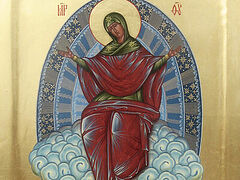
The wonderworking Icon of the Mother of God, the “Deliveress” was translated to the New Athos Monastery of St. Simon the Canaanite in the Caucasus1 from Holy Mount Athos, where it had been kept by Schemamonk Martinian from the Russian St. Panteleimon Monastery.2 The devout schemamonk had received the icon from the ascetic Konstantius Theodoulus. The holy icon has been renowned for its miracles since ancient times. The Most Holy Theotokos is depicted in it holding the blessing Christ Child in Her right arm.
 In 1841, while Elder Martinian was visiting Greece for monastery affairs, the inhabitants of Sparta were delivered from an unprecedented locust plague through prayers in front of this icon. The situation was dire; even a cross procession with a particle of the relics of St. Alexis, the Man of God, had no significant effect on the insects. During the prayer service, the locusts began flying into people’s eyes, causing the residents and officials to scatter in terror. Only when everyone, from the youngest to the oldest, led by four priests at the Church of the Life-Giving Spring, celebrated Vigil followed by the Divine Liturgy and carried the “Deliveress” Icon out into the field, praying fervently before it, did a miracle occur. The Mother of God miraculously delivered the land from the calamity: The locusts suddenly rose and flew away, their dense swarm nearly blotting out the sunlight. Unexpectedly, a flock of birds resembling starlings appeared and finished them off.
Through the prayers of Elder Martinian before this icon, a dead boy was brought back to life. Consequently, inhabitants of various villages started taking their sick relatives to him, and they were all healed at the wonderworking icon of the Mother of God. But when the elder, accustomed to the solitude of a desert life, grew weary of the multitudes, and fearing he might become proud from the praise of men withdrew into a cave, the merciful Queen of Heaven commanded him to leave his place of seclusion. First, he heard a voice telling him to return to the people, and then, at night, he saw a white pillar of light extending from earth to heaven, and again he heard a voice commanding him not to hide the gifts of grace emanating from the holy icon, for it was done for the glory of the Mother of God, and not his own, and by Her power.
When the elder had to return to Mt. Athos, the residents wished to express their gratitude to him, and through him—to the monastery. Sent with him was a letter signed by a local priest, which read as follows: “Blessed be God, Who sent us this holy and virtuous man, through whom the word of Jesus Christ, spoken in the Gospel, was fulfilled in us: They that be whole need not a physician, but they that are sick (Matt. 9:12). We all confess together that we have received no small spiritual benefit from the Most Reverend monk, Father Martinian, who lived near our village for about two years, and that throughout this time he appeared to all of us as a true father, who never ceased to instruct us spiritually and to visit us bodily, healing us from our illnesses—by the grace of our Lady Theotokos’ icon, which he always kept with him. His prayers, frequent vigils, and supplications to the Lady Theotokos delivered us from various diseases and from the destructive locusts, which prior to this time had not ceased to damage our trees, vineyards, crops, and the like, and are currently damaging areas both outside and inside our diocese, yet did not approach us—by the help of the Lady Theotokos, through the prayers of Her servant, Martinian. But now the time has come for us to be deprived of him, for he is departing for his home on grace-filled Mount Athos. Thus, it behooves us with warm tears to beg for his holy prayers and blessing—that they may preserve us and to show at least small gratitude for his great benefactions which we have received. May he remember us in the time to come, when he prays together with his holy fathers and brethren, so that through their prayers God may be merciful to us now and at the Last Judgment. Amen.
Signed: Petros Griminos, priest-on-duty of the Church of Saint Spyridon.”3
Heavenly Patroness of the New Athos Monastery
According to the testament of Schema-archimandrite Macarius (Sushkin),4 from St. Panteleimon’s Monastery this icon was translated to the New Athos Monastery on July 20, 1889, and a feast day in its honor was fixed on October 17/30.
On the day the icon of the Heavenly Patroness arrived, the pilgrims joyfully rushed to the pier, while the monastics went out to meet it in a cross procession. His Eminence Alexander, Bishop of Sukhumi, met the icon of the Mother of God and solemnly brought it into the church. He placed it on an analogion adorned with flowers, and celebrated a thanksgiving service.
Then, a deed of gift from the Archimandrite of the Russian St. Panteleimon’s Monastery on Mt. Athos was read aloud. Sealed with the monastery’s stamp and signed by the elder brethren, the deed stated that the Wonderworking Icon of the Mother of God the “Deliveress” was gifted to the New Athos Monastery of St. Simon the Canaanite in accordance with the testament of the reposed father and mentor of St. Panteleimon’s Monastery, Schema-Archimandrite Macarius—as a blessing and a pledge of mutual love and the unbreakable spiritual bond between the two monasteries.
 Schema-Archimandrite Macarius (Sushkin) The first celebration of the wonderworking icon took place on October 17, 1889. Early that morning, a storm washed ashore over a ton of fish of various kinds and sizes. The brethren and monastery laborers gathered them directly with their bare hands. A similar sign occurred here on October 14, 1876, ahead of the consecration of the first Church of the Protecting Veil of the Most Holy Theotokos.
At the New Athos Monastery, the Queen of Heaven deigned to glorify Her icon with three striking healings. On May 16, 1891, two disabled men arrived at the New Athos monastery; one had swollen legs and lower abdomen, while the other had been unable to use his left leg for twenty years. Both could barely move, relying heavily on crutches.
On May 19, during Matins, the first of them venerated the holy icon and instantly felt completely healed. Setting his crutches aside, he bowed to the ground before the icon of the Mother of God—something he had previously been unable to do—then took his crutches, carried them out of the church, and threw them away. During the evening service, the other pilgrim approached the miracle-working icon, kissed it, was also healed, and cast away his crutches. The following day, during the Divine Liturgy, a third pilgrim, who had suffered for twenty-seven years from a paralyzed right hand, venerated the wondrous icon and received complete healing.
In the nineteenth century, a workshop at the New Athos Monastery created a copy of the Icon of the Theotokos “Deliveress”, bridging the history of the Old and New Athos Monasteries. The icon depicts the Apostle Simon the Canaanite5 and Greatmartyr Panteleimon holding the “Deliveress” Icon against the backdrop of the New Athos Monastery cathedral. Such icons were more common than the standalone image of the “Deliveress”. One of the early copies, apparently from the beginning of the twentieth century, is kept at the cathedral of the New Athos Monastery. During the Soviet era, it was kept in Maikop6 and was returned to the monastery in the 1990s.
A newly painted icon of the same iconography was presented to St. Panteleimon’s Monastery on Mt. Athos by His Holiness Patriarch Alexei II of Moscow and All Russia during his visit to the monastery in February 1998. The icon is housed at the Cathedral of the Protection of the Most Holy Theotokos.7
On Holy Mount Athos, the feast of the Mother of God in honor of Her wonderworking “Deliveress” Icon at the Rossikon was fixed on April 4, commemorating the preservation of Emperor Alexander II from death.
At the New Athos Monastery of St. Simon the Canaanite, the feast day of this icon was fixed on October 17, also in grateful remembrance of the miraculous survival of the Sovereign Emperor Alexander III with his entire August family.
Less than a month before that miraculous event—on September 24, 1888—the royal pilgrims visited the New Athos Monastery. On that day, Emperor Alexander III personally laid the foundation stone of the Cathedral of the holy Greatmartyr and Healer Panteleimon, which later housed the wonderworking Icon of the Mother of God the “Deliveress” until the monastery’s desecration in 1924.
Empress Consort Maria Feodorovna, Tsarevich Nikolai Alexandrovich, and his brother, Grand Duke Georgy Alexandrovich, also laid bricks into the foundation of the cathedral. Later, four side altars were built in honor of the patron-saints of the Royal Family: the holy Right-Believing Grand Prince Alexander Nevsky, St. Mary Magdalene, and in the choir lofts—in honor of St. Nicholas the Wonderworker and Greatmartyr George the Victorious.
On October 17, the imperial train derailed near the Borki station of the Kursk-Kharkov-Azov Railway. The Emperor held up the collapsed roof of the carriage.
Empress Consort Maria Feodorovna recalled that when she crawled out from under the wreckage, she could not see a single living soul. Terror seized her. Suddenly, her daughter Xenia appeared. “I saw my sweet little Xenia emerge from under the roof a little way off on my side. Then came Georgiy, who shouted to me from the roof, ‘Misha is here too!’ And finally, Sasha [Emperor Alexander III] appeared, whom I immediately embraced. We were in the part of the carriage where a table had been, but nothing that used to be in the carriage survived—everything was destroyed. After Sasha, Nicky [the future Nicholas II] appeared, and someone shouted to me that Baby [Princess Olga Alexandrovna] was safe and sound, so from the bottom of my heart I could thank our Lord for His bountiful mercy, for keeping them all alive, not a single hair of their heads lost!
“Just think, only poor little Olga was thrown out of the carriage, and she fell down a high embankment but received no injuries, just like her poor fat nanny. But my unfortunate waiter suffered leg injuries as a result of a tiled stove falling on him. But what grief and horror we experienced on seeing the many killed and wounded—our dear and loyal people! It was heartbreaking to hear the cries and groans and not be able to help them or simply shelter them from the cold, since we ourselves had nothing left! They were all very touching, especially when, despite their suffering, their very first question was, ‘Is the Sovereign alive?’ And then, making the sign of the cross, they said, ‘Thank God, then everything is alright!’ I have never seen anything more moving. This love and all-consuming faith in God was truly astonishing and served as an example to everyone.”8
In 1889, the Most Holy Governing Synod established a thanksgiving service to the Lord with prostrations on this day. Following the death of Emperor Alexander III, in 1895, the Synod—acting on the instructions of Emperor Nicholas II—decided that this established thanksgiving service should henceforth take place according to the general rite of thanksgiving services.
The Icon of the Mother of God the “Deliveress” was highly venerated in the Imperial Family. In the Ipatiev House in Ekaterinburg, among the personal belongings of the martyred Grand Duchess Tatiana, a book in a blue embossed binding was found—The Prayer Rule for Those Preparing for Holy Communion; On the first page the martyred Tsarina had written in her own hand: “To my little Tatiana from Mama. February 9, 1912. Tsarskoye Selo.” A silk bookmark lay inside the book, with a small silver Icon of the Mother of God, the “Deliveress” attached to one of its ends.9
The brethren of the Monastery of St. Simon the Canaanite treasured the “Deliveress” Icon as their greatest possession, turning to it for help and consolation in all their sorrows. When the monastery was closed in 1924, its lands confiscated, and many monks had fled into the mountains, its churches were plundered—the Bolsheviks tore the icons from the walls and stripped the monastery of its relics.
According to the Orthodox Encyclopedia, the wonderworking Icon of the Mother of God the “Deliveress” “was kept by a monk of the New Athos Monastery who remained in Abkhazia. Following the end of the Second World War, he was appointed parish priest at the newly opened Church of the Protection of the Theotokos in the town of Gudauta, where he brought the miracle-working icon with him. To this day, the church houses an icon case made for the ‘Deliveress’ Icon, likely back in the pre-revolutionary period at the New Athos Monastery. A copy of the wonderworking image was kept inside this icon case. According to unverified reports, during the second half of the twentieth century, The ‘Deliveress’ Icon was taken to the Holy Dormition Pochaev Lavra in what is now Ukraine.”10
And in the K Svetu (“To the Light”) magazine, issue No. 16 for 1997, the following information was published: “The Holy Icon called the ‘Deliveress’ has been found again, but it is in Russia. The second appearance of the Queen of Heaven in Her wonderworking icon in New Athos will clearly testify to God’s blessing on the reviving monastery and this entire region, a part of the earthly portion of His Most Pure Mother.”11