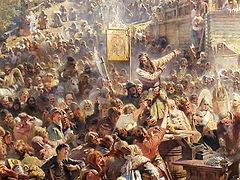
Citizen Kuzma Minin and Prince Dmitry Pozharsky. 2009. Artist: P. Moskvitin
Before we are all united with Christ in the Sacrament of Holy Communion, I would like to speak about unity—about the unity of our people, about the Russian spirit, for which we pray daily in church as we invoke Holy Rus’. Every day this prayer is offered in our churches. And it is important for us to understand what this spirit is, what Holy Rus’ truly means.
The Lord has endowed our people with a very gentle, sensitive, and vulnerable soul, yet one that is strong and steadfast. I am speaking not of every individual person, but of the spirit of our people as a whole. Throughout the ages, there have been ascetics who embodied this spirit of Holy Rus’, and we have always taken pride in them—and rightly continue to do so to this day. The examples are countless.
Let us take Ilya Muromets, for example. According to the epic tales, he lay upon a stove1 until the age of thirty-three, unable to rise from his bed. But one day, wandering pilgrims came to him. They prayed and asked him to bring them some water—and he was healed. He rose and went forth to defend the Russian land. He is an image of dormant strength awakening at the moment of need. After his military feats, he embraced monasticism and ended his life as a saint in the Kiev Caves Lavra.2 One might ask, where is the manifestation of the spirit in this? Here it is—the spirit of faithfulness.
Another example is the holy Right-Believing Prince Peter and Princess Fevronia. He was a prince; she was a commoner. When the boyars demanded that he abandon his wife in order to continue ruling Murom, he chose his wife and departed. He relinquished his power and became a nobody. Yet after some time, the people appealed to him once more, because there was no one to govern them. And he returned. This is the spirit of love and faithfulness.
Or consider the righteous Admiral Fyodor Ushakov. He never lost a single battle. His fleet even rescued the enemy—when hostile ships were sinking, he ordered his sailors to lower their boats and pull the drowning men from the water, risking their own lives. For when a ship sinks, it creates a whirlpool, and those attempting a rescue risk being dragged beneath the waves. Moreover, Ushakov paid ransoms to save French prisoners whom the Turks, our allies, had captured and were holding for ransom. He sacrificed his own money to save their lives. This is the spirit of mercy.
Let us also remember Alexander Peresvet. With the blessing of St. Sergius of Radonezh, although he was a schema-monk he once again took up arms and went forth to face the Mongol Tatar Chelubey in single combat. According to one account, he knew how to secure victory. Chelubey was a giant of a warrior, and his lance was longer than usual. Peresvet entered the battle without chain mail, wearing only his monastic schema. He knew that the lance would pierce him. Yet he understood the importance of this sacrifice for his entire people. And according to the accounts, even after receiving the blow, he remained in the saddle. This is strength of spirit—a fervent, self-sacrificing spirit that knows no indifference. As the Lord says in the Apocalypse: I would thou wert cold or hot. So then because thou art lukewarm, and neither cold nor hot, I will spue thee out of my mouth (Rev. 3:15–16). This feeble, lukewarm spirit is not ours. It is alien to our people. And, what is especially important, it is alien to our enemies.
We have many enemies. Many countries have risen against us. The struggle against Holy Rus’ has not lasted merely four years; it has continued throughout virtually the entire course of her existence. All wars, in one way or another, are connected with this struggle. Even when the political system changed and it seemed that the Cold War had ended, hatred of the Russian spirit remained. Why? Because our spirit is active, fervent, compassionate, and anything but passive. It is not tolerant in the negative sense of the word, as it is in the West, where everything is permitted. Do you wish to commit sins against nature? Go ahead. Do you want drugs? By all means. Everything is permitted because no one cares. But that is not how things are with us.
It is time for us to undergo an inner transformation. It is time to awaken—like Ilya Muromets, who lay upon the stove for thirty-three years. We must realize that Christ is with us. But Christ may also withdraw from us if we cease to be ourselves, if we become indifferent and divided.
We must unite around a common ideal, a common faith, and a common destiny—just as happened in 1612, four centuries ago, in Nizhny Novgorod. Moscow was a thousand kilometers away—a ten-hour drive today, but in those days, a journey of many weeks on foot. The Russian people are not naturally inclined to haste, but when calamity strikes, they rise to the occasion.
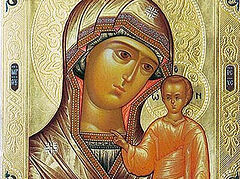
St. Hermogenes, languishing in captivity and dying of starvation, wrote letters and sent them throughout the Russian land—to Kazan, where he had once discovered the Kazan Icon of the Mother of God while still a simple archpriest, and to Nizhny Novgorod.
And there, in the marketplace, an ordinary man named Minin received a special inspiration from God. The people heeded his call. They gathered together and realized that there was no point in waiting for the enemy to reach Nizhny Novgorod. They united, marched forth, and drove the enemy out of Moscow.
Thus we gained many more centuries of relative peace.
And now, too, let us be united. In our thoughts. In our spirit. Let us kindle within ourselves this spirit—the spirit of living faith. The many ascetics whose memory we cherish will help us in this endeavor. And we shall feel strength—the united strength of the Russian people.
May the Lord preserve you all!