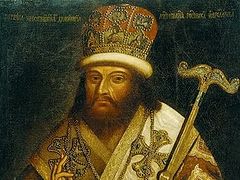
On October 28/November 10, the Russian Orthodox Church commemorates St. Dimitry, Metropolitan of Rostov. In this interview, Archpriest Pavel Khondzinsky, Dean of the Department of Theology at St. Tikhon’s Orthodox University of the Humanities,talks about the significance of the saint’s outstanding work, his influence on the spiritual life of Russia, and his contribution to introducing the Russian people to the saints.
 Archpriest Pavel Khondzinsky. pstgu.ru —Fr. Pavel, are the Lives of the Saints by St. Dimitry of Rostov a unique phenomenon in the history of Russian culture?
—The work on the collection of the saints’ Lives took St. Dimitry about twenty years. He began it back in 1684 as a simple hieromonk in Kiev and completed it in 1705 as Metropolitan of Rostov. This prolonged labor required not only literary skill but also deep spiritual immersion, systematization, and critical analysis of numerous sources. The work is, of course, immense; it is a true labor of asceticism, beyond any doubt—and a literary one as well.
—In total, there are 664 Lives, including twenty-four Lives of Old Testament saints, 571 of universal Orthodox saints, sixty-five of Russian saints, and four of Southern Slavic saints. A tremendous volume! There is an opinion that St. Dimitry’s Lives of the Saints became the most widely read work in Russia, the most popular book after the Gospels.
—I do not have the statistics at hand, so I cannot say for sure, but they certainly held great significance and played a most profound role in shaping popular piety in the subsequent era. And for this, of course, we must be grateful to St. Dimitry.
—Why did the need to compile such a collection arise specifically in the late seventeenth century?
—At that time, the Russian Church already had the Great Menaion Reader, compiled in the sixteenth century by St. Macarius, Metropolitan of Moscow. This was an attempt to gather all Christian literature circulating in the Muscovite state and organize the texts according to the days of the liturgical year. It contained not only the lives of the saints, but also, for instance, texts written by the saints themselves, among many other things. However, the Great Menaion Reader existed in only a few manuscript copies; it was never printed and, unfortunately, has not been published in its entirety to this day.
The Lives of the Saints by St. Dimitry of Rostov, however, were written in a different era and served a different purpose. They stand at the crossroads of liturgical texts and those intended for private reading. Why liturgical? Because there used to be a system of readings prescribed by the Typikon, which have practically vanished from our contemporary liturgical life. To be sure, Gospel and Epistle readings remain, as do the Paremias—the Old Testament readings during Lent—but we no longer read the lives of the saints during daily services. The only exception is the life of St. Mary of Egypt, which is read once a year. We no longer read the Patristic writings daily during worship, even though it is fundamentally prescribed by the Typikon: a text by a Holy Father is supposed to be read every day, alongside readings from the Prologue—a collection of moral tales, most often, though not exclusively, drawn from monastic life. All of this has fallen out of our tradition. Yet in St. Dimitry’s time, the need for this component of worship was still very much alive. At the same time, these books could already be read privately: after all, these were no longer manuscripts, but printed books.
Thus, the work by St. Dimitry of Rostov served as a link between the liturgical life of the Church and everyday secular life, which by that time, as we know, was gradually separating and drifting away from liturgical life... St. Dimitry’s Lives of the Saints sought to reunite private life with Church and liturgical life, and this is also where their value lies.
There is another important point. As it happened, St. Dimitry requested a copy of the Great Menaion Reader from the Dormition Cathedral of the Moscow Kremlin to use as a guide for writing his own Lives of the Saints. However, this copy took quite a long time to travel from Moscow to Kiev, where St. Dimitry was beginning his work. In the meantime, he discovered other sources, though it’s hard to say whether by chance or not. Among them was the Acta Sanctorum by the Bollandists. This was a Catholic congregation that searched for and published ancient acts of martyrs. It was thanks to them that his work was enriched by the lives of many ancient saints who had either never been included in Russian tradition or had fallen out of it over time. Mostly, these were saints of the Universal Church and early martyrs. And for St. Dimitry, this was of fundamental importance, because for him true holiness was, above all, martyrdom. If you look at his Lives of the Saints, a large portion of the texts consist of the lives of martyrs from various eras.
 St. Dimitry, Metropolitan of Rostov
—Did this influence the specific features of the collection?
—St. Dimitry expressed a truly remarkable and profoundly Christian thought, in my view: that compassion and sympathy for another human being are, in a sense, also a form of martyrdom. In this regard, he provided an excellent example—the life of St. Natalia. She was not executed and suffered no physical harm, yet she empathized so sincerely with her loved ones who were tortured for the name of Christ that the Church ultimately recognized her as a martyr. This case confirms St. Dimitry’s idea that the Christian life is, one way or another, a martyrdom or passion-bearing—that is, the voluntary acceptance of some form of suffering. How did he explain this? He said that there is no true love without the desire to accept torment for the beloved. Christian love is exactly like that: if Christ suffered for us, then our response to Him is our suffering for His sake.
Let us recall the first Russian saints, Boris and Gleb. If we look literally at their lives and deaths, they were victims of a political assassination. Their brother, Svyatopolk, sought to seize the throne of Kiev and eliminate his rivals. Why, then, do we regard them as saints? Beyond the concrete evidence—such as the healings that occurred at their tombs, which proved their holiness but did not yet reveal the nature of their podvig—we find an explanation of what truly happened in one of the texts dedicated to them. In his final prayer before death, St. Boris addresses the Heavenly Father, saying: “I thank Thee, Father, that Thou hast granted me to share in the sufferings of Thy Son.” The holy brothers refused to fight for the Kievan throne and chose not to shed Christian blood; instead, through the voluntary acceptance of suffering, they sought to imitate Christ. Consequently, their deaths became deaths for Christ, even though no one had forced them to renounce Him. Furthermore, St. Dimitry extends this principle to the Christian perception of life as a whole. In his view, any suffering, sorrow, illness, or injustice that we accept as being sent by the Lord is the very essence of passion-bearing, which in this sense is understood as living our lives for Christ’s sake.
—But why was it St. Dimitry who undertook this monumental project?
—The saint began this work with the blessing of Archimandrite Varlaam (Yasinsky) of the Kiev Caves Lavra. St. Dimitry of Rostov (secular name: Daniel Savvich Tuptalo) graduated from the Kiev Brotherhood College (later the Kiev Mogila Academy). In 1668 he took monastic vows, in the 1670s he was ordained hierodeacon, then hieromonk in Chernigov, and in 1684 he settled at the Kiev Caves Monastery. It was there that he received the obedience to “compile the lives of the saints and, having thoroughly emended them, to commit them to writing.”
—Is it known what difficulties he had to face? Probably, the main one was the insufficiency of sources?
—It is important to note that the saint strove to work critically with his sources. He selected the most authoritative accounts and compared them with one another, acting in this regard as a Church scholar. However, the most remarkable source for the lives of the saints was his direct dialogue with the saints—a wondrous combination of scholarship and holiness.
—Do you mean those fantastic elements that are present in the saint’s book despite his scholarly approach?
—I would not venture to call them “fantastic.” It is simply a record of a completely real mystical experience of St. Dimitry. His diary contains an entry about an apparition of the Martyr Orestes, who told him that, in describing his sufferings, the saint did not mention some of the torments he had endured. In other words, St. Dimitry had no difficulty whatsoever in reconciling his mystical life with his scholarly work on texts. For him, the ultimate authority lay in the Scriptures and liturgical texts. In his Homily on the Annunciation, for instance, he uses a paraphrase of the well-known Annunciation Canon—a dialogue between the Archangel Gabriel and the Mother of God.
—Fr. Pavel, can St. Dimitry’s work be considered simultaneously spiritual, historical, and belles-lettres?
—The thing is, the concept of “fiction” or “belles-lettres” in the sense we use it today is hardly applicable to that era. But of course, this is both spiritual and historical literature, and above all, ecclesial literature. It combines all of these features. And this, too, is a distinctive characteristic of the book.
—How do you evaluate its style?
—Highly vivid. A lively, spiritually animated, and remarkably complex language, because it is late seventeenth-century Russian—complete with all its inherent Slavonicisms, plus Little Russian (Ukrainian) elements, alongside occasional Polish words and expressions. At first glance, such a mixture might seem poorly integrated. Yet, thanks to the talent of St. Dimitry, it all somehow melted down into a unified, bright, distinctive, and expressive whole that harmonizes perfectly with the message he conveys.
Unfortunately, in reality, we don’t know the Lives of the Saints very well. Not only because they are ideally meant for daily reading—I am not even talking about that right now—but because the saint’s work has reached us in adaptations made in the late nineteenth century. Back then, it was decided to bring it in line with the norms of the contemporary Russian language. They did so, but little of the original remained. What we read today is not even a translation, but a rework done by students of the famous Russian historian Vasily Klyuchevsky. This adaptation calls to mind a well-known publishing joke: “What is a post? A post is a well-edited tree.” That is roughly what it looks like. We cannot form a proper opinion of St. Dimitry’s style based on these “translations.”

If possible—and now, thanks to the internet, it is—it would be better to read it in an edition from at least the 1840s. It still preserves the nuances of his language and his remarkable style, which is incredibly vivid and distinctive.
—Could you tell us about how the book was printed?
—It is well known that it faced objections, as it were. At some point, the first volume of the Lives of the Saints was withdrawn from circulation at the insistence of Patriarch Joachim. It never reached the reader because it included the Lives of Blessed Jerome and Blessed Augustine. As these were Western saints, this was held against the saint as a “Latinism.” Rather than argue, he simply removed them.
There were also objections regarding his view on the Nativity of the Theotokos, which was indeed close to the Latin perspective on the Immaculate Conception. However, we must take into account the popular veneration of the Mother of God in southwestern Russia, where Catholic and Orthodox traditions were closely intertwined. In that context, it was difficult to clearly separate the two. From the Catholic standpoint, at the moment of her conception, the Virgin Mary was cleansed not only from all potential future sins but also from the consequences of Original Sin. Orthodox Tradition holds the mystery of this event in higher reverence, speaking only of her sanctification by the Holy Spirit at the moment of the Annunciation. St. Dimitry chose not to argue here either: he removed the text, but in his rough drafts, he kept making excerpts from the Holy Fathers, wishing above all to understand the issue for himself. Unfortunately, he never managed to shape this work into a finished treatise.
—What can be said about the relevance of his work today?
—Saints are saints precisely because they write for their own time and in the language of their own time; yet, if their writings become part of Church Tradition, they prove to be necessary for all subsequent generations as well. Therefore, the Lives of the Saints and the works of St. Dimitry in general remain relevant to us primarily for the reason mentioned above: they recognize the principle of passion-bearing as a universal principle of Christian life. I think it would be beneficial for all of us to internalize this.
—How would you recommend reading St. Dimitry’s book? Volume by volume, straight through, or selectively?
—It depends on your capabilities, time, and so on. The main thing is to read. It is available (in Russian) in digital format; the original Lives of the Saints exist in lower quality, but they can be found in full on the internet.
—Could you tell us about St. Dimitry’s activities as a pastor and archpastor? Are there any known details about his ascetic life, non-possessiveness, and mercy?
—He was a true unmercenary—after his repose, only thirty-nine rubles were found in his cell. He strove in every way to live by his cherished principle of Christian passion-bearing. Although, unfortunately, he could do very little to actually change the lives of his suffering flock. Yet it was no accident that we mentioned the Martyr Natalia: Like this saint, he sought to share in the suffering of his people.
It is known that he had a strained relationship with the local governor in Rostov (now in the Yaroslavl Region). There is a story that during the service, the governor’s daughters kept talking loudly and laughing. Concluding the Divine Liturgy one day, the saint pronounced the exclamation “The blessing of the Lord be upon you…” as follows: “The blessing of the Lord be upon you, except for those who talk and laugh.”
The governor resolved to take revenge on St. Dimitry the only way he could. The next time the saint was celebrating the Divine Liturgy, the governor ordered a public flogging to be carried out on the square right under the cathedral windows. Naturally, this was accompanied by such horrific screams that it was impossible to continue the service. The saint asked to stop the flogging, but of course, no one listened to him. Then he simply left the cathedral, without finishing the Liturgy. St. Dimitry owned a small house just outside Rostov, where he devoted himself to ascetic podvigs. For instance, in imitation of St. Theodosius of the Kiev Caves, he would intentionally expose himself to bites from gnats and mosquitoes for days on end…
Schismatics were a special concern of the Metropolitan’s, and his last major work, A Search into the Schismatic Bryn Faith, is dedicated to polemics against them. Importantly, he demonstrates a fundamentally different approach to polemics here compared to his predecessors. He argues that in Christianity, there are elements that remain immutable over time, and elements that are subject to change. It is crucial to distinguish between the two and not confuse them. Above all, the substance of our faith is unchangeable. As for modifications in rites, they are permissible—they have always occurred and will continue to do so. This is perhaps the core message of the work, which today we would call the principle of historicism.
—And what is known about his relations with Tsar Peter the Great?
—On the one hand, the Tsar treated him with respect. Having arrived in Moscow in the early eighteenth century, the saint was clearly on Peter’s side. In fact, just like the other bishops who came from Little Russia and were summoned to Moscow by Peter. Truth be told, they sided with each other against a common enemy: both Peter (for his own reasons) and they (for theirs) disliked Moscow.
On the other hand, when Peter took his “protest” against formal, medieval piety to the point of outright defiance toward religion and Orthodoxy, the hierarch, naturally, did not support the Tsar and maintained a rather independent stance in this regard. Why? I believe it was because he was, at the very least, prepared for martyrdom, if not actively seeking it. For instance, in Moscow, in the presence of members of the Royal Family, he delivered a sermon on Herod’s banquet, drawing parallels between the Gospel narrative and contemporary life.
It is known that in his final years, St. Dimitry grew closer to the circle of Tsarevich Alexei (1690–1718)—Peter’s son, whom the Tsar later executed. The Metropolitan passed away in 1709—before the young prince’s political affair went to trial; otherwise, there is no telling how it would have turned out for him. It is entirely possible it would have ended in martyrdom.
—Fr. Pavel, what insights into St. Dimitry’s worldview do you believe a reader can glean from his writings?
—The main thing is that he was a true Christian.