Photo: Daniil Serdyukov
In our last talk, we examined the hymn “O come let us worship and fall down…” which is sung as the clergy carry the Gospel into the altar in the Small Entrance.
After the entrance, the choir sings the troparia and kontakia appointed for that day, while the priest, standing before the altar, reads a prayer in a low voice. In general, the priest reads many prayers throughout the Liturgy. Those that he addresses directly to God are read quietly, secretly. Others are read aloud so the people can hear them. One of the so-called secret prayers is the prayer of the Trisagion hymn.
Let us first quote it in its entirety:
O Holy God, Who restest in the saints, Who art praised with the thrice-holy hymn by the Seraphim, and art glorified by the Cherubim, and art worshiped by all the Heavenly hosts, Who from non-being hast brought all things into being, Who hast created man according to Thine image and likeness, and hast adorned him with Thine every gift; Who givest wisdom and understanding to him that asketh, and Who disdainest not him that sinneth, but hast appointed repentance unto salvation; Who hast vouchsafed us, Thy lowly and unworthy servants, to stand even in this hour before the glory of Thy holy altar, and to offer the worship and glory due unto Thee: Do Thou Thyself, O Master, accept even from the lips of us sinners the thrice-holy hymn, and visit us in Thy goodness. Pardon us every sin, voluntary and involuntary; sanctify our souls and bodies, and grant us to serve Thee in holiness all the days of our life, through the intercessions of the holy Theotokos, and of all the saints, who from ages past have been pleasing unto Thee.
Now let’s look at just the first lines:
O Holy God, Who restest in the saints, Who art praised with the thrice-holy hymn by the Seraphim, and art glorified by the Cherubim, and art worshiped by all the Heavenly hosts…
The priest addresses God directly, calling Him holy. At the Liturgy, both the priests and all of us through the priest have the opportunity to speak to God face to face, just as we speak with our father, a friend, and those closest to us. At the same time, we address God with unconditional reverence and love. We revere Him as the holy, immaculate, true God, Who created Heaven and earth. We love Him because He’s our Father, our Brother, our everything.
“O Holy God.” “Holy” means that there’s no defilement in God, nothing dark, sinister, or imperfect. God is holy and He is the only holy one. In the strictest sense of the word, no one else is holy save God. Those whom the Church calls saints are holy in a relative sense. The righteous lived according to the commandments, labored in asceticism, and thus became friends of God and partakers of His holiness. But the only one who is holy in the fullest sense is the Triune God.
I recently visited a school, and someone asked me: “If science ever proves that God doesn’t exist, what will you do then?”
“Nothing,” I said, “because science simply can’t prove that God doesn’t exist. On the contrary, science quite often disproves itself.”
For example, how often do you take some kind of medicine, only to learn twenty years later that it’s been discontinued because it’s been proven harmful? There are many things that science presents as absolute truths today only to reject fifty years later, declaring that the latest discoveries show the truth is something else. And that’s how it should be. The very terms “science” and “to know” are etymologically related. People once held certain views based on the scientific data of their day, and now they have different ones. Science advances, makes discoveries, gains new knowledge, and refutes or corrects old views. That’s natural.
But in God there’s nothing that’s in danger of being challenged or called into question. First and foremost, because God is above all else. Science is incapable of comprehending the existence of God: God is beyond the realm of scientific knowledge. God can’t be known through human logic—God reveals Himself to man through the grace of the Holy Spirit. God has no so-called weaknesses that could be corrected or changed. God is holy, and holy in the absolute sense. This is a very important truth we need to know.
If we venerate the saints, whether contemporary or ancient, we do it because they acquired the grace of the Holy Spirit and partook of God’s holiness, thereby confirming the truth of the Gospel words. However, the only truly holy one is God. Not only we, wretched sinners, but also the saints of the Church, despite their righteousness, remain human, with the imperfections inherent to every man.
So it’s a mistake when we idealize the clergy and ask: “Why does this priest, this spiritual father, this bishop act like this?” We’re all men, subject to human frailty and imperfection. It’s important to remember this, both in relation to others and to ourselves. We have to accept ourselves as we are, not be overwhelmed by manic perfectionism, and not get into painful emotional states where we’re tormented by doubts: “Should I say this or not? Maybe it’s not correct? Should I do this or that? What if I mess up?” You’re human, and it’s perfectly natural to make mistakes. Humbly repent and move on.
And we mustn’t demand holiness of others, which we incorrectly equate with infallibility. We tend to think a holy person makes no mistakes. Why are we so easily tempted by the behavior of others? Precisely because we have a false conception of holiness. Yet there’s no man who doesn’t make mistakes and have faults. There’s no man who isn’t in danger of falling into sin at any moment, right up to his very last moment.
“Who restest in the saints.” When we say that God “rests,” we mean He finds peace in a man’s soul. Think about yourself: Sometimes you come home tired, exhausted, and you lie down on a soft bed to finally get some rest, and say with delight: “What bliss!”
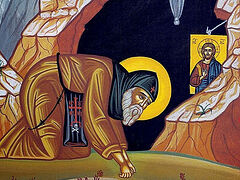
 St. Ephraim of Katounakia I remember one time we gave Fr. Ephraim of Katounakia a blanket. They had just started producing synthetic acrylic blankets at that time. They were light, soft, and warm. Blankets like this are sold everywhere now, but back then they were a novelty. Someone sent several of them to our brotherhood, and our Elder Joseph decided to give one to Fr. Ephraim, who was already bedridden at that time. The blankets that Fr. Ephraim had in his desert cell were old, of unknown age, and had been repeatedly patched and repatched. I should note that Fr. Ephraim generally didn’t accept any gifts, even though he lived in poverty. He wore an old coat, covered from top to bottom with so many patches of various colors (yellow, orange, green, red) that there was no way to tell which fabric it was originally made of.
So we brought him this blanket. Since our Elder Joseph was Elder Ephraim’s spiritual brother (they were both disciples of Elder Joseph the Hesychast), Fr. Ephraim accepted the gift. The next day, we got a letter from him: “Joseph, I received your blanket. Oh, what a relief! What a blanket!” Of course, this blanket wasn’t anything special. But for an ascetic who slept on boards, covered with old rags, a new, warm blanket was a great event: “Oh, what rest I found! How warm I am! What joy! The rest that you’ve given me, may God grant you in His Kingdom!”
Modern man, who never has to get tired and whose home is full of every kind of comfort, doesn’t find any peace in anything. In one house, I saw chairs that massage you, knead your back, warm you, cool you, move around... Basically, they do everything but feed you. But even in this you won’t find any peace.
When a man’s life is filled with work and fatigue, then he knows how to experience pleasure. If you’ve ever completely fasted from food and water in the first three days of Great Lent then you know that on Wednesday, when you’re hungry after three days of fasting, when you have a prosphora after Communion, it tastes like a real treat. You eat a prosphora, have a small glass of holy water, and you feel your whole body gain strength and come alive. Whereas before Lent, we eat and eat and eat, but still can’t seem to gain any strength.
God finds rest in those who abide with Him and are like Him. In what sense are they like Him? These people have what Christ has. And what did Christ tell us about Himself? What is He like? The Lord described Himself, saying: Learn of Me; for I am meek and lowly in heart: and ye shall find rest unto your souls (Mt. 11:29). Christ pointed to two things: meekness and humility. So He finds rest in men who are humble and simple and have a meek, peaceful heart. It’s in souls like these that the Lord rests, and not at all in those who never make mistakes (and sinless people don’t exist anyway).
God finds peace in a man who may make mistakes, even sin at times, but who always humbly acknowledges his weaknesses, repents of his transgressions, doesn’t make excuses, and prays to God for forgiveness of sins. In other words, God rests in the man who doesn’t have a high opinion of himself, who doesn’t consider himself important or flawless, who doesn’t lament over a mistake he’s made and keep going with: “Why did I do that? How could I have made a mistake? Why…?” Worries like this sometimes wear on your nerves so badly that you even have to see a doctor.
God rests in the saints—in their simple, humble, modest souls. It’s wrong to think only monks and hermits can become saints. No, even kings can become saints. God testified about King David, who was a king and lived in a palace, surrounded by gold and other luxuries: I have found … a man after mine own heart (Acts 13:22). We know that David, this saint of God and prophet, fell into temptation and committed the grave sins of adultery and murder. However, he then offered profound repentance, and the Holy Spirit found rest in his soul.
When I hear the words, “Who restest in the saints,” a whole procession of simple and humble souls passes before my mind’s eye: those I once encountered somewhere along the way, and those I interact with in daily life. These are people of all ages, ranks, and positions: children, the elderly, college kids, schoolchildren, clerics, laymen, monastics, the poor, the rich—whoever. With their humility, simplicity, and innocence, they give rest to the Holy Spirit of God within themselves. They don’t want to offend anyone, don’t want to treat anyone unfairly, don’t want to hear anything bad, and guard their minds from corruption. All this helps them discover the beauty of human nature within themselves.
A man of meek and humble heart is truly beautiful, for he becomes what God intends him to be, how man came from the hands of the Creator—that is, like God. A meek and humble man finds spiritual peace and joy, experiencing the boundless freedom bestowed upon him by the Holy Spirit of God.
To be continued…