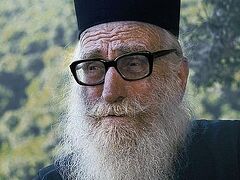
On October 6/19, 1914, one of the most venerated elders of the Serbian Orthodox Church of the late twentieth century—Elder Thaddeus/Tadej (Štrbulović) of Vitovnica—was born.
Born Tomislav, he grew up in a peasant family, enduring a difficult childhood filled with hardships. He lost his mother at an early age and was himself weak and sickly. Mistreated in his father’s house, he often ran away. The boy was deeply perceptive and vulnerable. From his early years, he completely gave up non-fasting food and began to long for another kind of life—a life in Christ, far removed from the vanity of the world. Later in life, the elder recalled his childhood, saying, “From childhood, I understood that there is a concept of service: Parents serve their children, and children serve their parents. And then the thought came to me that if everyone serves someone else, then I want to serve God, because He is above all. That is how the Lord called me from the earliest years.”
 Elder Thaddeus (Štrbulović) of Vitovnica
After graduating from school, Tomislav entered a trade and craft school to train as a tailor. One day, advanced tuberculosis landed him in a Belgrade hospital, where the doctors gave him only a few years to live. The young man refused treatment and decided to devote his remaining years to God. He went to a Serbian monastery and told the abbot everything. A Russian monk, a refugee from Russia, happened to be present during their conversation. Looking at the pure-hearted Tomislav, he said, “You won’t find the kind of monasticism you are looking for in any of the local monasteries. That way of life exists only in the Miljkov (also spelled Milkovo) Monastery, where Russian monks have gathered. You must go there!” Tomislav heeded this advice and set off for the Miljkov Monastery in honor of the Entry of the Theotokos into the Temple.
Most of this monastery’s brotherhood did indeed consist of Russian monks who were refugees from the USSR. The monastery was headed by Schema-Archimandrite Ambrose (Kurganov)—who had formerly lived at the Optina Monastery, was a disciple of St. Ambrose of Optina, and was a man of high spiritual life. It was there that the seventeen-year-old Tomislav arrived in 1932. Later, the elder described that moment as follows: “A novice took me to a cell so that I could rest. At six in the evening, the Vigil commenced and lasted until eleven. Every day, the Divine Liturgy was celebrated and the full prayer rule was performed. When Monday came, Father Archimandrite called me over and asked:
“‘Do you like our life? Do you want to stay with us?’
“‘I do like it.’
“‘Well, fine, but do you want to stay?’
“‘I do.’
“‘You will go and guard the vineyard.’
“And so, I stayed at the Miljkov Monastery.”
Regarding monastic obediences, the elder continued: “They gave me a prayer rope and taught me how to pray… I thought I had only five years to live and that I shouldn’t waste them. So, I decided to seek my own path to God… my very first obedience was to guard the vineyard. I used to love sleeping, and one day, while I was dozing off, thieves came and stripped all the grapes. When I woke up, I saw the grapes were gone. Terrified, I waited for the monastery steward. He arrived, looked around, and didn’t say a single word to me. Not a single word! The next day, he came to me again and said, “Tasa (that was my name as a novice), batiushka has blessed you with a new obedience.”
Tomislav failed at his new obedience just as he did at the next one. Yet, he did not hear a single word of reproach from anyone, because a spirit of love reigned at that monastery under Schema-Archimandrite Ambrose, in accordance with the apostolic word: Charity suffereth long, and is kind (1 Cor. 13:4).
Gradually, Novice Tomislav’s physical health grew stronger. Under the spiritual guidance of Fr. Ambrose, he advanced in faith, acquiring the fruits of the Holy Spirit even at a young age. This is how the elder described his time at the monastery: “Here at the monastery, I once felt that I loved everything. A kind of wondrous, ineffable joy enveloped my entire being. I felt an indescribable peace. I loved everything and could no longer feel anger. I pitied everything that suffered. At any moment, I could weep for human sorrow and suffering. And this continued until Blessed Abbot Ambrose fell asleep in the Lord. As long as Father Archimandrite Ambrose was alive, all was well.”
Novice Tomislav also had conversations with the future St. John (Maximovitch) of Shanghai. The latter took his monastic vows precisely at the Miljkov Monastery and would visit there during the summer while serving as a lecturer at St. John the Baptist Theological Seminary in Bitola (now in North Macedonia). Together they tended the monastery’s garden, during which Fr. John would tell the young novice about the writings of the Holy Fathers and examples from the Lives of the Saints.
Following the passing of his spiritual mentor, Schema-Archimandrite Ambrose, Tomislav moved to the Serbian monastery of Gornjak. There he took his monastic vows under the name Thaddeus and was ordained hierodeacon. In 1938, he was ordained hieromonk.
With the outbreak of the Second World War, Fr. Thaddeus was arrested by the Nazis and thrown into a Belgrade prison alongside St. Nikolai (Velimirovic) of Zica. Although Hieromonk Thaddeus was released shortly after, he was arrested again in 1943. This time, he faced the death penalty. While in his cell, he received consolation from God. He later recalled the moment: “Suddenly, a tall warrior appeared before me with a golden ribbon crossed over his chest. He wore no helmet on his head. He was tall and handsome—none like him exists on earth! Holding a scroll in his hand, he looked at me, and I understood that he was an angel, a consolation from the Lord! The warrior of God unrolled the scroll and said, ‘Look, this is a map of Serbia. Do not be afraid, do not fear; you are yet to comfort and encourage many.’” A month later, Fr. Thaddeus and St. Nikolai were transferred to the Vojlovica Monastery, where they were able to celebrate the Liturgy.
After the war, Hieromonk Thaddeus served his obedience in various places and became the abbot of the Patriarchate of Pec Monastery. Reflecting on that time, the elder later recalled: “I suffered a great deal there; the Communists caused a lot of trouble, creating difficulties and putting up obstacles wherever they could. But thank God, with His help, we overcame everything.”
In 1959, Fr. Thaddeus traveled to Holy Mount Athos, where he stayed for a couple of months. Reflecting on this later, he shared: “I was not feeling very well in Hilandar—I thought it was my heart. Then one night, I had a dream. It was as if all of us, the Athonite monks, were going to receive a blessing from the Most Holy Mother, the Abbess of Mt. Athos. The brethren were stepping forward, kissing Her hand. I approached too, and asked Her to implore Her Son and our God to forgive the sins I had committed throughout my life. I waited for Her response. ‘That is nothing,’ She replied, ‘Your nerves are just very weak.’ That is what the Mother of God said… And so, I had to return.”
In 1962, Fr. Thaddeus was appointed Abbot of the Vitovnica Monastery. Ten years later, due to poor health, he asked to retire but was instead assigned to serve as the acting abbot of the Pokajnica Monastery. After some time, he returned to Vitovnica. There, with the blessing of the ruling hierarch, he entered into his ministry as an elder, undertaking the ascetic labor of self-sacrifice in providing spiritual guidance to the faithful. People flocked to Elder Thaddeus by the hundreds, and he received them with love and warmth, even though he himself suffered from nervous exhaustion. He survived two heart attacks. Reflecting on this, the elder would say: “I suffered two heart attacks because I had to speak to people so much. I thought it was the end of me, but here I am, alive again. Still, I have no strength to talk anymore—I can only celebrate the Liturgy and sing. But what can I do if people come with their troubles and worries? I never used to suffer from high blood pressure, but now, when I listen to someone, learn about his sorrows, and take them on myself, my blood pressure spikes. I don’t like taking medicine, yet here I am, alive!”
 The Vitovnica Monastery
The elder instructed those who came to him: “The Lord is everywhere. He dwells in the heart, and that is why He says we must live by the heart and labor with joy. When we seek the Lord with all our hearts—there He is, He is right here! For He is our Father. After all, even our earthly parents expect attention from us, hoping that we will return the love they once gave us, yet we so often grieve them… We must seek God with all our hearts. When we practice doing everything from the heart, that itself becomes our sincere prayer, love for our parents and loved ones, and the Lord is right beside us… Every task we do is simultaneously a prayer. If our thoughts are focused on our work, and if we do it with all our hearts, it means we are laboring for the sake of God. But when we think we are working only for the sake of people, that is wrong.
“Earnest prayer means prayer from the heart. Let us pray to the Lord with all our hearts. He does not require philosophy; we only need to ask from the heart, like a child asking his parents: ‘Help, O Lord, every soul, and do not forget me, O Lord! Help everyone find peace, and help us love Thee as the angels love Thee. And give us the strength to love Thee as Thy Most Holy Mother loves Thee. Grant me such strength as well, O Lord!’
“We must forgive everything from the heart. Inner peace cannot be preserved as long as our conscience reproaches us for anything… It is of great significance if there is a person in a family who truly prays. Prayer draws down the grace of God; everyone in the household feels it, even those whose hearts have grown cold. Therefore, we must pray without ceasing… Everyone is called to holiness. Every soul is born holy. Both the great and the small—everyone must be holy—for life is a Divine energy that originates from God, the Source of life. That is why everyone receives it, both angels and humans. This energy is always with us. And God is the sole Giver of life.
“Spiritual life is a life of the mind and intellect. Therefore, we must pay attention to what swarms within us, and pray day and night to the Lord to deliver us from all evil, to cleanse us, and to give us the strength to drive away the onslaught of the spirit of malice. The Lord has shown us how we ought to be: humble, obedient, and submissive to the will of God. Good deeds that we perform are pleasing to Him. Almsgiving and everything we do for our salvation, for the benefit of our neighbors, and for the Holy Church—all this is good and pleasing to the Lord. But what is most pleasing and precious to the Lord is a malice-free, simple-hearted, childlike love that binds us so closely to His heart. This is what is dearest to Him—this is what He seeks from us. And every soul can attain this: the rich and the poor, the old and the young.
 “A deep faith in a person inevitably evokes and seeks prayer. Long-standing, intense prayer will surely give birth to love. And the purpose of human life is nothing other than to purify one’s heart so that it begins to sing with joy. The prayer of the heart leads to such joy of the heart. And for a joyful person, nothing is heavy, because he is full of love… Take the trouble to have good thoughts and good desires for both friends and enemies, and you will see what good fruit both you and everyone around you will receive.
“God is pleased with those who are humble and meek in soul. They do not get angry when you offend them; they are full of kindness and peace… As long as we focus on the negative aspects of the people who come to us, we cannot have peace of mind and repentance. As long as we harbor thoughts of offense caused by our enemies, friends, relatives, or loved ones, we lack peace and quiet, and we live in a state of hell.”
The holy Apostle Paul wrote in one of his epistles: Yea, and all that will live godly in Christ Jesus shall suffer persecution (2 Tim. 3:12). Elder Thaddeus did not escape this fate either; slanderers and envious people expelled him from the monastery. In the final years of his life, he found refuge with his spiritual children. The elder reposed in the Lord on the night of April 14, 2003, and was buried at the Vitovnica Monastery, where he had served for many years. May the Lord give rest to the soul of Archimandrite Thaddeus in the dwellings of the righteous!
Bibliography:
Peace and Joy in the Holy Spirit. Elder Thaddeus of Vitovnica, translated from Serbian by Svetlana Luganskaya (Moscow: Novospassky Monastery, 2010).
Elder Thaddeus. Our Thoughts Determine Our Lives (Belgrade, 2008).
Archimandrite Thaddeus of Vitovnica, Grains of Good Thinking: Thoughts and Advice for Every Day (Moscow: Nika, 2017).