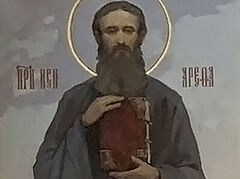
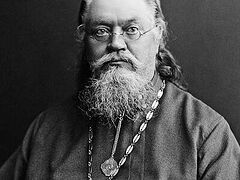
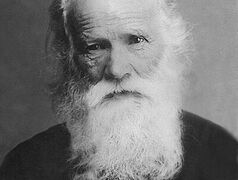
On November 25, 1937, “business as usual” was underway at the Butovo firing range: “anti–Soviet elements” were being executed—without mercy and without a thought of sin. Among those “elements” was Igumen Theodosy—a monk, a pastor, a child of God, a man who had devoted his life to serving the Lord and his fellow man.
His Birthplace: the Village of Kazanskoye, the Livny District of the Oryol Governorate
 Igumen Theodosy (Tarasov) The Oryol governorate of southern Russia. In the late eighteenth century, as the urban Yamskaya Sloboda (coachmen’s settlement) near the district town of Livny expanded, a new settlement of coachmen—Makhovoy Verkh—emerged between the Sosna and Kshen Rivers. At the beginning of the following century, its population exceeded 1,000 people, and a village assembly decided to build a church. They raised the funds, erected a church in honor of the Kazan Icon of the Most Holy Theotokos, and renamed the village. Thus, Kazanskoye came into being. Here, in 1884, a son was born into the peasant family of Ivan Tarasov, descendants of the original settlers from the urban coachmen’s settlement. The child was baptized at the church of the Kazan Icon and christened Fyodor/Theodore, which means “given by God.”
In 1869, a school opened in the village of Kazanskoye, where Fyodor Tarasov could have studied as well. However, Fyodor Ivanovich’s questionnaires state that he was homeschooled. It is also unknown what he did prior to 1911 and who gave him the blessing to go to the Holy Trinity-St. Sergius Lavra, the largest monastery in Russia.
Sergiev Posad. The Holy Trinity-St. Sergius Lavra. A Novice
The glorious monastery was founded by St. Sergius of Radonezh in 1337. A spiritual stronghold of Russia, an educational center, a military fortress, and a place of great beauty and grace on earth—the Holy Trinity Lavra of St. Sergius draws the hearts of many believers. In 1911, Fyodor Tarasov arrived at the Lavra and became a novice to prepare for taking monastic vows. However, in 1917, the October Revolution took place and the Decree on Land was adopted, followed in 1918 by the Decree of the Council of People’s Commissars1 of the RSFSR on the Separation of Church and State and of School from Church. The monastery was given the legal status of a labor artel, and its property and lands were confiscated. Although monastic life continued for a short time longer at the Gethsemane and Chernigov Sketes of the Lavra, Tarasov left the monastery and Sergiev Posad and moved to Moscow.
Moscow. The Holy Protection Stavropegic Monastery
In 1635, the Holy Protection Monastery was founded in Moscow. In doing so, Tsar Mikhail Feodorovich (1613–1645) honored the memory of his father, Patriarch Philaret (Romanov), who had passed away on the feast of the Protecting Veil of the Most Holy Theotokos. In 1918, Fyodor Tarasov arrived at the monastery, which had only eleven years left before its closure. He became an official novice—that is, a novice formally enrolled in the monastery brotherhood by decree of the consistory. On April 16, 1919, Archimandrite Alexei (Patrikeyev) tonsured Tarasov with the name Theodosy/Theodosius.
At the beginning of the following year, 1920—which marked the start of widespread persecution against the Church—he was ordained hieromonk. Several years later, he became an igumen and was an active member of the Church Council. After the monastery was shut down,2 Igumen Theodosy went to the Moscow Church of the Jerusalem Icon of the Mother of God.
The Church of the Jerusalem Icon of the Mother of God at the Slaughterhouses (beyond Pokrovskaya Zastava)
In the late nineteenth century, on the outskirts of Moscow in Kalitniki, there was a street named Myasnaya-Bulvarnaya (since 1952, V. S. Talalikhina Street), so called because the city slaughterhouse, meat trading rows, and the Meat exchange were located nearby. In 1912, the Church of the Jerusalem Icon of the Mother of God in the Russian Revival style was built on this street, designed by the architect Sergei Voskresensky. The church could accommodate up to 2,000 people. Money for construction and building materials was raised by the whole community: slaughterhouse workers, merchants, and peasants from the nearby village of Dubrovka, whose residents were engaged in livestock farming. The church clergy consisted of a priest, a deacon, and two readers. From 1912 to 1935, Archpriest Pavel Uvarov served as the rector.
In 1929, following the closure of the Holy Protection Monastery, the Church of the Jerusalem Icon sheltered some of its former brethren and allowed them to continue serving. Among them was Igumen Theodosy. He moved into an apartment on Zhelty Lane—a street which seems to have vanished forever from the map of Moscow.
 Church of the Jerusalem Icon of the Mother of God
The presence of monks from the Holy Protection Monastery at the church drew ever-growing crowds to the services. This situation at a church that Soviet authorities branded a “hotbed of ardent religionists” was bound to provoke discontent, so the matter was resolved in the most traditional way: every monk was arrested.
The First Arrest and Exile
On April 16, 1932, Igumen Theodosy was arrested and placed in one of Moscow’s jails. On June 3, a troika of the OGPU Plenipotentiary Representation3 for the Moscow Region sentenced him under Article 58-10—for propaganda or agitation containing an appeal to overthrow or weaken Soviet power or to commit counter-revolutionary crimes. The igumen was sentenced to three years of exile in Kazakhstan, where many hardships awaited him. Nevertheless, exiled priests, against all odds, sometimes managed to find refuge in an Orthodox church, meaning they had the opportunity to pray and celebrate services. After the exile ended, returning to Moscow was impossible. Fr. Theodosy took up his residence near the town of Kashira about sixty miles south of Moscow.
The Moscow Region. Church of the Tikhvin Icon of the Mother of God in Sredneye
The Church of the Tikhvin Icon of the Mother of God in the village of Sredneye near Kashira,4 built in 1819, was closed just over a century later—though only briefly. This short closure allowed the church and its interior to be preserved. Such a miracle was made possible by the efforts and courage of Anastasia Ivanovna Kazyonnova, a choir singer and parish council member who traveled to the capital with a petition. Reopened in 1929, the church was never closed again.
On returning from a three-year exile in Kazakhstan, Igumen Theodosy moved to the village of Sredneye and was appointed reader at the Church of the Tikhvin Icon, where Fr. Alexei Kolokolov served as rector. Following the mass closure of churches across the Moscow region, this parish held immense significance for residents of the Kashira and Stupino districts and drew large numbers of believers.
The Case of “Former Priests Kolokolov and Tarasov and Nun Dulneva”
Life at the Church of the Tikhvin Icon struck the authorities as overly active—a distraction that “kept people away from the village reading room, depressed attendance at meetings, and stood as an overall obstacle to building a bright future”. Witnesses soon emerged from Sredneye and surrounding villages. They complained about the priests, citing, for instance, the donations collected for funeral services and Baptisms. They expressed outrage over rumors that “the former priest Kolokolov intended to run for the Supreme Soviet,5 with Tarasov backing him in everything”, and claimed that “the churchmen wanted the village club shut down”.

Thus, in 1937, a group case was fabricated against Kolokolov, Tarasov, and Thecla Grigorievna Dulneva, a former novice of the Convent of St. John the Baptist in Kashira,6 who had already served a five-year exile in Kazakhstan. This group of “priests and monastics” was accused of “conducting counter-revolutionary, insurgent agitation aimed at overthrowing, weakening, and undermining Soviet rule, urging people to vote for Kolokolov, and committing counter-revolutionary crimes”. In denunciations and during interrogations, witnesses reported that “the three frequently said Soviet power would soon come to an end”.
This resulted in an indictment stating that the priests and the nun were arrested on October 28 and placed in the Kashira prison. Notably, in 1937, the town of Kashira in the Moscow region was included in a restricted-access zone where former convicts, “kulaks” (wealthier peasants), disenfranchised persons (“lishentsy”), and other elements deemed alien to Soviet power were prohibited from residing. Consequently, the “Kolokolov-Tarasov” case, which was referred to the NKVD troika for the Moscow region, was high-profile, as the issue of coexistence between Soviet citizens and the clergy was considered critically important. The priests pleaded not guilty; however, this had no bearing on the verdict in their case.
On November 21, 1937, the NKVD troika for the Moscow region sentenced Priests F. Tarasov and A. Kolokolov to the supreme penalty—execution by firing squad—and citizen F. Dulneva to a term in a corrective labor camp.
On November 25, 1937, Igumen Theodosy was executed at the Butovo firing range and buried in a mass grave—or rather, in one of the thirteen burial trenches.
In January 1959, Igumen Theodosy (Tarasov) was posthumously rehabilitated in connection with the 1937 case, and in February 2004, in connection with the 1932 case.