Earlier, I wrote an article on the New Martyr Nikolai Varzhansky. And it felt only natural to follow it up with a piece on Hieromartyr Neophyte Lyubimov, for one very simple reason: they were relatives. Nikolai was married to Zinaida, the youngest daughter of Archpriest Neophyte, making him Fr. Neophyte’s son-in-law. It was Archpriest Neophyte who penned the famous letter in support of the arrested Nikolai. The letter was addressed none other than to Vladimir Lenin himself, who at the time headed the entire godless machine known as the RSFSR. In this letter, Fr. Neophyte referred to Nikolai as his son, adding “son-in-law” only in parentheses. This single fact speaks volumes about the warmth of their relations and how truly close they were.
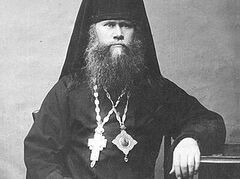
 The Hieromartyr Neophyte Lyubimov The future hieromartyr was born on January 12, 1846 in the village of Mordovskiye Lipyagi (also known as Tabory) in the Samara district of the Samara governorate.1 His parents were Deacon Porfiry Petrovich Lyubimov and his wife Evdokia Gerasimovna.
Nothing is known about how the boy’s name was chosen. The parents gave their son a rather unusual and uncommon name. I can only say one thing: on January 24 (all dates are according to the old calendar), The Holy Church honors the memory of Venerable Neophytos the Recluse of Cyprus, who lived in the twelfth–thirteenth centuries.
I often marvel at how providential pious parents were in choosing names for their children, so much so that the personality of the patron-saint exerted the most powerful influence on the life of the person named after him. St. Neophytos of Cyprus became famous not only for his ascetic life but also for his spiritual writings, which, as his Life states, were written in plain language rather than a pompous “ecclesiastical style”. This made it easier for people to read and understand these works, and they flocked to the saint. He was also the author of the monastic rule. His Life tells us that “in his monastery near Paphos, the ascetic laid the foundations for a culture of upbringing and systematic spiritual education that assumes a small number of monks,” while “his extensive literary heritage makes him the greatest Greek author of medieval Cyprus.”
Our Russian Hieromartyr Neophyte was a missionary and educator who likewise “laid the foundations for a culture of upbringing and systematic spiritual education” which largely shaped the formation of Russian Orthodox Church pastors and their future wives. And likewise, people were greatly drawn to him. In addition, Archpriest Neophyte authored collections of sermons (Words and Speeches and Words and Homilies).
Neophyte graduated from the Samara Theological School and the Samara Theological Seminary. His God–given talents and academic achievements were so evident that he studied at the Kiev Theological Academy at public expense—or, in modern terms, on a full scholarship. On graduating from the Academy at the age of twenty-eight, he received a master’s degree in theology and was appointed teacher at the Simbirsk Theological Seminary.2
Here in Simbirsk, Neophyte married Maria Lvovna Murashkintseva. Her father was a merchant in the town of Ardatov (in Mordovia) and the warden of the local Holy Trinity Cathedral.
The Lyubimov family had three children. However, this beautiful, God–loving family was not spared by grief: their eldest son, Pavel, passed away in the prime of his youth. He was a highly promising young man and a graduate of the Simbirsk Classical Gymnasium. He had planned to enroll in the Imperial University of St. Vladimir, but died after contracting pneumonia.
Their middle daughter, Anna, married an official, while the youngest, Zinaida, as I have already written, married the missionary Nikolai Varzhansky.
Neophyte engaged in extensive teaching activities in Simbirsk. At the Seminary, he taught homiletics, liturgics, practical guidance for pastors, dogmatics, and moral theology. At the Simbirsk Military Gymnasium, he taught the Russian language and civil history. He also taught these same subjects at the Simbirsk Diocesan Girls’ School. Looking ahead, I should note that he dedicated nearly fifteen years of his life to serving at the School.
He believed that being educated was not a privilege reserved for the noble and wealthy, but a necessity for all
St. Neophyte held highly broad views on education, seeing it as a global process. He believed that being educated was not a privilege reserved for the noble and wealthy, but a necessity for all. He used to say, “The acquisition of knowledge is essential for every human being as long as they exist on earth. Everyone must learn throughout their lives: this is demanded by both the responsibility and the moral duty of a rational being. The Lord has commanded us to labor... to labor not with the body alone, but even more so in spirit… with all the powers of the soul.”
Furthermore, St. Neophyte was deeply critical of the past, when girls were not expected to receive an education, “when there was not even a mention of any schools for the female sex, when literacy itself was intended solely for men, and a woman’s lot was strictly limited to homemaking. They were benighted times.”
He was convinced that “Christian truths… must be known to every Orthodox Christian,” regardless of sex, social, or financial status. All the more highly educated should be the spouses of priests, whom the Diocesan Girls’ School was preparing. Neophyte recognized the lack of education among priests’ wives as wrong, stating that a priest’s helpmate should be a young woman prepared in every respect, including the acquisition of various knowledge: “I am speaking of the priest’s wife who was underdeveloped mentally and, one might say, morally, which is why she could not absorb the good lessons of her husband in matters of faith and Christian morality.” Therefore, he strove with all his might to correct the situation that had developed over decades. Yet at the same time, he instructed the School’s graduates, calling them to modesty, gentleness, and humility: “Do not pride yourselves on your education, be it before your relatives—regardless of how simple, poor, and unlearned they may be—or before strangers, bearing in mind that true education and a strictly moral upbringing are incompatible with pride and arrogance. Do not shun labor, especially domestic work; do not imagine that labor and occupations are beneath you. No labor or useful occupation, even the simplest, is humiliating; most degrading of all are pride and idleness.”
In the civil service, Neophyte had reached the rank of Court Councilor (7th class) with seniority by the age of thirty-four. Two years later, in 1882, he was elected a member of the Theological Seminary’s Academic Assembly. Two more years later, he was appointed to the Seminary Board’s Academic Administrative Assembly. In 1885, he was appointed catechist and inspector of the Simbirsk Diocesan Girls’ School, where he served for the next fifteen years. A few words on the institution itself. Originally a monastery orphanage, it later evolved into a school exclusively for girls of the clerical estate—that is, the daughters of the clergy. While graduates were qualified to work as home tutors or village schoolteachers, the School’s primary mission was to prepare young women to become priests’ wives.
Exactly three weeks after his appointment, Neophyte was ordained deacon at the Church of the Entry of the Mother of God into the Temple at the Diocesan School, and the following day, priest. Thus, the Lord placed the thirty-nine-year-old Neophyte in this position to educate and spiritually guide the School’s female students.
 Simbirsk Diocesan Girls’ School
What was this decision—to take up the priesthood—for St. Neophyte? How did he come to it? It did not happen immediately upon graduation from the Theological Academy, but rather at a mature age. What inspired him to become a priest? Let Fr. Neophyte himself share his thoughts:
“The desire to embark on this spiritual labor set before me did not come without hesitation, anxiety, and a fear of this new path. A priest must tirelessly proclaim the entire will of God to the people, preaching the Word of God to the great and the small, the educated and the uneducated, the rich and the poor. He must diligently and reverently celebrate the Divine service, administer the holy sacraments to the faithful in purity of spirit and body, and offer up prayers both in the church and in the homes of parishioners—intelligibly, without haste, and without distraction. In short, he must be a worthy instrument and a conduit of the grace of God into the souls of the faithful… He must always stand on guard so as not to demean himself or his calling in any way. It was this exalted purpose and position of a shepherd among his flock that deeply troubled me and made it so difficult for me to choose this new ministry as a pastor in your parish.”
And, of course, he was deeply anxious. Would he cope? He understood the colossal burden that the Lord had placed on his shoulders. Yet, he also knew that he would carry out his ministry righteously and honestly, for he would have to answer to God Himself for everything. Addressing his flock, Fr. Neophyte said:
“Do not demand that I deviate from my direct duty, and do not expect me to be a man-pleaser just to win your favor. The Savior said to His disciples, and through them to us, the pastors: Woe unto you, when all men shall speak well of you (Lk. 6:26). Watch whether I conduct my ministry among you rightly; if rightly, thank the Lord, and if I stumble, do not abandon me—support me with your sympathy, advice, labor, and prayer. That is what love is. If, however, against all expectation, you see or notice anything in my life that causes you to stumble, remember then the Lord’s words: All therefore whatsoever they [unworthy pastors] bid you observe, that observe and do; but do not ye after their works (Mt. 23:3).”
However, education, upbringing, and spiritual guidance were not the only responsibilities Fr. Neophyte had to undertake at his post. He was almost immediately tasked with expanding the School in a purely practical sense. The building could no longer accommodate all the prospective students and needed to be renovated—or rather, expanded with a series of new structures. A fundraising campaign was launched across the deaneries of the Simbirsk Diocese; a certain amount was raised, and a design was prepared. Construction began in 1886, overseen by Fr. Neophyte. Almost immediately, it became clear that the design had a number of shortcomings. For instance, it failed to provide for any utilities…
We can only imagine how, under such conditions, Fr. Neophyte managed the construction of the new classroom building, a dormitory for the girls, a bathhouse, a laundry, a hospital, and other facilities. On top of that, he taught at both the School and the Seminary, while also celebrating church services. After three years of these exhausting labors, he noted that the workload had become simply unbearable. He petitioned to be relieved of his teaching duties at the Seminary, and his request was granted. From then on, Fr. Neophyte dedicated all his energies exclusively to the Diocesan Girls’ School.
 Commemorative plaque to Archpriest Neophyte Lyubimov in Simbirsk
It must be said that Fr. Neophyte handled his construction mission brilliantly. On September 18, 1897, he submitted a detailed report describing the completed work to the School Council, and a commission was invited to inspect and accept the buildings.
Fr. Neophyte took great care of his students, providing for them both spiritually and materially. He wanted to ensure they had comfortable living conditions and a good education. He was equally warm-hearted toward the teaching staff. Fr. Neophyte advocated for the teachers of the School to receive a decent salary. He even submitted a proposal to the Simbirsk Diocesan Congress of Deputies regarding the need to increase the teachers’ hourly pay. Bishop Barsanuphius (Okhotin) of Simbirsk and Syzran endorsed the Congress minutes with a resolution: “To be executed. May God grant that this favorable time comes soon.”
However, Fr. Neophyte cared about more than just the students’ time within the School walls. With his pastoral words, he inspired the girls for their future service as priests’ wives after graduation. He would paint pictures of potential parish life for them, vividly explaining what could and should be organized, and how:
“Do not shrink from serving in the choir… By doing so, you will help to reverently lift the minds and hearts of the congregation up to the Heavenly throne. And what praise you will receive from the Lord and from the people if, through your zeal, you form a children’s choir to glorify the Lord and His saints in the house of God! The Orthodox faithful will gather in great numbers, filled with a spirit of prayer, to listen to your beautiful singing, and through it, the hearts of those who come into the church of God will be softened, and their thoughts will be directed toward the Creator of the world… Yet your service for the benefit of your neighbor on the feast days may well continue even after you return home from the house of God. During these hours, the doors of your homes may be opened in the afternoon to those seeking moral and religious guidance and wise counsel… The remainder of the Lord’s Day may be devoted to visiting the sick and those in distress or need, taking a most heartfelt part in their lives.”
The students reciprocated their mentor and pastor’s care with great love and respect:
“As our catechist, inspector, and spiritual father, you have striven to sow the seeds of Divine teaching in our young hearts… God knows what lies ahead for each of us after graduation. Some of us may lead happy, joyful lives, while others may face a difficult path filled with sorrows—perhaps even a struggle for a crust of bread. But whatever awaits us, and wherever we may find ourselves, we will always remember you with love and heartfelt gratitude… and pray for you all our lives.”
On the completion of construction work at the Diocesan Girls’ School, Fr. Neophyte resumed his other obediences. In 1898, he became the chairman of the Committee for Developing Rules for Written Exercises, and in 1899, he was appointed teacher of Greek at the Simbirsk Theological School.
For his selfless service to God, Fr. Neophyte received several awards, including the Order of St. Stanislaus, 3rd class, in 1883; and a pectoral cross in 1896.
In 1900, Fr. Neophyte concluded his service at the Simbirsk Diocesan Girls’ School and was transferred to All Saints’ Church in Simbirsk, taking on additional roles as principal of the parish school and teacher of the Law of God.
Having excelled in the construction of the Girls’ School buildings, he was given a similar obedience here as well. Now he was building the Theological Seminary and a dormitory for the students. That same year, 1900, Fr. Neophyte was appointed chairman of the Simbirsk branch of the School Council and principal of the Sunday school at the city college.