On September 12, 2024, the Russian Orthodox Church celebrated the 300th anniversary of the translation of the relics of St. Alexander Nevsky (1724).
 In all periods of history, outstanding personalities have been at the center of Russian history and culture, closely linked to Orthodoxy. One of these figures was the Right-Believing Prince Alexander Yaroslavich Nevsky. He lived in the era of feudal division and internecine wars in Russia, which weakened the Russian State and opened the way to Russia for external enemies.
Internecine wars were complicated by the religious wanderings of the appanage princes and the princes of Veliky Novgorod. For example, Prince Daniel Romanovich of Galicia, along with some of his wealthy people, considered adopting the Catholic faith in exchange for various privileges from Europe.
 Henryk Siemiradzki. Alexander Nevsky in the Horde. 1843 Russia suffered huge losses from the Mongol-Tatar invasion: many Russian cities and towns were razed to the ground. It is good that the Mongol-Tatars did not strive to change the faith in Russia. They were not interested in the religious and cultural life of the Russian State. They were only concerned with the collection of tribute from the Russians and the security of the State they had established. The Horde brutally suppressed the military alliances of the Russian princes with other rulers against the Mongol-Tatars.
Prince Alexander Yaroslavich Nevsky was religious, brave, steadfast, and devoted to his country and people. For him, the interests of Russia were above his personal life and personal interests. The Russian Orthodox philosopher Ivan Ilyin wrote about such people: “Without a person’s commitment to traditional religious values, there can be no genuine patriotism; because he ascends to God in the same way as his Motherland ascends to God, and in this direction to the Godhead he is identical with it and inseparable from it.” That is why a person should strive to “be a spirit and serve the Spirit of God.” It is necessary to see the purpose of life in it, since without this meaning human life is “pointless and degrading”.
With all his life, Prince Alexander Nevsky proved that he was honestly carrying on the cause of his ancestors: the holy Prince Vladimir Equal-to-the-Apostles, Princes Yaroslav the Wise and Vladimir Monomakh, who had done much to strengthen the power of Russia.
Alexander Yaroslavich became a prince in Veliky Novgorod. He was very conscious of the need to unite the Russian lands, but was also aware of the impossibility of accomplishing this task in the near future. In the mid-thirteenth century, Russia had split into the North-East, the South-West, and Novgorod.
Prince Alexander Yaroslavich understood that the state, religious and national principles are closely interrelated. Therefore, he set himself three tasks. Firstly, to stop the internecine wars that undermined Russia’s might. Secondly, to protect the Russian State from external enemies. Thirdly, to preserve Orthodoxy in Russia.
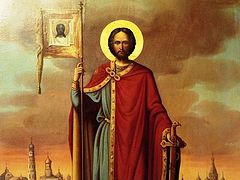
 Yu. Pantyukhin. Alexander Nevsky. The left section of the triptych, For the Russian Land (2003)
For him the preservation of the Orthodox faith in Russia was the most important of the three tasks, because the destiny of Russian civilization depended on it. After all, Western missionaries and the Catholic Church were constantly striving to gain dominance in Russia. Prince Alexander Yaroslavich kept it in mind. He crushed the Swedes in 1240 and the Crusaders in 1242. These victories of St. Alexander Nevsky stopped the military and religious capture of the Russian land by the West, prevented the German knights from subjugating the North of Russia and converting the Baltic Slavs to Catholicism, and delayed their advance eastward until 1941.
In 1248, Pope Innocent IV, having lost hope of converting the Russian State to the Catholic faith, invited Prince Alexander Yaroslavich to convert to Catholicism, promising help in the struggle against the Mongol-Tatars in return.
Alexander Yaroslavich categorically refused, because he understood perfectly well that in this way the Catholics wanted to rob Russia of its strength and subjugate it to their power, and Russia could not fight on two fronts in those years.
In 1247, Batu Khan insisted on the young Prince Alexander Yaroslavich’s coming to the Horde, where he arrived together with his brother Andrei. The khan was amazed by the wisdom and responsibility of the Russian prince, and gave him a task: having received a jarlig (a written permit or license) authorizing his rule in Kiev, the prince had to gather the military and economic strength to consolidate his position in this city and its surroundings. He passed this test in a fitting manner. The Horde rulers did not encourage internecine strife among princes in Russia, and sought to establish their power structure in the lands they had conquered, because it was easier to deal with submissive prince-rulers.
In 1252, Prince Alexander Yaroslavich was granted seniority and a jarlig to rule in Vladimir by Sartaq Khan, Batu Khan’s son. The former oldest prince in Russia, Andrei Yaroslavich, was removed by the Mongol-Tatars for his attempt to conclude a military alliance with the West against the Horde, for which the inhabitants of Pereslavl and its surroundings paid a very high price, being burned to the ground by the Mongol-Tatars.
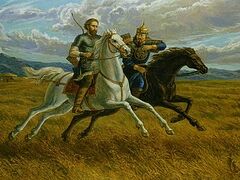
 Philipp Moskvitin. Prince Alexander Nevsky and Sartaq Khan in the Horde, 1999–2000
Prince Alexander Yaroslavich rebuilt Pereslavl and its villages. He formed an alliance with the Horde, although it was hard for him to do it, especially since his father had been poisoned in the Horde. But he rose above his personal feelings and emotions to save the Russian State.
In 1261, Grand Prince Alexander Yaroslavich ensured that an Orthodox bishop’s representation be opened in Sarai (the capital of the Horde) that represented the interests of Russia and the Russian people under the Mongol-Tatar Khan.
The Mongol-Tatar khans kept a close eye on the Russian princes’ commitment to the alliance with them. The military alliance with the Horde gave Russia the opportunity to build its own independent policy, religion, and economy.
Thus, the tasks that Prince Alexander Yaroslavovich had set himself at the beginning of his activity were fulfilled: the security of North-Western Russia was ensured, the internecine wars between the Russian appanage princes were stopped, and, most importantly, Orthodoxy was preserved on Russian soil.
Prince Alexander Nevsky reposed in 1262 on his way home from the Horde. Before his death, he received the monastic schema with the name Alexei.
 Henryk Siemiradzki. The Death of Alexander Nevsky, 1876 In 1724, Tsar Peter I the Great ordered the holy relics of Grand Prince Alexander Nevsky to be translated to St. Petersburg, where the Russian prince had stopped the aggressors from the West on the banks of the Neva River several centuries earlier. Peter the Great drew up the first design of the Order of the Holy Right-Believing Prince Alexander Nevsky. In 1725, the order was officially established by Empress Catherine I.
When during the Great Patriotic War (World War II), descendants of the German and Teutonic knights advanced again on Russia, besieged Leningrad, and wanted to wipe this city off the face of the earth, trying to break the spirit of the Russian people, the country’s Government ordered that Leningrad be defended to the last drop of blood. In March 1942, the Order of the Right-Believing Prince Alexander Nevsky was reestablished. It was awarded to the commanders of the Red Army. The Order of Alexander Nevsky is one of the few State awards of Russia that spans different periods of history: imperial, Soviet and post–Soviet.
During the difficult years of the Great Patriotic War, the Russian Orthodox Church organized a collection of donations for the front. With these funds, the Alexander Nevsky Aviation Squadron and the Dmitry Donskoy Tank Column were built. These names show the sacred nature of the Soviet people’s liberation war against Nazi Germany and the preserved spiritual bond of our people with the holy princes—defenders of the Fatherland, one of whom was the Right-Believing Prince Alexander Nevsky.