The Holy Smolensk-Zosima Hermitage is a men’s monastery in the Vladimir Province, founded in the seventeenth century by St. Zosima of Alexandrov. Let’s take a closer look at the history of the monastery.
 Smolensk-Zosima Hermitage
Information about Schemamonk Zosima, the monastery’s founder, is extremely scant. It’s known that he initially labored ascetically at the Holy Trinity-St. Sergius Lavra. In time, he received the schema and departed for the greater struggle of desert-dwelling on the bank of the Molochka River in the impenetrable Vladimir forests. This was in the second half of the seventeenth century. There were wooden churches that had been built during the Time of Troubles in the place where the hermit settled. St. Zosima brought the Smolensk Icon of the Mother of God with him, built a wooden chapel, and devoted himself to silence in the majestic stillness of the forest. He took St. Sergius of Radonezh as an example for his monastic labors. His cell was cramped and empty, with only a few holy icons on the wall, including the Smolensk Icon. He dug a well, which turned out to have spring water. He rested on a pine stump. Over time, word of his pure and God-pleasing life spread throughout the surrounding area.
A small monastic community gathered around Schemamonk Zosima. The faithful, including royal personages, began visiting him. The elder possessed the gift of discernment and love for God and man. In addition to prayer, the brethren kept bees. St. Zosima reposed around 1710. His first hagiographer, Simeon Ermloaev, wrote about his burial: “Three weeks the deceased lay unburied, and despite the intense heat, he didn’t change, and there wasn’t the slightest smell. He dug his own grave and lined it with brick. According to accounts passed down, the funeral was magnificent and drew large crowds.” A white stone monument was erected at the burial site of Schemamonk Zosima.
After the death of their spiritual father, nearly all the monks dispersed to other places. The hermitage was shut down. The chapel built by St. Zosima was given to a nearby monastery. Just a few monks remained there. In 1728, they reopened the monastery, but it lasted only forty years before being abolished again. These monastic lands were popularly called the Yuliana Wastelands. In the following decades, the wastelands passed to different owners. Some merchants decided to cut down the forest at the site where St. Zosima labored, and he appeared to the loggers. His grave was discovered, with a sweet fragrance coming from it. They were unable to open his coffin. In 1848, a wooden chapel was erected over the site of his burial. As during the saint’s life, people began flocking to this chapel, entreating his prayerful help and receiving healings (which still occur today).
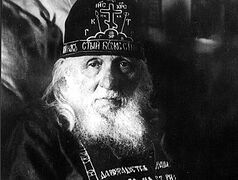
 St. Zosima The brethren of the Holy Trinity-St. Sergius Lavra asked the owners of the Yuliana Wasteland to sell it to them. They refused at first, but finally, in 1867, Schemamonk Philip, who was in charge of the Cenobium of the Mother of God of Bogolyubovo under the Holy Trinity-St. Sergius Lavra, accepted management of the former Zosima Hermitage. Seven monks settled there. They worked on clearing the forest thicket around the chapel, uprooting stumps, and beekeeping. A brick chapel was erected in place of the wooden one. Sometime later, a pious layman had the desire to build a proper church there. St. Zosima appeared to him in a dream and said: “I entreat you, don’t abandon the work you’ve begun, and the Lord will help you and not forsake you.”
In 1888, the Holy Trinity-St. Sergius Lavra received this petition:
Burning with a heartfelt desire to do something good on earth for the benefit of my soul, I conceived the unwavering intention to build, at my own expense, a church from the stone Zosima Chapel in Alexandrov County, Vladimir Governorate (where lies the coffin of Elder Schemamonk Zosima), by adding to it a stone altar, a refectory, and around the church a building with several cells for the brethren, out of my heartfelt devotion to this holy place revered by local residents. And I ask the Council to petition His Eminence for permission to do this to glorify the name of God and to preserve the eternal memory of this God-pleasing man.
The ruling hierarch approved the construction and the work began. The church was built in the name of the Smolensk Icon of the Mother of God. In 1890, a wooden building with sixteen monastic cells was built.
Despite the man’s efforts, the Zosima Hermitage remained in a rather poor state. Then, Archimandrite Pavel (Glebov), the abbot of the Holy Trinity-St. Sergius Lavra, put great effort into reviving it, and attracted many donors. Thanks to them, the monastery was put in good order: A stone building for the brethren and a new church with carved iconostases were built. Archimandrite Pavel was remembered by his contemporaries as a kind man and a zealous worker. In 1904, he was buried in the church he had built at the hermitage so dear to his heart. Before his repose, he had appointed Hieromonk German (Gomzin), the spiritual father of the Gethsemane skete (who was later canonized), as the new builder of the monastery.
St. German led the Zosima Monastery for twenty-six years, until 1923. Under him, the monastery became, according to Schemanun Ignatiya (Puzik), “an oasis of eldership.” Hieromonk German prayed the Jesus Prayer and was a loving spiritual father for many of the faithful. His contemporaries said of him: “His virtues were hidden… In the abbatial ministry, he served the Lord without hypocrisy—he sought neither to please the brethren nor the hierarchy. For this he suffered, but he was granted blameless joy.”
Hieromartyr Seraphim (Chichagov) wrote about the hermitage during the time of St. German’s abbacy:
It’s not the external decoration of buildings and material prosperity that Zosima Hermitage is famous for… The blessed monastery is quiet and simple in appearance. The spirit of this great simplicity is especially imprinted in the worship that is the focus of life at the Zosima Hermitage. The church services are quiet and peaceful. The reading and singing is slow and smooth. Everything is imbued with a spirit of deep humility and penitential compunction. Everything is so proper, according to the typikon, and yet so simple.
By 1910, the number of brethren in the monastery had increased to a hundred, and the monastery itself had undergone a major external transformation, having become a place of pilgrimage for multitudes of the faithful. They would go see Elder German, and later his spiritual son—St. Alexei (Soloviev). Among the visitors to the monastery were Church figures, representatives of the intelligentsia, and the common people. Almost all of the holy Optina elders had already departed to the other world by that time, and the St. Zosima Hermitage took up the labor of eldership in spiritually guiding the people, receiving the name “Northern Optina.” Nun-Martyr Elisabeth, Hieromartyrs Seraphim (Zvezdinsky), Seraphim (Chichagov), and Ignaty (Sadkovsky), Monk-Martyr Ignaty (Lebedev) of Zosima, Metropolitan Anthony (Khrapovitsky), Bishop Arseny (Zhadanovsky), and teachers and students of the Moscow Theological Academy all received guidance there.
At the beginning of the twentieth century, the monastery’s architectural ensemble included three churches, fraternal and work buildings, and a tall bell tower with chimes. Abbot German personally painted icons of the Savior and the Mother of God for the Smolensk Icon Church. Hieromartyr Seraphim left details about the monastery’s life at that time:
The brethren live by the example of the Holy Fathers, under the guidance of the elders, revealing their thoughts and sins to them daily, listening to their experienced counsels and instructions. The number of the brethren is up to one hundred: fourteen hieromonks, eight hierodeacons, eighteen riassaphore monks, twenty stavrophore monks, and up to forty novices. The Zosima Hermitage’s characteristic asceticism includes lengthy church services, the Sarov rule with noetic prayer and prostrations on weekdays, and strict obedience not out of fear, but out of conscience, and tireless work.
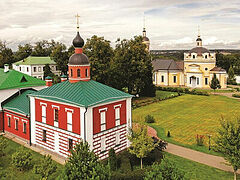
 Zosima Hermitage There are as many as fifteen obediences: reading the Psalter day and night for benefactors, serving in church, painting icons, woodturning, doing carpentry, binding books, baking prosphora, baking bread, working in the kitchen, sewing vestments, painting, working in the forge, in the cattle yard, in the locksmith shop, and tinning cookware. The inhabitants of Zosima Hermitage bear their labors meekly, silently, and without murmuring, taking care not for worldly needs, but for the one thing needful. The brethren take care of practically all necessities themselves; no one is exempt from working; everyone works, headed by their abbot, who by his own example teaches the brethren unceasing vigilance, prayer, and labor, remembering the precept of St. John Chrysostom that “an example is the most effective teaching.”
At the end of his life, Abbot German, endowed with so many gifts from God, accepted the great schema. He departed to the Lord in January 1923. His last words were: “We all must prepare for the Heavenly mansions!” He foretold that during his lifetime the monastery wouldn’t be closed. But just a few months after his repose, it happened.
The brethren were dispersed. Some of them settled in Vysoko Petrovsky Monastery in Moscow, where the abbot was Archbishop Bartholomew (Remov), a spiritual son of St. German who was later shot at the Butovo training ground. Another part of the brotherhood settled not far from Elder Alexei. Four of them were vouchsafed a martyr's crown in the coming years (they are included in the Synaxis of Zosima Hermitage saints). We have writings about one of them in particular, Monk-Martyr Ignaty, from his spiritual daughter Schemanun Ignatiya (Puzik), who wrote: “Batiushka was a zealot for the ancient monastic path, the path of the venerable and God-bearing Fathers. He loved this path from his youth, but the providence of God led him to be a confessor for His holy name, calling him in his last years to endure bonds and prison.”
The Smolensk-St. Zosima Hermitage was looted and desecrated by the Soviet government. Its valuables were seized and an orphanage was established there, and later, a military unity. The bell tower was truncated and converted into a water tower, and a club was set up in the main cathedral. The restoration of the monastery, as with many other famous monasteries in the former Soviet Union, began only in 1992. The restoration wasn’t easy—a new brotherhood was gathered, and the buildings were gradually returned to the monastery. The main cathedral currently houses the relics of St. Zosima of Alexandrov and Sts. German and Alexei of Zosima Hermitage. It also has the Smolensk Icon of the Theotokos, brought by the founder of the monastery, Schemamonk Zosima. Fraternal molebens are served daily at 6:00 AM at St. Zosima’s relics. The brethren are few in number and the monastery is still in need of further renovation work.
 Brotherhood of the Smolensk-Zosima Hermitage in 2020. Photo: zosymova-pustin.ru
According to tradition, before his repose, St. Zosima promised not to abandon those who turn to him for help at least once. Let us pray to the holy Elder Zosima with the words of his troparion:
Girded with virtue, thou didst acquire a peaceful spirit in thy life, valiantly imitating the labors of the venerable Abba Sergius, builder of the Holy Trinity Monastery, from whence thou didst go forth to a desert place and there, having conquered the demonic hosts, wast glorified as a true warrior of Christ. Wherefore, honoring thy memory with faith, we cry out to thee: Save us by thy prayers, Zosima, our venerable father.