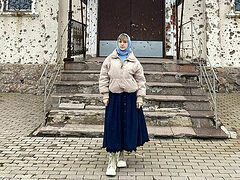
The locals say they haven’t seen such frosts in a long time: -14 in Skadovsk! And the wind from the sea pierces to the bones. Huddled against the cold, we arrived at the Church of St. Panteleimon, where Fr. Nikolai Kalinichenko set out tea and turned on a heater, quite willing to converse about life in his beloved city.
He told us that in the founders’ lineage (Skadovsk, in Kherson region) was founded in 1894) there is a saint—the hieromartyr John Skadovsky, who suffered for Christ at the hands of the Bolsheviks in 1937. The city’s first church was built in honor of St. Sergius of Radonezh. Its golden crosses were visible from twenty versts1 away, both from sea and land, making the church a beacon in both the spiritual and physical sense. In 1938 the communists destroyed the church; now a stadium stands on the site.

— Fr. John served in Kherson together with the hieromartyr Procopius (Titov). For us Orthodox of Skadovsk, it is important to know that among the city’s founders there is a holy intercessor. The first icon of Hieromartyr John was painted right here in our city. So the founders of this city have this familial connection to a saint. And if one looks a bit more closely at the city’s history, I’m sure some facts will inspire respect. For example, Sergei Baltazarovich Skadovsky, the city’s founder, introduced an eight-hour workday for his enterprise’s workers in the early twentieth century—he was the first in Europe to do so, by the way.
Sergei Baltazarovich Skadovsky, the city’s founder, introduced an eight-hour workday for his enterprise’s workers in the early twentieth century—he was the first in Europe to do so…
All sorts of Marxes, Engelses, Lenins, and other “benefactors of humanity” cursed the barbaric, slave-inhabited Russia—and here is a calm Russian response to their curses. Needless to say, the Skadovskys enjoyed respect and gratitude here. At every Liturgy we pray for the repose of Sergei and Maria, the city’s founders.
And now we feel the intercession of the saints, despite difficult times. My father once remarked that the city resembles a corner of paradise: “Even when winds and hurricanes rage around—ripping off roofs, uprooting trees—Skadovsk stands quietly and peacefully. The town is well built, with prayer and intelligence. Truly a corner of paradise.” And if it’s a corner of paradise, then it’s not without prayers for us, right? If only we ourselves prayed properly and lived according to God—that’s what’s important. We need to maintain good relations with the chief Architect, without Whom everything will be blown to smithereens. Except the Lord build the house, in vain do they labour that build it (Ps. 126:1).
—Regarding good relations with God. Since the late nineteen-eighties, only here in this small cozy town, according to locals, more than a dozen various sects have been active. I’m not talking about “classic” Catholics or Protestants—precisely sects. And this is with a population of twenty thousand! There was a similar situation in the rest of Russia, but now we’re coping somehow. How is it in Skadovsk?
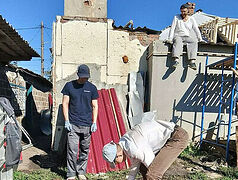
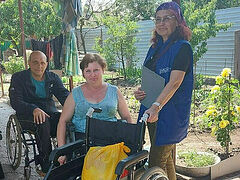
—The simplest and most pertinent example is the attitude toward volunteers from the Patriarchal Humanitarian Mission of the Russian Orthodox Church. When we come to someone offering help (care, food, cleaning, paperwork, etc.), the first reaction is angry distrust: “You want to ‘seize’ my house, get out!” At first we constantly encountered this. Gradually, of course, people got used to it and learned to distinguish the wheat from the chaff, but distrust remains: “Free help? No way, something’s wrong here!” But that’s external. Internally, in the soul’s disposition, as a priest I observe with sorrow that after decades of sectarian invasion, many of Skadovsk’s current residents have formed completely wild ideas about God, Orthodoxy, and the Church. It would seem that when Priest Nikolai, or some other Orthodox priest comes along, you might approach, ask a clear and honest question about Christ, try to figure it out together. Calmly, without anger or bias. I’m ready for conversation. But no. Instead of dialogue I encounter some kind of embittered alienation. It’s strange; when buying a car or other equipment, even clothes or shoes, we delve into technical details to ensure comfort and ease, yet in matters of the soul’s salvation we remain ungodly, inattentive and careless. Precisely ungodly. Often in faith, matters of bodily convenience decide: “I won’t go to those Orthodox—they have to stand, and bow, while here they sit!” and other nonsense. What would the holy Prince Vladimir say (and will say!) to such sorry descendants? Doesn’t this lack of discernment in religious matters, among other things, explain our current sufferings—spiritual and bodily? And people’s fatigue from sectarian importunity is understandable. Fatigue and irritation. Recently an old man, overcoming his infirmity, chased a girl from the Patriarchal Humanitarian Mission around the yard with a crutch, mistaking her for a sectarian—It’s both funny and sad. We barely calmed them both down. Such is the “greeting” prepared for us by the sectarians. They haven’t disappeared—they continue to gather, and everyone knows where, despite strict Russian legislation on this. And some sects, especially those masquerading as Orthodox, are simply breeding grounds for Nazism.
Some sects, especially those masquerading as Orthodox, are simply breeding grounds for Nazism
Its deadly fruits are visible now: the ongoing slaughter in Ukraine makes it undeniable. Under Ukrainian rule, we Orthodox could no longer serve as before. We are “untermenschen” to them. How the Kiev Caves and Pochaev Lavras suffer now, as well as all sincere Orthodox in Ukraine—words cannot convey. And it’s a pity that Russian media says so little about this.
—I must admit, sometimes our complacency, “great mercy and long-suffering” causes deep concern and indignation. And one recalls, with melancholy, the decisiveness of holy Prince Vladimir in these matters. It turned out to be a matter of survival—for both the people and the state.
—With prayer, I would add, to holy Prince Vladimir and other right-believing rulers of Holy Rus’. And it’s long past time for the Russian bear to come out of its den. It wouldn’t be bad to remove one well-known personage from the Mausoleum and finally bury him according to his own will—perhaps that would help awaken people.
—The transfer of the date of Christmas celebration in Ukraine, the forced rejection of the Julian calendar, as I understand—what is this, in your opinion?
— Another grave temptation, it seems to me. Orthodox Christians in Ukraine celebrated Christmas according to their familiar calendar2 and continue to do so despite all bans and persecutions; they weren’t persuaded or cowed. Many perhaps simply honor the customs of their grandfathers and great-grandfathers. One must undoubtedly celebrate the Nativity of Christ. But it seems to me the Lord will ask us not when we celebrate, but how we celebrate: one can behave like a swine or like Herod on December 25 by the Julian calendar, or behave like a Bethlehem shepherd on December 25 by the Gregorian calendar. It is another matter that the forcible switch to Gregorian is tied to hatred of the Orthodox Church—a wild desire to “become Europe” turned into open malice toward one’s brothers. What kind of Nativity of Christ is it if you greet not Christ but anger in your heart? It’s more like the slaughter of the innocents.
—Recently I received a spiritual lesson in a very unspiritual place. Kind Larisa, coordinator of the Orthodox Humanitarian Mission, asked me to pump, ahem, waste from one sewage tank to another for later transport and disposal. And so I stand there pumping all this—and think: How my sins must stink before Heaven if their earthly image turns my stomach. And how it must be for priests at Confession!
— A sharp observation. Indeed, sins stink—both literally and figuratively. I’m not talking about violations of basic hygiene when some don’t brush their teeth in the morning to commune on an empty stomach. No, it’s about how I reek when invited to the Gospel supper. Remember the piercing words of John of Damascus: “I stand before the doors of thy Temple, and yet I do not put away evil thoughts”? And how the prodigal son stank after his journey home—no perfume could handle it. And woe to us if we don’t follow his example, sincerely asking forgiveness from the Father and truly changing our life. No need to try masking the stench of sins with perfume, candles, wax, incense—it will be worse. Only God can wash us from sins—that’s why He came to our “cesspit.” When you, as a witness before God, stand at Confession and hear of sins committed, you look at your own life and understand: I’m no better, not at all! What condemnation or exaltation can we talk about here? You’re a sinner, the same as everybody else. So neither can the priest condemn another, nor should he be condemned. We’re all registered at the same legal address.
—From your observations, how does the participation of the St. Panteleimon Church community in the Patriarchal Humanitarian Mission affect the parishioners?
— First of all, as I’ve noticed, people learn compassion. Gradually learning—I see it myself—to pay less attention to their “wants” and whims (anything can happen) and help the suffering as much as possible, and we have plenty. We visit in the hospital, for example, young Artem, who can’t breathe on his own. But he hears, understands and speaks with difficulty. We converse with him; recently he communed with great desire. He especially befriended our altar server Timothy, a teenager in eighth grade. They quickly found a common language. Now Timothy goes to the hospital ahead of me to talk with his friend, comfort him in his own way. And his character has begun to change for the better… Such a school of self-denial is very needed for us all. Not only in Skadovsk, but in Russia in general. It’s very important to remember that the world doesn’t revolve around you, as it turns out.