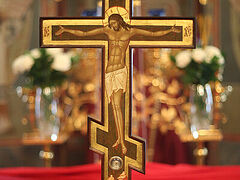
Whosoever will come after me, let him deny himself, and take up his cross, and follow me (Mark 8:34).

One cannot follow the Lord, who bore the Cross to Golgotha, without a cross; and all who follow Him inevitably walk with a cross.
What, then, is this cross? It is every kind of difficulty, burden, and sorrow that comes upon us—both from without and from within—on the path of faithfully fulfilling the commandments of the Lord and living according to the spirit of His teachings and requirements.
Such a cross is so inseparably joined to the Christian that wherever the Christian is, there is this cross also; and where there is no such cross, there is no Christian. A life of ease and comfort does not befit a true Christian. His task is to cleanse and correct himself. He is like a sick man who needs cauterization and surgery—and how can that be without pain?
He seeks to free himself from the captivity of a powerful enemy—but how can that be without struggle and wounds?
Rejoice, then, when you feel the cross upon yourself, for this is a sign that you are following the Lord on the path of salvation, on the way to paradise. Endure a little longer. The end and the crown are near!
On Bearing the Cross
We must understand that the Lord does not compel us to bear His Cross—that is, to endure the suffering which He accepted for our sake. He does not say, “If anyone would come after Me, let him take up My cross,” but rather, let each take up his own cross (cf. Matthew 16:24). For our Lord knows that we are not able to bear His Cross; but our own crosses, according to our strength and with His help, we are able to carry.
And this Cross was not so much burdensome for Him as it is relieving and saving for us. His burden is our rest; His labors—our reward; His sweat, our relief; His tears, our cleansing; His wounds—our healing; His suffering, our consolation; His Blood, our redemption; His Cross, our entrance into Paradise; His death, our life.
—Metropolitan Platon of Moscow
Our cross consists in the fear of the Lord. Therefore, just as one crucified cannot move as he wishes, so we must direct our will and desires not toward what pleases us or flatters our passions, but according to the law of the Lord, with Whom we have been crucified. And just as one nailed to the cross no longer thinks of present things or the objects of his passions, does not concern himself with tomorrow, does not desire possessions, is not proud, does not quarrel or envy, does not grieve over present things nor remember past wrongs, but considers himself dead to all that is material and thinks only of where he will go in a few moments, so we also, being nailed by the fear of the Lord, must die to all things—not only to worldly vices, but even to everything worldly, and turn all our attention to that place to which we may depart at any moment. For in this way we can mortify all our desires and fleshly passions.
Each person has his own cross, and when a servant of Christ, for the love of God, patiently bears his cross, he becomes a partaker in the suffering of the Lord, and his cross is made like unto the Cross of the Lord. Our sufferings are regarded by the Lord as though they were His own. And just as He said of those who do good: Inasmuch as ye have done it unto one of the least of these my brethren, ye have done it unto me (Matt. 25:40), so also He says to those who wrong us: Inasmuch as ye have done it unto them, ye have done it unto Me. For the Lord suffers in us as in His own members; and we who suffer, as it were, gather the fragments left over from the Lord’s banquet, according to the words of the Apostle: I… fill up that which is behind of the afflictions of Christ in my flesh (Colos. 1:24).
Our Cross, and the Cross of Christ
The Lord said to His disciples, If any man will come after me, let him deny himself, and take up his cross, and follow me. (Mt. 16:24).
What does his cross mean? Why is his [our] cross, that is, the separate cross of each person, called also the Cross of Christ?
Our cross: It is sorrows and suffering in this earthly life, and everyone has his own.
Our cross: It is fasting, vigils, and other pious ascetic labors by which the flesh is humbled and placed in submission to the spirit. These labors should correspond to each one’s strength, and everyone has his own.
Our cross: It is sinful infirmities and passions, and every person has his own! Some of them we are born with, while others we are infected with on the path of our earthly life.
The Cross of Christ is Christ’s teaching.1
Our cross is vain and barren, no matter how heavy it may be, if it is not transformed into the Cross of Christ by our following Christ.
For the disciple of Christ, his own cross becomes the Cross of Christ, because the disciple of Christ is firmly convinced that Christ unsleepingly keeps vigil over him, that Christ allows him to have sorrows as the necessary and inescapable condition for Christianity, that no sorrow could come close to him if it had not been allowed by Christ, that through sorrows a Christian is assimilated into Christ, becoming a partaker of His lot on earth, and later also in heaven.
For the disciple of Christ, his own cross becomes the Cross of Christ, because the true disciple of Christ honors the fulfillment of Christ’s commandments as the only goal of his life. These all-holy commandments become a cross for him, on which he continually crucifies his old man with its passions and lusts (cf. Gal. 5:24).
From this it is clear why, in order to accept the cross, we must first deny ourselves even to the depths of our souls.
Sin has mingled so powerfully and a profusely into our fallen nature that the Word of God does not cease calling it the soul of fallen man.
In order to take our cross upon our shoulders, we must first deny the body its lustful desires, leaving to it only what is necessary for existence. We must recognize our “righteousness” as the cruelest unrighteousness before God, our reasoning as completely unreasonable, and finally, having given ourselves to God with all the strength of our faith, we must commit ourselves to the ceaseless study of the Gospel, and renounce our own will.
Whoever has made this renunciation of himself is able to accept is own cross. With submission to God, calling out for God’s help to strengthen him is his weakness, he looks without fear or confusion at an approaching sorrow, and prepares himself to bear it magnanimously and courageously. He has hope that through it he will become a partaker of Christ’s sufferings, and attain to the mystical confession of Christ not only with his mind and heart, but also in very deed, by his very life.
The cross is only burdensome as long as it is our own cross. When it is transformed into the Cross of Christ, it takes on an extraordinary lightness, For my yoke is easy, and my burden is light (Matt. 11:30), said the Lord.
The cross is placed upon the shoulders of the disciple of Christ when that disciple recognizes himself as worthy of the sorrows sent down to him by Divine Providence.
The disciple of Christ correctly carries his own cross when he recognizes that those very sorrows sent down to him, and no others, are necessary for his upbringing in Christ and salvation.
Our patient carrying of our own cross is the true vision and awareness of our own sin. There is no self-deception at all in this awareness. But whoever recognizes himself to be a sinner yet at the same time complains and cries out from his cross simply proves that he is only flattering himself with a superficial awareness of his sin, and thus deceives himself.
Patiently bearing one’s own cross is true repentance.
O you who are crucified on the cross! Know Christ—and the gates of heaven will open to you.
From: Readings For Every Day of Great Lent, Ed. N. Shaposhnikova (Moscow: Danilov Monastery, 2025).