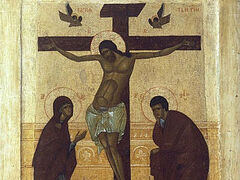
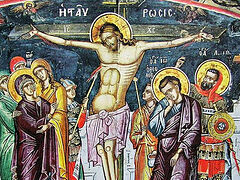
James Tissot. The Raising of the Cross, 1886–1894.
In the name of the Father, and of the Son, and of the Holy Spirit!
Dear fathers, brothers and sisters, for 2,000 years we have been living in a world in which Christ is Risen. We have the Holy Church, we have the sacraments, and we have the grace of God, which we receive in these sacraments; we are accustomed to this and cannot imagine our life any other way. And now that Lent is ending, many of us are looking forward to this coming feast, making plans for the future, and already feeling this festive mood. But today in its services the Holy Church asks us to wait a little with this feast inside ourselves so that we can somehow prayerfully experience the whole sorrow of this day. True, Pascha, the Resurrection of Christ, is the “feast of feasts” and the “triumph of triumphs”, it is the greatest festival in all the universe. But this feast was preceded by the most somber and sorrowful day that had ever shaken the entire created world. And that day is today—Holy and Great Friday.
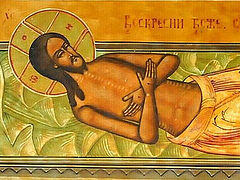
Today we have gathered at the image of the Savior’s tomb (the Holy Shroud) in order to experience this moment once again, when, as it is said in the services, all of nature responded, the sun was ashamed and hid its face, there was darkness from the third hour to the sixth, and the earth itself with difficulty refrained from opening up and swallowing the lawless people who had raised their hand against the Savior. When the Lord died on the Cross, the earth shook, rocks were split apart, tombs opened, and the curtain in the Temple was torn in two. The chosen people of their own free will crucified their Messiah and God, and their spiritual leaders dispersed from Golgotha with a sense of satisfaction that they had succeeded in killing the righteous man. The disciples deserted the Lord, and all of them scattered. And, of course, today it is hard for us to blame them, because then they had nothing; they had no Church, no sacraments, no grace, and no knowledge as we have, for we know that we live in the world of the Risen Christ.
And even His closest disciples—to whom it had been revealed that He was the Messiah, and to whom the Holy Spirit had revealed that He was the Lord Jesus Christ, the Son of God—were waiting for another Messiah and for the “Heavenly Kingdom” on earth. They were already planning about which of them would sit at the right and left hand of the Lord. That is, they were waiting for an earthly kingdom. None of them had expected that those centuries of waiting for the Messiah would conclude with such a terrible and shameful death, this execution, because there was no more shameful method of execution in the Roman Empire at that time. No one had expected that everything would end this way. Especially the Mother of God Who had been foretold that a sword would pierce through Her own soul (cf. Lk. 2:35). That’s exactly what happened on this day. Because since the very beginning She had known Who the Lord was and that He had been conceived by the power of the Holy Spirit; She had seen all His miracles, and, as it is written in the Gospel, Mary kept all these things, and pondered them in Her heart (Lk. 2:19)—and today a sword pierced through this heart.
Fathers, brothers and sisters, why do we all need to feel all this again today? Because before the feast we must understand thoroughly what forced the Lord to accept death. And the answer is our sins, our human sins. The Holy Fathers write that the Savior had to endure torment surpassing the combined suffering of all sinners in hell. It’s hard for us to even imagine what this was like! It was the price for the sins of all people, beginning from Adam and right up to the last person living on earth prior to the Second Coming of Christ. As the Fathers write, our sins also contribute to the suffering of the Lord on the Cross. Therefore, we cannot even mentally justify ourselves by saying that we were not present there and did not participate in the Crucifixion of the Savior; in reality, we participated and continue to participate through our sins.
The Savior suffered throughout His life, from the moment He was born; and there was no place for Him in Bethlehem, He was born in a humble manger. And right up to the moment when on this day He accepted death at the hands of His chosen people. As He Himself said, I am not sent but unto the lost sheep of the house of Israel (Matt. 15:24). And today, in the words of the hymns for the service, He addresses the Jewish people: “O My people, what have I done to you?... I have given sight to your blind, cleansed your lepers… By what means have you repaid Me? For manna you have given Me gall, vinegar in return for water.” And one of the greatest temptations for the Savior was that, by the power of His Divinity, as He Himself said, He could have sent twelve legions of angels to set Him free.
The Jews who walked by the Cross laughed at Him, mocked Him and yelled out: He saved others; Himself He cannot save. If He be the King of Israel, let Him now come down from the cross (Mt. 27:42). But the Lord endured to the end and did not come down from the Cross; the Jews did not believe in Him, but you and I, who are standing here today, believed in Him. In the sticheron I quoted, the Lord continues His words, saying: “I can bear no more. I shall call My gentiles (meaning the nations) and they shall glorify Me with the Father and the Spirit.” Brothers and sisters, these “gentiles” are you and me who are standing here today, including Holy Russia, which adopted Christianity and produced a great host of saints. I really want to hope that all this will continue in our Motherland, that our country will continue to preserve Christianity and bear the yoke of Christ on its shoulders.
The Lord endured the Passion in order to be victorious, to overcome the ultimate tragedy of the human race—our sin. With our sins We “weave” a “web” that holds and keeps the whole world in the “nets” of death. But the Lord died such a death, which was “woven” out of His Divine love. And so death could not withstand Him, could not withstand the Divine power, and retreated. The Lord’s soul descended into hades, like all people’s souls, according to human nature; but hell was defeated. Unable to withstand the Divine power, it was shaken. The holy Elder Barsanuphius of Optina (1845–1913) said in one of his conversations: “Hell has been conquered, but not totally abolished.” The Lord said of Himself: I am the way, the truth, and the life (Jn. 14:6).He is the way through the truth to eternal life, and we must walk this path.
Two thieves were crucified next to Christ, and this fact also has a deep meaning for us, because here we see that literally a few minutes, a few thoughts, a few words separate eternal life from eternal perdition. Two thieves were convicted of the same crime, but one of them blasphemed God, while the other experienced the moment of repentance on the Cross. And the Lord said to him: Verily I say unto thee, Today shalt thou be with me in Paradise (Lk. 23:43).
One way or another, all of us standing here are “thieves” from God’s point of view. We constantly commit sins, we are transgressors, and because of our sins, we deserve to suffer in our lives. but these sufferings are not necessarily salvific to us, since suffering in itself is not the earnest of our salvation; the earnest of our salvation is our repentance. The Holy Fathers say that there is no distance between repentance and Paradise. But repentance must be real, so that it can break through this “armor”, into which our hearts have literally grown in our lifetime, as we continue to sin.
Brothers and sisters, of course, each year during Lent we want to achieve something for ourselves; we try, we make efforts, but by the end of Lent we have to admit that this year it has once again exposed our sins, passions, and weaknesses. But the love and mercy of our God are boundless. He was crucified beside two thieves precisely because He wanted to show us that no matter what sins we commit—only repentance matters. And any criminal sentenced to the most shameful execution can find himself in Paradise for just two words said to the Lord.
So, today let us invoke the mercy of God prayerfully, looking at the image of Christ lying in the tomb, and implore Him to vouchsafe us to repent like the good thief and inherit the Heavenly Kingdom. May God save us all. Amen.