St. Longinus the Centurion. Artist: Andrei Drozdov, 2009
Reading the Passion Gospel of Matthew puts the mind before a paradox that both surprises and frightens us at the same time. We see a picture where everything seems inverted from a perspective of human logic.
It was not hostile pagans, indifferent pseudo-believers, convinced atheists, or even those who had never heard of God, who rejected Christ. He was put to death by those who should have recognized Him as the promised Messiah first. The scribes and Pharisees were professional theologians--people who devoted their lives to studying the Law and the prophets. All their way of life and work was preparing for the meeting with the Messiah. But envy and hatred were born instead of the joy of recognition, and instead of gratitude--the cry: Crucify Him! (Lk. 23:21). They were thoroughly convinced that they were exposing and punishing a blasphemer and impostor.
This brings to mind the Apostle Paul's stern warning: Knowledge puffeth up, but charity edifieth (1 Cor. 8:1). Even knowledge of Divine truths can blind you, if it becomes a heavy and lifeless load of the intellect, an object of pride, and not the life of the heart. It creates an illusion of “possessing God”, blocking the way to the True Living God. Only one thing can protect us against this terrible spiritual blindness--a humble and contrite heart, of which the holy Prophet and Psalmist King David says: A broken and a contrite heart, O God, Thou wilt not despise (Ps. 50:19). It’s precisely this kind of heart had the simple fishermen, publicans and harlots, who, without sophistry, were drawn to the True Source of Life, feeling His Love.
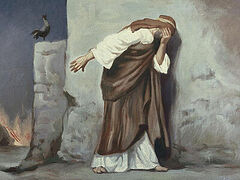
But the Gospel irony is not over here. The depth of human fall is revealed completely when even these ingenuous disciples, witnesses of all the great miracles, all the sermons and promises of Christ, forsook Him and fled (Mt. 26:56) in the hour of danger. I will smite the shepherd, and the sheep of the flock shall be scattered abroad (Mt. 26:31)—these are prophetic words of the Prophet Zachariah, repeated by Christ. Even personal communication with God does not guarantee faithfulness when this God becomes a Prisoner and a Victim, not a Victor.
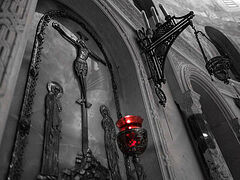
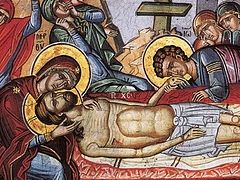
And here, in this pitch darkness of spiritual blindness, betrayal and apostasy, the most incredible thing happens. A miracle occurs, which is greater than the healing of a paralytic or the resurrection of Lazarus. At the moment of His extreme belittlement and humiliation (kenosis) on the Cross, when the Son of God gives up His spirit amidst intense mockery and ridicule from the surrounding crowd, when He dies and is seemingly defeated forever, it is then that the eyes of those who were very far from Him open. A Roman centurion, a pagan who ensured that execution went according to law, suddenly confesses: Truly this was the Son of God (Mt. 27:54). And one of the thieves, who is also dying in agony, is able to see the King in the pitiable Man beside him, Who was wounded all over and disfigured.
Why did they, who had not known the Scriptures and had not seen miracles, get to know what was hidden from the wise teachers and even from the closest disciples? Because they did not see Christ through the force of human logic or external impression. The Savior was hanging on the Cross, and the terrible signs--darkness and an earthquake--were frightening rather than convincing. Only those who were enlightened by the Holy Spirit Himself could see God in a humiliated and mangled Man.
It is easy to believe in Christ as a Wonderworker, Healer, Teacher, Prophet, King and Victor Who is Transformed and Resurrected. Our "Euclidean" logic,1 as Fyodor Dostoevsky called it, understands the language of power and success. But to believe in Christ Who is Crucified, humiliated, and weak is contrary to human ideas.
For the Jews require a sign, and the Greeks seek after wisdom: But we preach Christ crucified, unto the Jews a stumblingblock, and unto the Greeks foolishness (1 Cor. 1:22-23).
This is the greatest paradox of the Gospel and the most important miracle in everybody's life: to recognize God in His lowliness, to love Him in His abasement, and to confess Him in His suffering and death. All the miracles performed by the Lord in His earthly life were leading to one thing--so that, having seen His power, we could one day see His love stretched out on the Cross. After all, Christ’s power is made perfect in weakness (2 Cor. 12:9).
Even the glorious miracle of the Resurrection will remain for us just a distant historical fact, a fruitless message unless in the stillness of our hearts we turn to Him, Crucified, with the bold, penitent, and simple petition of the good thief: Lord, remember me when Thou comest into Thy Kingdom (Lk. 23:42).