God hath chosen the weak things of the world to confound the things which are mighty (1 Cor. 1:27).
 The Venerable Martyr Maria (Lelyanova)
Maria of Gatchina (secular name: Lydia Alexandrovna Lelyanova) was a nun of the Russian Orthodox Church and an Orthodox saint, who is venerated as a venerable martyr. Years of complete physical immobility, which she endured with extraordinary patience, led to Mother Maria of Gatchina being granted the gift of comforting the sorrowful. Already in her lifetime she was called “Holy Mother Maria”. People from all over Russia flocked to her for help, not fearing persecution from the Soviet Government.
The future St. Maria was born on February 11/24, 1874 in St. Petersburg into the family of the merchant Alexander Ivanovich Lelyanov, the owner of a sealing wax factory; his house was located at the factory. Her uncle, Pyotr Ivanovich, owned a prestigious fur store on Bolshaya Morskaya Street and was a member of the St. Petersburg Duma for several years. The Lelyanov family of merchants was well-known and highly respected in the capital.
In Baptism, the newborn was named Lydia. The family lived not far from the Novodevichy Convent in honor of the Resurrection of Christ beside the Holy Transfiguration Church. Lydia spent her happy childhood and youth there. Her father passed away when Lydia was three and a half years old and her sister Julia was one and a half years old, and the girls were left in the care of their mother and older brothers.
Lydia studied at a girls’ gymnasium (a specialized secondary educational institution). Shortly before her graduation, she suddenly contracted encephalitis at the age of sixteen. The disease immediately led to severe complications: Lydia developed Parkinson’s disease, rheumatism and gout. She was brought to the final exams in a wheelchair.
Her family made tremendous efforts to help the girl; they showed her to renowned Russian professors of medicine, took her abroad to consult with luminaries of European science, and carried out the recommended, expensive courses of treatment, but alas, they were unable to help Lydia. She was getting worse and worse—the disease took on severe and incurable forms. Her arms and legs began to wither; her body “shrank”, became small, and only her face remained “attractive and bright.” In 1909, on the advice of the doctors the family moved to Gatchina (a town twenty-eight miles south-west of St. Petersburg)—to the two-storied house of her older brother Vladimir, situated near St. Paul the Apostle’s Cathedral. Vladimir was the owner of the Elizabeth pharmacy. This small, weak, but handsome gentleman began to take care of his sick sister selflessly.
By 1912, she could no longer move, and for the final twenty years of her life she remained bedridden. The saint lay motionless on her back, and any movement and the lightest touch on her body caused unbearable pain. The course of her illness was unusual—patients with similar diagnoses suffer not only from muscular atrophy and damage to the nervous system, but their brains and personalities are also destroyed. However, all of Lydia’s cognitive abilities and emotional state remained intact. It was noted with surprise by the professors of medicine who kept the saint under observation, and her acquaintances spoke about the “work of Divine Providence”, that thanks to her great faith, her mental clarity and strength of spirit remained. Doomed to complete paralysis, the sufferer did not grumble and humbly endured her malady, accepting it as the will of God, to which she fully submitted and learned to pray unceasingly.
Although Lydia had near-total muscle paralysis, including in her face, yet she retained the ability to speak until her very death. With great difficulty, she pronounced words slowly and separately with her mouth half open—but others understood her well. She was fed liquid food with a small spoon.
After her parents had died, only her brother Vladimir and younger sister Julia remained with Lydia. However, throughout her life in Gatchina, many learned about this amazing, sick woman who couldn’t move at all, who courageously endured a serious illness, but remained meek, friendly and kind. Some religious women began to live in their house and help in the care of the profoundly disabled woman. Clergy often visited the meek sufferer to hear her confession and give her Communion, celebrating prayer services at her bedside “to strengthen Maria in bearing her cross”, after which the priests talked with her for a long time.
Gradually, a spiritual family formed around the hopelessly ill woman, consisting of women of different classes, who called themselves the Community of Devotees of St. John of Kronstadt. The community was pastored by the famous missionary and spiritual writer, Archpriest John Smolin, cleric of St. Paul’s Cathedral in Gatchina, and after his death in 1927—by Archpriest Peter Belavsky (1892-1983). Members of the family community read the Holy Scriptures and held spiritual conversations. They sang at house prayer services and later even formed a real church choir, which participated in services in the churches of Gatchina.
In his work entitled, Russia’s New Martyrs, Priest Michael Polsky testifies that having become profoundly disabled, Lydia “not only did not deteriorate mentally, but demonstrated exceptional personality and character traits, unusual for such patients. She became extremely meek, humble, submissive, unassuming, focused on her inner life, and immersed in unceasing prayer. She endured her serious condition without the slightest murmuring.”1
The Christian acceptance of the severe malady purified the righteous woman’s soul, and the Lord endowed her with the gifts of clairvoyance and spiritual consolation. Over time, people from all over Russia started flocking to her for spiritual advice, comfort, and prayerful help. Numerous people visited her daily, and through her prayers they received what they asked for. Visitors could be identified by the question: “How can I find St. Maria?” And locals would give them the saint’s address. Queues of people of different professions, ranks, income, and religious beliefs lined up by her house every day. Many would bring money and food to the sick Lydia, which she immediately ordered to be given out to those in need, including “former” people,2 among whom were generals and their families. Lydia’s regular visitors included Alexei Alexeyevich Epanchin and his daughter Nadezhda, a nun of the closed Nezhadovo Convent (the Leningrad region); the general’s wife Ekaterina Ivanovna Telyakovskaya; the general’s wife Iraida Dubrovina; the admiral’s wife Pats-Pomarnatskaya; nuns from the local Holy Protection dependency of the Pyatogorsky (meaning “the fifth hill”) Convent of the Theotokos (now the village of Kurkovitsi not far from Gatchina) and others.
 Metropolitan Benjamin (Kazansky) of Petrograd and Gdov Metropolitan Benjamin (Kazansky) of Petrograd and Gdov, a future hieromartyr, who was already widely known in Petrograd as an intercessor for the poor and a righteous archpastor, blessed St. Maria to become a nun. In 1922 Lydia was tonsured at the dependency of the Pyatogorsky Convent in Gatchina—in the Church of the Protecting Veil of the Mother of God, before a vast concourse of people.
“I remember that there were many bishops, priests, and deacons who came from St. Petersburg… It was very solemn, the huge dependency church was packed,” wrote Anna Alexeyevna Epanchina, a sister of Mother Maria’s community.
With bated breath, those who were able to get into the church watched as Archimandrite Macarius (Voskresensky) of St. Alexander Nevsky Lavra tonsured the bedridden Lydia into the mantia, naming her “Maria” in honor of St. Mary of Egypt.
Patient endurance of a terrible long-term illness with God’s help made Mother Maria capable of comforting other suffering people. Professor Ivan Mikhailovich Andreyev recalled:
“A young man who was depressed after the arrest and exile of his father, a priest (during the persecutions), left Mother Maria with a joyful smile, having decided to become a deacon. A young woman’s mood turned from sadness to radiant joy, and she resolved to become a nun. An elderly man, who had grieved deeply for the loss of his son, came out set straight and encouraged. An elderly woman who had arrived sobbing left calm and steadfast.”
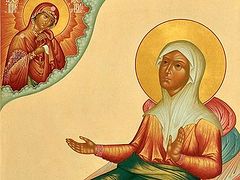
 Icon of St. Maria of Gatchina When in March 1927 the professor himself complained to Nun Maria about the intense sadness that had been overwhelming him for weeks, she replied:
“Your melancholy is a spiritual cross. It is sent to help Christians who cannot repent properly—that is, after repentance they fall into their former sins... And that is why only two remedies cure this sometimes extremely severe mental suffering: You must either learn how to repent and bring forth fruits of repentance, or, with humility, meekness, patience and great gratitude to the Lord, bear this spiritual cross, this melancholy, remembering that the Lord accepts our bearing of the cross as fruits of repentance… But what a great consolation it is to realize that your melancholy is subconscious self-punishment for the lack of the required fruits… It is necessary to be moved to tenderness by this thought—then melancholy will gradually melt away, and true fruits of repentance will appear…”
Later, the same professor recalled:
“From these words of Mother Maria, I felt as though someone had ‘performed an operation’ and removed a spiritual ‘tumor’ from my soul… And I left her transformed.”
Mother Maria was acquainted with archpastors and clergymen, many of whom subsequently became new martyrs and confessors. In 1928–1929, she was visited by Archbishop Dimitry (Lyubimov). Before his arrest and martyrdom, Metropolitan Benjamin (Kazansky) of Petrograd and Gdov visited Nun Maria and gave her his photograph with the inscription: “To the deeply revered sufferer Mother Maria, who comforted me, a sinner, as well as many who sorrow.”
 Archpriest Peter Belavsky When in 1929 Archpriest Peter Belavsky, Mother Maria’s spiritual father, was arrested and sent to the Solovki prison camp, she corresponded with him, dictating letters to her sister Julia and cheering the political prisoner. In a letter to Fr. Peter in Solovki dated February 22, 1931, she wrote:
“Why are you surprised that your mood changes? Look at the beautiful sky—now it is clear and blue, but then huge white clouds appear, like snow-white blocks of ice attached to the firmament. And suddenly black storm-clouds with a copper sheen come, and pretty soon they will thicken. It is dark in nature, and the entire animal kingdom is in an anxious state—black clouds press on the brain and squeeze the heart. But then the wind blows with a loud crash of thunder and a heavy downpour; later the sky clears up, the sun comes out, the air clears, there appear a breath of pleasant freshness, everything livens up, and people perk up… Isn’t that what you experience, my dear, and everybody else, including me? When, after shedding hot tears, our hearts are cleansed and we feel a great sense of ease? Oh, how much mercy the Almighty has! Happiness has not abandoned you in the north, either. Happiness because live in the midst of nature. Nature is our mother; it educates us, comforts us and makes us happy. The Spirit breathes everywhere, and there has not been a single day when you have not been remembered.”
In February 1932, yet another wave of arrests of monastics swept through Leningrad. The Leningrad section of the OGPU3 wrote:
“Church people play an active role in the atmosphere of intensified class struggle and fierce resistance by counterrevolutionary elements to the development of socialist reforms in agriculture… The Protection Dependency of the Pyatogorsky Convent (in Gatchina), which closed in 1922, actually continued to exist until recently, and its nuns have not changed their spiritual or daily lives whatsoever…
“Spiritually, the nuns of the dissolved dependency… formed a group around ‘Mother Maria’, who has been suffering from rheumatism and gout for twenty years in such a severe form that she has had to lie on her back throughout her illness… She is visited by people in large numbers not only from the urban community, but also peasants and those from different places seeking her counsel on how to deal with certain misfortunes that have befallen them…”
On February 19, 1932, St. Maria, the disabled nun, was arrested along with her sister Julia. Two Cheka4 officers came up to the saint’s bed and, twisting her arms, dragged her along the floor. They dragged her down the stairs from the first floor, ignoring her screams and moans from acute pain. Then, rocking her by arms and legs, they threw Mother Maria into the frozen back of a truck and took her to Leningrad. She was placed in a pre-trial detention house there. Since it was impossible to keep the sick nun in prison, she was transferred to the prison department of the former Alexander Hospital on the Fontanka River. The ascetic was charged with participation in “illegal gatherings where the Gospel was read” and “conducting anti-Soviet propaganda in conversations on religious topics.” The nun answered the investigator’s questions calmly and confidently:
“I believe that Metropolitan Sergei (Stragorodsky) was wrong to order us to pray for the Soviet Government—it does not need that. In general, let those who want to pray for it do so… I believe that we should only pray for authorities if they are true authorities.”5
The investigator questioned the witnesses who unanimously said that in the town and the surrounding area Nun Maria was regarded as a holy woman endowed by God with the gift of clairvoyance. On March 22, 1932, a closed extraordinary session of the OGPU Collegium sentenced Nun Maria to three years of exile without the right to reside in the central or border regions of the country. After nine months of investigation, the nun’s brother Vladimir was sentenced to five years in a Siberian concentration camp, and her sister Julia, who was also involved in the case of the Community of Devotees of St. John of Kronstadt, was sentenced to three years in a concentration camp. (Julia lived a long life and died in 1959). The nuns of the dependency of the Holy Protection who venerated Mother Maria received various terms of exile and forced labor camp.
In the hospital, Nun Maria was subjected to savagely brutal experiments, involving painful operations and the cutting of her tendons. Exhausted by her arrest, interrogation, and illness, Mother Maria fell asleep in the Lord in the prison infirmary in Leningrad on April 4/17, 1932, on her name day—the Sunday of St. Mary of Egypt during Lent. Mother Maria was a double martyr—not only did she work her salvation by enduring tribulation with patience, but she also died for Christ. The sufferer’s body was given to her cousin for burial. Her funeral was ordered to be carried out secretly, without publicity. She was buried at the Smolensk Cemetery of Leningrad—close to the Chapel of Blessed Xenia of St. Petersburg. A memorial cross was set up on the site of her grave.
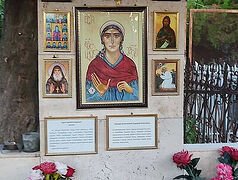
 The memorial cross on the site of the former grave of St. Maria of Gatchina at the Smolensk Cemetery (St. Petersburg). Photo: Smolenskoe-spb.ru
Immediately after Nun Maria’s martyrdom, her grave became an important place of pilgrimage. Funeral services were held there; people venerated the cross and took earth from her grave.
In 1981, Nun Maria of Gatchina was canonized by ROCOR among the host of New Martyrs and Confessors of Russia. The Russian Orthodox Church of the Moscow Patriarchate glorified St. Maria of Gatchina twenty-five years later—on July 17, 2006, and included her name in the Synaxis of the New Martyrs and Confessors of the Russian Church. She is commemorated on April 4/17 (her repose); in the Synaxis of the New Martyrs and Confessors of Russia on January 25 / February 7 if this day falls on Sunday (otherwise on the Sunday nearest to January 25 / February 7); and in the Synaxis of the Saints of the St. Petersburg Metropolia (the third Sunday after Pentecost).
On March 26, 2007, the holy relics of Nun-Martyr Maria of Gatchina were uncovered at the Smolensk Cemetery in St. Petersburg. They were solemnly translated to the Cathedral of St. Paul the Apostle in Gatchina where they are venerated by the public to this day.
 The solemn translation of the relics of St. Maria of Gatchina to St. Paul’s Cathedral in Gatchina. Photo: Aquaviva.ru
In February 2017, the Pokrovsky Ostrov (“Protection Island”) St. Petersburg Cultural and Educational Center hosted a preview screening of the documentary, “Christ’s Chosen One. St. Maria of Gatchina.” In March of that year, the film was premiered at the St. Alexander Nevsky Lavra.
It was decided to build a church in honor of St. Maria of Gatchina in St. Petersburg; on October 31, 2020, a memorial cross was erected at the construction site in the Frunzensky district and a prayer service with the rite of consecration was celebrated. On May 12, 2023, Metropolitan Varsonofy of St. Petersburg and Ladoga visited the church under construction.
This saint’s help is commonly sought when suffering from serious illnesses. Her name is also invoked for sick children and loved ones.
 The holy relics of St. Maria of Gatchina
Sources:
The Lives of the New Martyrs and Confessors of Russia of the Twentieth Century, April, compiled by Igumen Damascene (Orlovsky) (Tver: Bulat, 2006), 27–32.
Devyatova Svetlana, “Venerable Martyr Maria (Lelyanova; 1874–1932),” Orthodox Women Ascetics of the Twentieth Century (Moscow: Nika, 2021).
Antonov V. V., “She Possessed the Gift of Consolation… Vozvrashchenye No. 3 (St. Petersburg, 1995), 44–48.