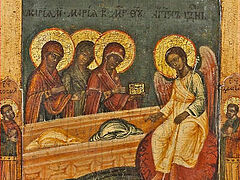
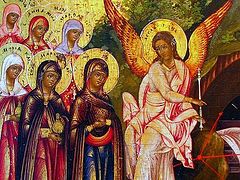
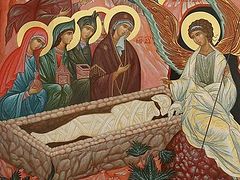
This Sunday is designated by the holy Church of Christ to bless the memory of the Holy Myrrh-bearing Women. Who were the Myrrh-bearing Women? All of the Evangelists primarily point to Mary, born in the Galilean city of Magdala, the one from whom Jesus cast out seven demons. Mary Magdalene repaid the Lord for such a blessing with fervent love.
The second Myrrh-bearer, Mary, the mother of James and Joses, followed the Savior all the way to the tomb. The son of this Mary, James Alphaeus, was one of the Twelve Apostles. And Salome was the mother of the Sons of Zebedee, the Apostles John and James. Besides Mary Magdalene and Mary the mother of James, the Holy Apostle Luke points to other Myrrh-bearing Women—Joanna and the others—without mentioning them by name (Lk. 24:10).
Who was this Joanna? The wife of Chuza the steward of Herod, who was also healed by the Lord. According to the Holy Apostle Luke, the women undoubtedly included Susanna (Lk. 8:1–3) and many others who served Christ from their resources. Of course, the Myrrh-bearing Women included Martha and Mary, the sisters of Lazarus, who so fervently loved the Lord.
The holy Church of Christ blesses the memory of all saints, and Christians especially cherish these Myrrh-bearing Women, these happy companions of Christ, who served the Master not only from their substance, but also with the work of their hands; who were devoted to Him with all their hearts, who suffered together with the Lord, who surrounded Him not only during His travels but also on His path to the Cross, to Golgotha, and remained with Him at the very Cross. The remembrance of their self-sacrifice, labors, and incomparable and tender love for Christ fill the hearts of believers with the same love for the Lord and the desire to serve Him unto death itself!
Christ neither chose the Myrrh-bearing Women nor called them to follow Him as He did the Apostles and the Seventy Disciples, but they themselves followed Him as the sole purpose of their regenerated life, as eternal truth, as their Savior and the Son of God, despite His apparent poverty, simplicity, and the open hostility towards Him from the high priests and teachers of the people. They themselves left their homes, labors, possessions, families, and followed the Lord, rejoicing that they could be of some use to Christ and His community.
During Christ’s procession to Golgotha, only the Myrrh-bearing Women wept and sobbed. The Lord heard the women’s cry and addressed them with a word of comfort. What must these loving women have been feeling, standing at the Savior’s Cross and seeing all the shame, horror, and, finally, the death of their beloved Teacher? All the disciples fled in fear—even the Apostle Peter, who promised to die with Jesus and thrice denied Him. Only the Mother of God with John the Theologian and the Myrrh-bearing Women remained at the Cross itself. Then the Mother of God was carried away, for she had lost consciousness, but Mary Magdalene and the other Myrrh-bearing Women, whom the crowd had pushed back from the Cross, remained there until the very end.
When the Son of God gave up the ghost, the same Myrrh-bearing Women hastened home to prepare spices and ointments, while Mary Magdalene and Mary the mother of Joses watched where the body of Jesus was laid in the tomb. They left only after it was completely dark, to then come back to the tomb before dawn. And for their zeal for the Son of God, for their determination to honor Him at His burial, for their unshakable faith, these holy women were the first among all people to receive the testimony of the Resurrection of Christ and became the first and most powerful preachers, as they learned it from the mouth of the angel.
And so, beloved mothers, wives, and sisters, we have the example of the reverent Myrrh-bearing Women before us! Their lives are still quite instructive for modern Christians. They weren’t distinguished by virtues until they knew Christ. Mary Magdalene was possessed by an evil spirit, Martha was a model of worldly desires and worldly vanity, but the Savior’s Divine teaching, the Son of God’s miracles, and Christ’s grace completely revived them.
Following the example of the Myrrh-bearing Women, many Christian women later turned with living faith to Christ, Who ascended to Heaven. In the history of Christianity, we see many mothers and women who loved the teachings of Christ and the holy Church more than their noble birth, earthly glory, honors, riches, and enjoyments of the world; more than their parents, husbands, and their children; who preferred death to renouncing Christ and His commandments. We even know mothers who led their own children to execution for Christ and joyfully gave them as a sacrifice to men, that they might be glorified in the Kingdom of God. Some spread the teachings of Christ with great courage and patience and enlightened entire countries. Many churches and monasteries were built by pious queens, princesses, and boyars.
Even now, the holy Church looks with hope to you, pious wives and sisters! You still uphold the faith in your families and care for the adornment and beauty of our churches. But nowadays there are many women with a disposition and state of spirit unprecedented in the history of Christianity. I mean those who don’t find anything for themselves to do, who languish in their lives, who complain of boredom and sincerely ask everyone what they should do, what kind of activity they should take up. They acknowledge that they have a lack of energy and health and an absence of any aspirations, desires, talents, or love for anything whatsoever. As if they have no obligations, as if they’re not daughters of their fathers and mothers, not mothers of their children, not wives of their husbands!
The question is: What should those who have elderly parents to take care of but are still bored do? Comfort their parents and help them prepare for their transition to the afterlife. Is this not an obligation, a duty, a service to their parents, and most importantly, to God? What should married women do? Preserve what their husbands earn, create a pleasant hearth for their husbands, raise their children, maintain the Spirit of God in their homes, and be an example of Christian life for the younger members of the family and servants. The more prepared children are for the spiritual life and the struggle against the passions, the easier their life will be and the freer from sorrows, trials, and temptations they’ll be.
But in order for a mother of a family to be able to sacredly fulfill her important obligations, she needs knowledge of the faith, sincere faith, understanding of God’s love, love for God, and a life that’s inseparable from the holy Church. Those who have no children of their own can dedicate their lives to other people’s children, who are often destitute, abandoned, orphaned, and often fall into sin through ignorance.
They also ask about where to find rest from daily cares and worries. A strange question for a worldly person! After all, so many entertainments and pleasures have been invented in the world, but we must acknowledge, therefore, that worldly pleasures don’t entertain and don’t give rest, but only bring financial ruin. This is undoubtedly so. Therefore, let these wives and maidens learn true life from earlier Christian women, from their ancestors who found peace and rest in spiritual reading, in prayer, in Church life, in charity, in enlightening the people.
Beloved sisters in Christ, help your pastors, serve the Lord!
Amen.