In the name of the Father, and of the Son, and of the Holy Spirit! Christ is Risen!
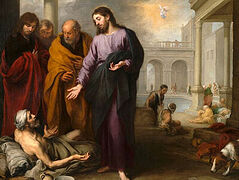
Dear brothers and sisters, on these holy days of Pascha, we all remember miracles that we’ve experienced. After all, this paralytic who was at the Pool of Bethesda, at the Sheep’s Gate, is each one of us; for we too feel that we are good for nothing.
For we all know from spiritual knowledge that it is a terrible thing to fall into delusion, when a person begins to consider himself talented, intelligent and perfect in some way. That is, not what the Apostle Paul speaks about: My (God’s) strength is made perfect in weakness (2 Cor. 12:9)—the pride of a man who is praised by this foolish world, which only speaks of man’s omnipotence; about his supposed spiritual and physical development, that he is the crown of creation and the master of the world.
Young people are taught this from an early age, and they grow up to be proud, and therefore blind. Because when something out of the ordinary happens and a child can’t cope with it, he becomes discouraged, desperate, and falls into the most terrible sin—he murmurs against God. But you know what happens to our children then. And this happens precisely because he has not learned the simplest thing: that the strength of God is made perfect in weakness.
When a person feels that he is good for nothing, when he realizes that without union with Christ, without the sacraments of Christ he can’t do anything, then it appears that he hasn’t the skill to cope with the difficult situation he finds himself in. And he doesn’t know what to do. All his pride and worldly wisdom means nothing.
And then he begins to murmur against God: “Why didn’t You see me? Where were You? Why did You abandon me? Where were Your helpers? And why didn’t You send anyone to protect me, why didn’t You give me the wisdom to avoid this unpleasant situation, or illness, or serious incident in my life?”
This happens because Christ doesn’t dwell in in that person. His parents didn’t bother to teach him that only with Christ does the human soul become the most precious gem or diamond, the greatest jewel on earth.
Saints have always lived and still live among us. What makes them holy? The fact that Christ dwells in them. We all know that our body is the temple of the Holy Spirit, and if we ruin it, we lose everything. And if we keep the grace of God that we receive in the divine sacraments, then, according to St. Seraphim of Sarov, “thousands of people around us will be saved.”
And concerning human pride: when Nikolai Motovilov1 was troubled by St. Seraphim’s words and in general by the story about how a believer who confesses the Orthodox faith and lives according to the Law of God can be possessed, he himself began to suffer from demonic possession. Just for this doubt alone a demon entered into him, and for many decades he suffered from this terrible fire burning from within, but did not die! This occurred to him by Divine Providence for the glory of God, because Motovilov didn’t perish, but inherited the Heavenly Kingdom, like his great teacher—St. Seraphim of Sarov.
St. Mark the Ascetic tells us why we have this spiritual feebleness. Why are we like this? There are three causes: ignorance with lack of awareness (that is, we don’t want to know anything and even forget what we know); sloth with negligence (I want to do it, but I don’t do it—that is, constant laziness); and stony insensitivity (this is the culmination of everything that was said above, when a person no longer feels. He wants to feel, but he is already stony, hardened in sins; his heart is insensitive, a heart of stone—that is, an insensitive and unscrupulous person).
This state is a sign of stony insensitivity, and it is very difficult to heal it. But nothing is impossible with God. And that’s why at confession people tell us priests what’s going on in their lives, and there are miraculous cases when a person returns to the bosom of the Church of Christ, to repentance, reforming his soul even after many years of stony insensitivity. And this happens through the prayers of his loved ones.
That’s why we pray for each other, because by doing so we save both the other’s soul and our own, and we bring great profit to our souls. Because we all know how bad it feels when someone close to us… You have ninety-nine relatives who go to church, confess and receive Communion, but one of them has walked away from God. And your heart aches for the one who has voluntarily distanced himself from the grace of God.
And a true Christian’s heart is sure to ache. That is, when a person imagines that he is like a loving mother who has ten children, nine of whom have found faith, but one has not, and her heart does not ache for the nine children who have found grace, but only for the one who has gone astray.
St. Mark the Ascetic says that the way out of all this (that is, the cure for these three things he named) is prayer and patience. That is, only with patience and prayer can you overcome stony insensitivity, sloth, ignorance, and lack of awareness. There is no other remedy.
And our whole lives as Orthodox Christians consist of these very things—prayer and patience, which we constantly lose. Why? Because we are not alone on this earth; there is also spiritual wickedness in high places (Eph. 6:12) that doesn’t allow us to do this most important works.
We can’t wait, because we want to have everything right now: “Lord, fulfill our prayer requests right away!” But the Lord alone knows to whom, when, how much, and at what time it is useful to receive what someone asks for; or, perhaps, it is not useful for him at all.
People ask for what they want out of their weakness and folly, but the Lord knows what each one of us really needs. Therefore, it is always necessary to add at the end of prayer: “Lord, may it be not as I want, but as Thou willest.”
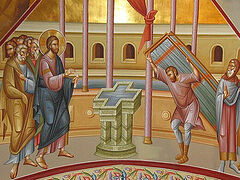
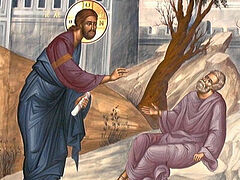
And returning to the paralytic… look how laconic this story is! The Lord asked him: “What are you doing here?” he replied. But the Lord didn’t say much. He just commanded: Rise, take up thy bed, and walk (Jn. 5:8). That’s it. Simple and plain. And the man rose and walked away.
This is the kind of faith we must acquire—like that of the paralytic—to rise and walk by the Word of God, living according to God’s commandments and taking care of fulfilling the most important goal of a Christian’s life—to find Christ in ourselves and become His true son or daughter, so that Christ can live in us, in our hearts, in the temples that the Lord has prepared for Himself.
And it depends on us: either we open the door of our hearts to God, or it will remain closed. Therefore, people around us are waiting for this call from us. Maybe someone, without even realizing it, is waiting for us to come up to them and say, “Why are you doing this?”, or, “Why aren’t you doing this? Why not come with me?”
Because when someone feels love and the presence of God in himself, he cannot do otherwise, for out of the abundance of the heart the mouth speaketh (Mt. 12:34). But when our mouths are silent, it is, unfortunately, a sign that we don’t have Christ—there is only ritualism in us.
Alas, there is often no faith in people, but there is a lot of ritualism in them. It was precisely ritualism that destroyed the Jewish high priests who crucified Christ. They believed in rituals, they kept the Sabbath, but they did not have love—they did not do what the Lord calls on us to do: Thou shalt love the Lord thy God with all thy heart, and with all thy soul, and with all thy mind, and with all thy strength… And… Thou shalt love thy neighbor as thyself (Mk. 12:30–31).
If only we lived like this and strove to find faith in salvation and healing, and not just followed endless laws and rules! People will always invent new ones. Lawmakers come up with new laws every single day—that is their job. Does this make it any better on earth? Answers can vary. But the Lord has written all the laws in the Holy Scriptures, which are unshakable, unchangeable and eternal.
Thus, dear brothers and sisters, let us follow the laws of the Holy Scriptures, God’s words that He has bequeathed us and that are important to us, for the salvation of our souls and the salvation of all our loved ones. Amen. Christ is Risen!