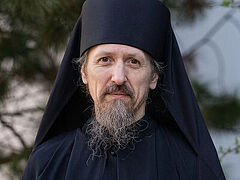
The deeply venerated and beloved Russian elder, Fr. Valerian Krechetov reposed in the Lord last November († 11/14/2025.) He was tonsured Archimandrite Seraphim, and shortly before his death received the Great Schema with the name Mikhail in honor of the Archangel Michael. Schema-Archimandrite Mikhail (Krechetov) waged a lifelong struggle for human souls on the spiritual front. Statesmen, military leaders, and students compared their “maps” of their own personal spiritual battles with him as with a compass.
 Schema-Archimandrite Mikhail (Krechetov)
There is a common phrase that there are no atheists in the trenches. We’re all at war now. Yes, but everyone believes in what they want. “They say that ‘the main thing is to believe in God.’” Fr. Valerian rebuked such people. “And they add that ‘how to believe is everyone’s personal choice.’” He noted that this phenomenon was predicted by St. Theophan the Recluse in the nineteenth century—this lukewarm indifference to the truth is self-importance born of pride, conceit, and egoism; and the further we go, the more there are such atomic beliefs. As St. Theophan predicted and as batiushka reminded, before the end there will be “as many faiths as there are men”. And these “faiths” are the easiest to defeat and break. A mental war is being waged against us also.
A video for the Russian song, “The Russian Army” (“Hey, brothers, we’ve been sitting for too long”) has recently become viral with millions of views, but the image of the khan and wizard directing the enemy army dominates it. Even if the victory of our army is shown in this video, Evpaty Kolovrat1 (whom Russian neopagans are trying to pass off as their own) uses some torn red cloth as a banner, and not the banner with the Savior’s image. In the end, the hero dies, and this video, like the film the footage it was borrowed from, is in fact a simulated defeat. The Dark forces are not opposed by the Almighty.
Our spiritual fathers, including Schema-Archimandrite Mikhail (Krechetov), raised the alarm: now Neopaganism is spreading even among the defense and law enforcers, the Interior Ministry, and the National Guard of Russia, and since this kind of “spirituality” requires neither efforts, nor self-examination, nor purity, it resonates with those who are not ready for an ascetic labor.
But all power belongs to God, as said Schema-Archimandrite Iliy (Nozdrin), a fellow ascetic of Fr. Valerian, who also reposed in 2025 and who had earlier tonsured Fr. Valerian. And those who really want to win will listen to the elders.
We are publishing more of some of the previously unpublished answers of Schema-Archimandrite Mikhail (Krechetov) to questions from the youth.
Courage is seeing your sins and mourning them
—Father, at the end of the first part of our conversation, we focused on the issue of the use of force: when it is not a sin, and when it is. And you even warned us… So even such valiant qualities as courage, firmness of purpose, and holding fast to your principles can also be from the evil one?
—I remember Elder Nikolai Guryanov rebuking an officer and Afghan War veteran in my presence: “You don’t have the courage!” The officer who had been to almost all the hot spots in the country and beyond was perplexed. “You’re confusing courage with heroics,” the elder explained to him. “Heroism is an moment, while courage is seeing your sins and mourning them.” The great Russian military commander and generalissimo Alexander Vasilyevich Suvorov (1730–1800), who famously did not lose a single battle, used to say: “If you conquer yourself, you will truly be invincible.”
What is firmness of purpose? The persistent pursuit of a goal. But what is your goal? That’s the whole point! Elder Joseph of Vatopedi said when I spoke with him on Mt. Athos, “The main thing in life is purpose.” What is your purpose in life? If it is the aim of Christian life—that is, according to St. Seraphim of Sarov, to acquire the grace of the Holy Spirit—it is one thing. But if a person has the accumulation of material wealth as his goal in life and is preoccupied with “building a career”, this is a completely different matter.
But even if the goal is right and lofty, in Orthodoxy the principle born in the Catholic West, “the end justifies the means,” is impossible. (It is popularly attributed to Ignatius of Loyola). In Orthodoxy, both the end and the means must be of the same spirit. The author Feodor Dostoevsky wrote about this as well: You can’t kill someone for the “happiness” of others.
As for holding fast to your principles, now such people are often labelled as “fanatics”. I became interested in its etymology—this word means a person who is consistent in his firm principles. So any decent person can be called a “fanatic”. The question is what you are fanatical about. If you’re a football fan, that’s one thing. But all scientists, great artists, and writers are also “fanatics.” Otherwise, they would have achieved nothing! There is persistence in folly, and there is persistence in something good—the question is what you persist in.
It is strange to say that the church is separate from the state
—God willing, we’ll talk more about great people later. And since we are talking about purpose as the main thing in life, then in the context of the previous conversation, where the last question was about those in authority, what is the purpose of the State?
—The purpose of the State... This is a wrong formulation here. The State is not a soulless machine—it is primarily people. There is division in the State, as well as among people. What is the purpose, for example, of a particular type of production? Meeting needs? Or making a profit? Different people evaluate it differently. This is only one of the tasks of the State—ensuring security: the preservation of people and the territory they live on.
—Then the object is to form morally upright people who agree with the highest ideal of the State. And since these are the ideals of Christianity…
—The State is a system in which, despite the common purpose of its components, there is also a main driving force of this whole “mechanism”—people. When they say that the Church is separated from the State, it is a strange thing to say. The Church on earth consists of people, and all these people are citizens of the state. How is it separated then? This is an abnormal and illegal situation.
Do you want to know what life under communism will be like?
—Once Archbishop Mark (Arndt) of Berlin and Germany expressed surprise that for some reason the Holy Baptizers of Rus’ were not particularly venerated in today’s Russia. Moreover, Princess Olga is criticized her “cruel revenge” for her husband’s murder, but by others for the conversion of her grandson, the ruler. They say, “Our ancestors believed in their gods, and everything was fine. Why did they need to change their faith?”
—What was good then? Human sacrifices? Cruelty? Polygamy? Only now these neo-pagans believe that it was good, because they didn’t live then! They should be grateful that they have grown up, because in that era they might have been sacrificed as babies and now would not be talking about how wonderful and good it all was. Let them try and live as their ancestors lived—they’ll all quarrel and slaughter each other…
There was a story in the Soviet Union: One man started selling kvass in his retirement. Someone came up to him and asked, “How much is your kvass?” He stated the price. The other said, “Let me pay for all the kvass, and you can give it out for free.” They agreed. Learning that it was free, people rushed there and got into a fight. The man in question had even to call the police, who asked, “What’s going on here?” The one who had paid for all the kvass confessed, “I’m old and won’t live to see Communism. So I decided to see what life will be like under Communism.” So, he saw it…
The answer to the main question of human existence
—Yes, and now we are being thrown back [to paganism] by this experiment on the Russian people. Abortions are new human sacrifices, not to mention squabbles and denunciations… It’s as if Holy Princess Olga Equal-to-the-Apostles did not exist with her miraculous vision of three radiant rays of sunlight: “If God deigns to have mercy on my Russian Land, may He inspire their hearts to turn to Him, just as God granted it to me.” as if there were neither St. Sergius of Radonezh with the Battle of Kulikovo for the faith, Nor do they remember the world-famous Holy Trinity Icon by St. Andrei Rublev, painted according to St. Sergius’ testament: “to overcome the hateful discord of this world by gazing at the Holy Trinity..” It’s nonsense. They say, “There are normal neo-pagans who do not believe in the forest goblin, but simply want to live in unity with nature, drawing ion its power. Is it really a bad thing?”
—Contact with nature doesn’t provide an answer to the main question of human existence: the question of life and death. Well, you live in a dugout for some time, and then? You will be buried in it. That’s it?

What kind of “power” do they draw from nature? They just invent everything! “I’m going to hold on to a birch tree now…” This is self-suggestion.
When we eat bread, we get strength—that’s clear. But seeing the beauty and generosity of nature, how can we not give praise to its Creator? As the Russian philosopher and poet Vladimir Solovyov (1853–1900) said, any philosophy logically comes to God; but materialistic philosophy cannot come to Him because there is no logic in it. Besides, what do these neo-pagans mean by “unity with nature”? They all live in cities! Well, you go to live in the countryside, and so what? By the way, most of our illustrious saints lived in unity with nature: Sts. Sergius of Radonezh and Seraphim of Sarov lived in forests.
—Yes, bears came to them. And they came to you too when you visited Georgia, the first earthly portion of the Mother of God [a bear cub came out to meet the elder there).
—So these neo-pagans are just throwing words around?
To be continued…