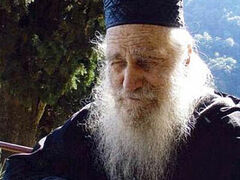
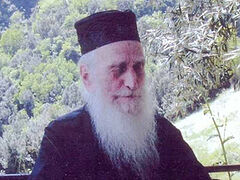
Elder Dionysius Ignat. Photo: romelders.substack.com St. Dionysius Ignat of the Kellion of St. George at Kolitsou, under Vatopedi Monastery on Mount Athos was canonized last August by the Patriarchate of Constantinople—the holy mountain’s jurisdiction. Recently the book, Rivers of Living Water: On the Holy Elders of Kolitsou, Mount Athos, by Hieromonk Nicodemus (Jones) was published by St. George Press. We present here a portion from the chapter entitled, “Metropolitan Athanasios of Limassol: Recollections of Elder Dionysius Ignat.”
I met Father Dionysius in 1987, when, following the invitation of the fathers from the former Brotherhood of Vatopedi Monastery, from New Skete where we lived, we went to Vatopedi to repopulate the monastery, and we founded the Brotherhood that exists to this day. I was among the first fathers who left New Skete for Vatopedi Monastery.
Father Dionysius was a monk dependent on Vatopedi Monastery and lived at the Kellion of St. George in Kolitsou. For this reason, he would often come to our monastery, either to collect supplies or for various other errands.
In the years I had already spent on Mt. Athos, I had heard of his name, that he was a famous and very pious spiritual father, but since we were younger and located on the opposite side of Mt. Athos, at New Skete, we had not had the chance to meet Fr. Dionysius at Kolitsou. We only heard beautiful words spoken about him. The same things were said by the elder monks from Vatopedi, before we had even met Elder Dionysius. The fathers of Vatopedi told us, “We too have a holy man here, Papa Dionysii the Confessor, the Romanian.” So we eagerly awaited the day we would meet him at our monastery.
And not long after, since, as I said, he was dependent on Vatopedi Monastery, Fr. Dionysius came to the monastery to collect some supplies, a blessing from the monastery. I ran at once to meet him, received his blessing, and asked him to speak with us, the new fathers, because we were, of course, in a difficult situation. We had left a small skete and come to a large idiorrhythmic monastery and were truly struggling. Our abbot [Elder Joseph of Vatopedi of blessed memory] was away; he was not with us, and we felt some uncertainty, so to speak...
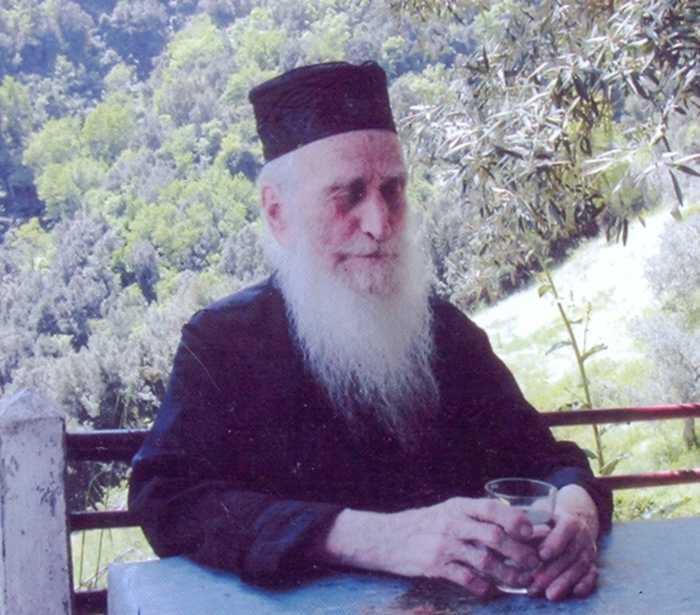 Elder Dionysius Ignat
Father Dionysius at first said, “What can I tell you? I do not even speak Greek! What can I tell you?” But we convinced him, and he came and sat down where the old hospital of the monastery was. We, the new fathers, gathered around him—ten or twenty of us—and he shared some spiritual words with us. He expressed his joy at the repopulation of Vatopedi Monastery, and he encouraged us to have patience, to have faith in Christ and the Theotokos, to pray, and not to fear, for God would help us.
While he was speaking, something paradoxical happened: a strong and intense fragrance began to emanate from him—not just a scent, but a powerful fragrance. At first, I thought I was the only one who noticed it, but I saw the other fathers looking at one another, and I realized we were all sensing it. I strongly suspect that Papa Dionysii also felt it, for at one point he said, “Please excuse me now, I must leave,” and stood up rather abruptly, interrupting his words, and left. After he was gone, we asked each other what had happened. The fragrance had filled the entire area, and we concluded it had been a supernatural event, connected to the Elder’s presence.
After this event, we became very close. He became our confessor. I would go to confess to him, because our Elder was not with us, and we needed a spiritual father. So we became very close to Fr. Dionysius, with whom we discussed all matters of the monastery. He was part of the old Vatopedi Brotherhood and knew all the other elder monks very well—their mentality, the way they were doing things, and if we had to do the same things or not—and he helped us greatly.
He was a very measured man, filled with discernment and nobility. Very noble—he never reproached anyone, nor did he shy away from dealing with us and our problems. He spoke with great refinement and deep respect for the older fathers and for the monastery. At the same time, he understood the challenges we faced, so he supported us.
A similar event happened again about three years later, when the monastery had already become coenobitic. I went with a brother and a layman on foot from Vatopedi to Kolitsou to visit Papa Dionysii. We met with him in his cell, spoke with him, he offered us some refreshments (kerasma), and we stayed there with him for two or three hours. As we prepared to leave, he accompanied us to the porch of his cell, and the brother said, “Geronda, give us one final word.” He said, “What can I tell you, Fathers? Humility, humility—what a great thing humility is. When a man is humble, when a monk is humble, God will make him known.” Instantly, the whole area became filled again with fragrance. I felt it, as did the other monk and the layman with us. Once more, the fragrance poured forth from the Elder, revealing his grace and holiness.
[…]
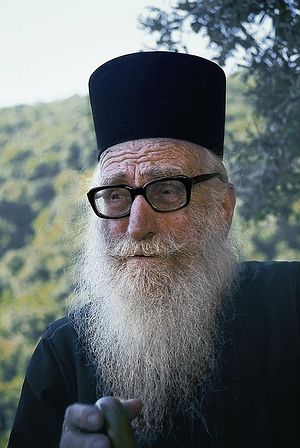 Elder Dionysius Ignat Many events from his life have been shared with us. He went through many hardships. There was poverty in the brotherhood that remained with him, great struggles... It was a time of major problems on the Holy Mountain. The fathers had to work by hand to sustain themselves, and Geronda remained in the same cell where he first arrived, never changing it. What struck me most—and left a great impression on me—was that when he first arrived, there were already many monks there before him, and the elder of the skete gave him a cell above the stable. Beneath his floor were animals, and Geronda lived above them. You can imagine—it was an improvised and improper place for a person to live. Animals make a mess, they smell, they make noise at night, and his Elder told him: “This is where you will stay until you die.” And even though Geronda eventually restored the whole skete, bit by bit, and new fathers later arrived, he remained in the cell where his Elder had placed him. I remember people asking him, “Geronda, why do not you move into the nice new cells you’ve built?” “No,” he would say, “my Elder told me to live there.”
His presence was very beautiful—especially when he served in church. Then he was truly majestic. When he served, he was truly like a prophet. His expression was very prophetic, as was the way he pronounced the litany’s exclamations (ekphoneses) of the Divine Liturgy—gentle, humble... I do not know if anyone ever recorded him, unfortunately. We did not think to record him—we thought such people would live forever. And indeed, they do live forever.
From the book, Rivers of Living Water: On the Holy Elders of Kolitsou, Mount Athos, by Hieromonk Nicodemus (Jones)