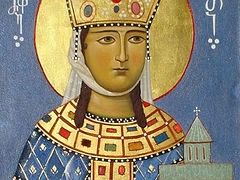
The Georgian and Russian Orthodox Churches commemorate the holy Queen Tamar twice each year: on May 1 (14)—a day that among many peoples of the world is known as the “festival of flowers”—and on the third Sunday after Pascha, dedicated to the Myrrh-Bearing Women. Both of these days bear symbolic significance.
If one were to compare the Church to a wondrous garden, then Queen Tamar of Georgia would be the royal lily in that garden. Whoever pronounces her name in prayer senses a spiritual fragrance, like that of heavenly flowers—the monasteries she built in the hearts of the mountains, the chapels upon rocky summits, and the churches and cathedrals raised in the valleys, majestic as the cliffs of the Caucasus. Whoever pronounces her name in prayer hears the ringing of bells proclaiming victory over the enemies of the Cross. Whoever pronounces her name beholds the blue and crimson hues of dawn over the sky of Georgia, before whose radiance the moon and stars grow dim.
Most peoples of the world, in their songs and legends, have called May the most beautiful month of the year. The Georgian Church dedicates its first day to Queen Tamar, perhaps because her reign was the brightest and most beautiful day in the life of Georgia.
The Georgian Church celebrates the memory of Queen Tamar on the feast of the holy Myrrh-Bearing Women—those who, like the Apostles, left all earthly things and followed Christ. Though Queen Tamar governed a vast kingdom, her soul remained with Christ like one of the Myrrh-Bearing Women. She poured out her mercy upon the wounds of Georgia like precious myrrh and sought to wipe away every tear from her eyes. If it were possible to call the queen by another name, that name would be “mercy.” If her reign could be described in a single word, that word would be “nobility.” The people and history have called her great, but her greatness lay not only in her victories, but also in the greatness of her Christian soul, which shines upon us through the mist of centuries.
Holy Queen Tamar took up the scepter as though it were a cross, and ascending the throne she declared: “I am the father of orphans and the mother of widows.” She became not merely a queen, but the mother and guardian angel of the peoples of Georgia.
Queen Tamar was called wise. Love grants a person a wisdom not of this world; love opens the human heart to God; love gives man the only true happiness—to become a sacrifice for others.
The life of Holy Queen Tamar was an unseen crucifixion for her people. If the holy fools concealed their gifts of clairvoyance and healing beneath the appearance of madness, and the monastics hid their spiritual labors in the desert or behind monastery walls, then the ascetic life of the Iberian crowned sovereign was hidden from the eyes of the world even more deeply—behind the splendor of the royal court, behind the heaps of gold and precious stones that the capitals and cities of the East laid at her feet.
By day, seated upon the throne, she governed the affairs of state and rendered judgment, astonishing all who came before her with wisdom and magnanimity, like Solomon himself. It was a court where justice triumphed, yet even for the condemned the wellspring of her mercy was not closed. Solomon’s sword pursued even those who clung to the altar of the Temple; but in Tamar’s palace, even the queen’s enemies—those who desired her death and sought to direct the sword into her breast—found forgiveness and mercy.
By night, Holy Tamar clothed herself in sackcloth and prayed to the Mother of God, calling Her the Queen of Georgia and herself Her lowest handmaid. The prayers of the holy crowned sovereign protected the land from visible and invisible enemies like fortress walls.
Kings rule over nations, yet the best among them serve their subjects as though they were their masters. The sleepless nights of Queen Tamar of Georgia passed in prayers as long and fervent as those of a schemanun, while her tears—at times clear as diamonds, at times crimson as rubies—flowed upon the earth like streams of myrrh. Her prayer was that flame before which demons trembled, just as wild beasts fear a burning torch, just as wolves dare not approach the fire of a campfire and only howl from afar.
While still young, Holy Queen Tamar was granted a vision in a dream: it seemed to her that wings had been given to her, and she rose high above Georgia into the heavens. Looking westward, she saw the Black Sea. Upon it, like swans upon a lake, sailed Byzantine and Genoese ships. To the south stood the Orthodox Byzantine Empire—Constantinople, the stronghold of Orthodoxy—rising like a giant upon two continents. To the north towered the peaks of the Caucasus Mountains, like white clouds, gleaming like the domes of a church.
Then she looked eastward and beheld the Caspian Sea, raging as its waves rose higher and higher. With terrifying thunder the boiling waters hurled themselves forward like lions rushing upon their prey. It seemed that the crests of the waves rose above the Caucasus Mountains themselves, that the Caspian would overturn like a vast chalice and swallow the whole Caucasus into its abyss, so that, as in the days of Noah, it would become the floor of an ocean, and Georgia would vanish forever into the depths of the raging waters.
Holy Queen Tamar began to pray to God for the salvation of her land, and she saw three angels in the form of youths riding swiftly on horseback toward the shore of the Caspian. Having halted there, they began shooting fiery arrows into the sea. A roar resounded as though the Caucasus Mountains themselves had collapsed; a pillar of fire rose to heaven as at the destruction of Sodom, and the whole vast Caspian burst into flames like a sea of burning oil. Then she saw the Caspian again, now in the form of an old man groaning and pleading for mercy.
Queen Tamar awoke in deep sorrow. She understood that a terrible danger would come from the East, yet the Lord would preserve Georgia during her earthly lifetime, just as He had preserved the Jews from the invasions of the Assyrians and Babylonians for the sake of the righteous King Hezekiah.
Under Queen Tamar, Georgia reached the summit of its power. A traveler standing upon a mountain peak surveys the land beneath his feet as though from the height of an eagle’s flight. He gazes with wonder at the azure flame of the sky, at the clouds like fantastical islands drifting through the blue expanse, at the meadows spread below like carpets embroidered with living flowers. Yet meanwhile, beyond the horizon, black storm clouds are already gathering. A tempest may overtake the traveler in the mountains; raging torrents may cut off his path. But as yet nothing foretells disaster—the sky remains clear and tranquil.
Already in the East the hordes of Genghis Khan are assembling. In the mountains of Altai, upon the plains of Manchuria, in the deserts of Mongolia, terrible forces are gathering. Soon the Mongol blade will cleave the map of the world from the Pacific Ocean to the Mediterranean Sea. China will fall. The smoke of burned cities and villages will clothe the sky above Georgia in black mourning. The fiery avalanche of the Mongols will sweep across Rus’. Mongol cavalry will reach the borders of Serbia, and Batu Khan, scooping water from the Adriatic Sea with his helmet, will pour it upon the shore as a sign that the land now belongs to the Mongols.
But while Queen Tamar yet lives, the sun will continue to shine over Georgia; the farmer will cast wheat into the furrows of the field; architects will build churches and fortresses; and a mother will nurse her child at her breast.
 Vardzia. Photo: Wikipedia
Like a royal crown, Queen Tamar of Georgia adorned the mountain peaks with stone crosses. In mountain gorges and deep forests she raised churches and monasteries, and upon the plains she built cathedrals like impregnable fortresses. It seemed as though all Georgia, through the mouths of its altars, was singing a hymn to God.
Queen Tamar completed the construction of monasteries begun under her father, King George III of Georgia, and her great-grandfather, the holy King David IV of Georgia. She completed the cave monastery of Vardzia—the castle of roses—where she spent Great Lent. She also built the monastery of Bethania Monastery in honor of the Nativity of the Most Holy Theotokos and restored the Georgian Monastery of the Cross in Palestine. Her treasury resembled a vast lake into which the riches of her extensive kingdom and its vassal lands flowed like rivers and streams, while from the other side of the lake poured golden currents and torrents for the needy and the poor, for the construction of monasteries, and for aid to Churches living under the yoke of Muslim rulers.
Her heart was open even to foreigners and those of other faiths, and her hand was generous toward them. She did not ask the hungry man, “Who are you?” nor the poor man, “What is your faith?”
Twice the united forces of the Muslim states of the Near East invaded Georgia, and twice they found a common grave in Georgian soil. The first campaign was undertaken by the Caliph of Baghdad, the head of the Muslim world, who united both royal and religious authority in himself. He held a position and unquestioned authority comparable to that of the pope within the Holy Roman Empire. The Muslim states bordering Georgia assembled an enormous army under the command of Atabeg Abubakr.
While the Georgian army was gathering, Queen Tamar spent many days praying in the churches of Tbilisi. At last the army departed through the gates of the capital. At its head walked Queen Tamar herself—barefoot, with her hair unbound, holding a cross in her hands, like the prophetess Deborah before the army of Israel. She blessed her warriors with the cross as they marched past her in ordered ranks, their armor and weapons gleaming, their banners raised high, knowing that many of them would never return.
Then she entered the Metekhi Church of the Most Holy Theotokos and stood praying before the icon of the Hodegetria, beseeching the Virgin Mary to save Georgia as She had once saved Constantinople when it was surrounded by the hordes of the Avars and Scythians.
Together with Queen Tamar, the people also prayed. Each confessed his sins before God. Those who had been enemies reconciled with one another; the rich forgave the debts of their debtors; prisoners and captives were set free. The churches remained open day and night.
In the Battle of Battle of Shamkor, the Georgian army won a great victory. The chief trophy of that battle was the fortress of Shamkor itself, which had been considered impregnable.
Especially terrible for Georgia was the invasion of the Muslims under the banners of the Sultan of Rum, Rukn al-Din Suleiman Shah, ruler of the state formed from a province torn away from Byzantium, who, like the emperors of Byzantium, considered himself an heir of the Roman Empire. Confident of victory, the Sultan of Rum sent Queen Tamar of Georgia a letter in which, with unheard-of arrogance, he demanded that the queen and her people accept Islam. Thus, the struggle against the Turko-Arab army was above all a struggle for the faith.
The Sultan of Rum expected that the Georgian army, inferior to his in number, would not dare to engage in battle but would retreat to defense while he captured fortresses and cities one after another and closed the ring of his forces around Tbilisi. The proud sultan, who considered himself the successor of the Caesars, wished to storm Tbilisi as Titus had once stormed Jerusalem, and to wash away in Georgian blood the shame of the defeat inflicted upon the Turks by King David IV of Georgia, who had wrested Tbilisi from their hands like a crown.
The Sultan of Rum was an experienced warrior. He had spent his life fighting Byzantines and Crusaders, winning victories and suffering defeats. But now something occurred that he had not expected: The war was decided in a single battle. Near the Vardzia Monastery, his army was shattered and perished like a wave breaking upon a cliff.
An army was hastily gathered throughout Georgia, as though the sound of a silver battle trumpet had swept across the whole land. Addressing her warriors, Queen Tamar said:
“Do not be frightened by the multitude of the enemy. Trust in the power of the Cross. In battle the judgment of God shall be revealed.”
The Sultan of Rum sat in his tent of snow-white silk receiving the envoy who brought word that the Georgians had accepted his challenge to war. At that very moment he was informed that the Georgian army was approaching.
“Perhaps,” he said, “it is a detachment from the allied emirates hastening to us after hearing the call to jihad—the holy war against the Christians.”
But he was told: “No, these are Christians; we have seen the Cross upon their banners.”
The Sultan of Rum fell silent. He could not understand how an eagle would dare attack a pack of wolves. Then he said, “The enemies come willingly upon my sword like sheep to slaughter. Now I shall not need to chase them through mountains and ravines.”
Then he added, “Saddle my warhorse, and prepare my finest Arabian steed as well.” That horse would later save the sultan from death and captivity. The Georgians buried the slain enemy soldiers with military honors; they did not take vengeance upon the dead.
 Tamar in the Church of the Dormition, Vardzia. Photo: Wikipedia There is no corner of Georgia where the name of Queen Tamar is not pronounced with blessing. The queen knew that the enemies of Christ would seek revenge upon her even after death, and therefore she commanded that she be buried in secret, so that her grave would remain hidden from the world forever. Georgia fulfilled her testament. Her grave was preserved from Muslims, from Mongols, and from those vandals who desecrate and plunder the tombs of their own rulers.
The entire country mourned the queen; all the people felt orphaned. It seemed as though the glory and greatness of Georgia had been embodied in the person of the queen, and that terrible trials now lay ahead.
At night, ten detachments rode out from the gates of the castle where Queen Tamar had died. Each carried a coffin, and the ten coffins were secretly buried in different places. No one knew which contained the body of the queen.
According to one tradition, she is buried in the Gelati Monastery, in the burial vault of the Bagrationi dynasty. Another tradition claims that she was buried in Jerusalem, for she had vowed to make a pilgrimage there but was unable to fulfill it during her lifetime. Her son, King George IV of Georgia, is said to have carried out his mother’s final wish: a Georgian detachment joined the army of the Crusaders and brought Queen Tamar’s coffin to the Monastery of the Cross.
But this remains a mystery that the lips of earth itself will never reveal…
Among the mountain dweller there is a tradition that when sorrows and calamities multiply, Queen Tamar will come again to Georgia, once more ascend her golden throne, and console her people. Yet Queen Tamar, reigning not upon earth but in heaven, has never abandoned Georgia in spirit and love, nor ever will.